
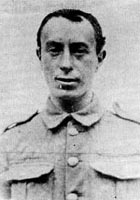
Isaac Rosenberg

Isaac Rosenberg Poems
The darkness crumbles away
It is the same old druid Time as ever,
Only a live thing leaps my hand,
A queer sardonic rat,
...
The plunging limbers over the shattered track
Racketed with their rusty freight,
Stuck out like many crowns of thorns,
And the rusty stakes like sceptres old
...
Through these pale cold days
What dark faces burn
Out of three thousand years,
And their wild eyes yearn,
...
Sombre the night is.
And though we have our lives, we know
What sinister threat lies there.
...
What in our lives is burnt
In the fire of this?
The heart’s dear granary?
The much we shall miss?
...
I snatched two poppies
From the parapet’s ledge,
Two bright red poppies
That winked on the ledge.
...
I killed them, but they would not die.
Yea! all the day and all the night
For them I could not rest or sleep,
Nor guard from them nor hide in flight.
...
Nudes -- stark and glistening,
Yelling in lurid glee. Grinning faces
And raging limbs
Whirl over the floor one fire.
...
Snow is a strange white word.
No ice or frost
Has asked of bud or bird
For Winter's cost.
...
Moses, from whose loins I sprung,
Lit by a lamp in his blood
Ten immutable rules, a moon
For mutable lampless men.
...
In his malodorous brain what slugs and mire,
Lanthorned in his oblique eyes, guttering burned!
His body lodged a rat where men nursed souls.
The world flashed grape-green eyes of a foiled cat
...
Grotesque and queerly huddled
Contortionists to twist
The sleepy soul to a sleep,
We lie all sorts of ways
...
I walk and wonder
To hear the birds sing,
Without you my lady
How can there be Spring?
...
A worm fed on the heart of Corinth,
Babylon and Rome:
Not Paris raped tall Helen,
But this incestuous worm,
...
I love you, great new Titan!
Am I not you?
Napoleon or Caesar
Out of you grew.
...
My eyes catch ruddy necks
Sturdily pressed back -
All a red brick moving glint.
Like flaming pendulums, hands
...
Wreck not the ageing heart of quietness,
With alien uproar and rude jolly cries,
Which satyr like to a mild maidens pride,
Ripens not wisdom, but a large recoil,
...
Ah, Koelue!
Had you embalmed your beauty, so
It could not backward go,
Or change in any way,
...
Crazed shadows, from no golden body
That I can see, embrace me warm ;
All is purple and closed
Round by night's arm.
...
Isaac Rosenberg Biography
Isaac Rosenberg was an English poet of the First World War who was considered to be one of the greatest of all English war poets. His "Poems from the Trenches" are recognised as some of the most outstanding written during the First World War. Isaac Rosenberg was born to Barnet and Annie Rosenberg, who had fled Devinsk in Lithuania to escape anti-Jewish pogroms. In 1897, the family moved to 47 Cable Street in a poor district of the East End of London, and one with a strong Jewish community. He attended St. Paul's School around the corner in Wellclose Square, until his family (of Russian descent) moved to Stepney in 1900, so he could experience Jewish schooling. He left school at the age of fourteen and became an apprentice engraver.He was interested in both poetry and visual art, and managed to find the finances to attend the Slade School. During his time at Slade School, Rosenberg notably studied alongside David Bomberg, Mark Gertler, Stanley Spencer, Paul Nash, Edward Wadsworth and Dora Carrington. He was taken up by Laurence Binyon and Edward Marsh, and began to write poetry seriously, but he suffered from ill-health. Afraid that his chronic bronchitis would worsen, Rosenberg hoped to try and cure himself by emigrating to the warmer climate of South Africa, where his sister Mina lived. He wrote the poem On Receiving News of the War in Cape Town, South Africa. While others wrote about war as patriotic sacrifice, Rosenberg was critical of the war from its onset. However, needing employment in order to help support his mother, Rosenberg returned to England in October 1915 and enlisted in the army. He was assigned to the 12th Suffolk Folk Regiment, a 'bantam' battalion (men under 5'3"). After turning down an offer to become a lance corporal, Private Rosenberg was later transferred to the 11th Battalion, The King's Own Royal Lancaster Regiment (KORL). He was sent to the Somme on the Western Front in France where, having just finished night patrol, he was killed at dawn on April 1, 1918; there is a dispute as to whether his death occurred at the hands of a sniper or in close combat. In either case, Fampoux is the name of the town where he died. He was first buried in a mass grave, but in 1926, his remains were identified and reinterred, not in England, but at Bailleul Road East Cemetery, Plot V, St. Laurent-Blangy, Pas de Calais, France. In The Great War and Modern Memory, Paul Fussell's landmark study of the literature of the First World War, Fussell identifies Rosenberg's Break of Day in the Trenches as "the greatest poem of the war.")
The Best Poem Of Isaac Rosenberg
Break Of Day In The Trenches
The darkness crumbles away
It is the same old druid Time as ever,
Only a live thing leaps my hand,
A queer sardonic rat,
As I pull the parapet's poppy
To stick behind my ear.
Droll rat, they would shoot you if they knew
Your cosmopolitan sympathies,
Now you have touched this English hand
You will do the same to a German
Soon, no doubt, if it be your pleasure
To cross the sleeping green between.
It seems you inwardly grin as you pass
Strong eyes, fine limbs, haughty athletes,
Less chanced than you for life,
Bonds to the whims of murder,
Sprawled in the bowels of the earth,
The torn fields of France.
What do you see in our eyes
At the shrieking iron and flame
Hurled through still heavens?
What quaver -what heart aghast?
Poppies whose roots are in men's veins
Drop, and are ever dropping;
But mine in my ear is safe,
Just a little white with the dust.
Isaac Rosenberg Comments
I wish my homework was on someone else. P.S. Glass of Jews please butler.




Delivering Poems Around The World
Poems are the property of their respective owners. All information has been reproduced here for educational and informational purposes to benefit site visitors, and is provided at no charge...
6/9/2026 6:52:00 PM # 1.0.0



hello poet, I like your poem. from bangladesh
this guy died over a century ago