
Ovid
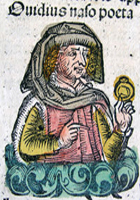

Ovid Poems
In summer's heat and mid-time of the day,
To rest my limbs upon a bed I lay,
One window shut, the other open stood,
...
...Short partings do best, though: time wears out affections,
The absent love fades, a new one takes its place.
With Menelaus away, Helen's disinclination for sleeping
Alone led her into her guest's
...
In summer's heat and mid-time of the day
To rest my limbs upon a bed I lay,
One window shut, the other open stood,
Which gave such light, as twinkles in a wood,
...
OF bodies chang'd to various forms, I sing:
Ye Gods, from whom these miracles did spring,
Inspire my numbers with coelestial heat;
'Till I my long laborious work compleat:
...
WHEN now Agenor had his daughter lost,
He sent his son to search on ev'ry coast;
And sternly bid him to his arms restore
The darling maid, or see his face no more,
...
NOW Glaucus, with a lover's haste, bounds o'er
The swelling waves, and seeks the Latian shore.
Messena, Rhegium, and the barren coast
Of flaming Aetna, to his sight are lost:
...
HERE, while the Thracian bard's enchanting strain
Sooths beasts, and woods, and all the listn'ing
plain,
The female Bacchanals, devoutly mad,
...
NOW shone the morning star in bright array,
To vanquish night, and usher in the day:
The wind veers southward, and moist clouds arise,
That blot with shades the blue meridian skies.
...
WHILE Perseus entertain'd with this report
His father Cepheus, and the list'ning court,
Within the palace walls was heard aloud
The roaring noise of some unruly crowd;
...
THE Argonauts now stemm'd the foaming tide,
And to Arcadia's shore their course apply'd;
Where sightless Phineus spent his age in grief,
But Boreas' sons engage in his relief;
...
PRIAM, to whom the story was unknown,
As dead, deplor'd his metamorphos'd son:
A cenotaph his name, and title kept,
And Hector round the tomb, with all his brothers,
...
PALLAS, attending to the Muse's song,
Approv'd the just resentment of their wrong;
And thus reflects: While tamely I commend
Those who their injur'd deities defend,
...
THE chiefs were set; the soldiers crown'd the
field:
To these the master of the seven-fold shield
Upstarted fierce: and kindled with disdain.
...
THENCE, in his saffron robe, for distant Thrace,
Hymen departs, thro' air's unmeasur'd space;
By Orpheus call'd, the nuptial Pow'r attends,
But with ill-omen'd augury descends;
...
Theseus requests the God to tell his woes,
Whence his maim'd brow, and whence his groans arose
Whence thus the Calydonian stream reply'd,
With twining reeds his careless tresses ty'd:
...
PYGMALION loathing their lascivious Life,
Abhorred all Womankind, but most a Wife:
So single chose to live, and shunned to wed,
...
Baucis and Philemon
THUS Achelous ends: his audience hear
With admiration, and admiring, fear
...
YOUR husband will be with us at the Treat;
May that be the last Supper he shall Eat.
And am poor I, a Guest invited there,
...
YE elves of hills, brooks, standing lakes, and groves,
And ye that on the sands with printless foot
Do chase the ebbing Neptune, and do fly him
...
SEEING thou art fair, I bar not thy false playing,
But let not me poor soul know of thy straying.
Nor do I give thee counsel to live chaste,
...
Ovid Biography
Ovid was born in Sulmo (Sulmona), in an Apennine valley, east of Rome, to an equestrian family, and was educated in Rome. His father wished him to study rhetoric toward the practice of law. According to Seneca the Elder, Ovid tended to the emotional, not the argumentative pole of rhetoric. After the death of his brother, Ovid renounced law and began travelling — to Athens, Asia Minor, and Sicily. He held minor public posts, but resigned to pursue poetry. He was part of the circle centered upon the patron Marcus Valerius Messalla Corvinus. He was thrice-married and twice-divorced by the time he was thirty years old; yet only one marriage yielded offspring — a daughter. Originally, the Amores were a five-book collection, circa 20 BC; the surviving, extant version, reduced to three books, includes poems written as late as AD 1. Book 1 contains 15 elegiac love poems about aspects of love. Most of the Amores is tongue-in-cheek, and, while Ovid adhered to standard elegiac themes — such as the exclusus amator (locked-out lover) lamenting before a paraklausithyron (a locked door) — he portrays himself as romantically capable, not emotionally struck by it, (unlike Propertius, whose poetry portrays him under love's foot). He writes about adultery, rendered illegal in Augustus's marriage law reforms of 18 BC. Ovid's next poem, the Ars Amatoria, the Art of Love, parodies didactic poetry whilst being a manual about seduction and intrigue; and it refers to the ludus duodecim scriptorum board game, an antecedent of modern backgammon. He identifies this work in his exile poetry as the carmen, or song, which was one cause of his banishment. By AD 8, he had completed Metamorphoses, an epic poem derived from Greek mythology. The subject is "forms changed into new bodies". From the emergence of the cosmos from formless mass to the organized, material world, to the deification of Julius Caesar, the poem tells of transformation. The stories follow each other in the telling of human beings transformed to new bodies — trees, rocks, animals, flowers, constellations et cetera. Famous myths, such as Apollo and Daphne, Orpheus and Eurydice, and Pygmalion are contained. It explains many myths alluded to in other works, and is a valuable source about Roman religion, because many characters are gods or offspring of Olympian gods. In AD 8, Emperor Augustus banished Ovid to Tomis, on the Black Sea, for political reasons. Ovid wrote that his crime was carmen et error — "a poem and a mistake", claiming that his crime was worse than murder, more harmful than poetry. The Emperor's grandchildren, Agrippa Postumus and Julia the Younger, were banished around the time of his banishment; Julia's husband, Lucius Aenilius Paullus, was put to death for conspiracy against Augustus; Ovid might have known of that. The Julian Marriage Laws of 18 BC were fresh in the Roman mind. These promoted monogamous marriage to increase the population's birth rate. Ovid's writing concerned the serious crime of adultery, which was punishable by banishment.)
The Best Poem Of Ovid
In Summer's Heat
In summer's heat and mid-time of the day,
To rest my limbs upon a bed I lay,
One window shut, the other open stood,
Which gave such light as twinkles in a wood
Like twilight glimpse at setting of the sun,
Or night being past and yet not day begun.
Such light to shamefaced maidens must be shown,
Where they may sport, and seem to be unknown.
Then came Corinna in a long, loose gown,
Her white neck hid with tresses hanging down,
Resembling fair Semiramis going to bed,
Or Lais of a thousand wooers sped.
I snatched her gown, being thin the harm was small,
Yet strived she to be covered therewithal,
And, striving thus as one that would be chaste,
Betrayed herself, and yielded at the last.
Stark naked as she stood before mine eye,
Not one wen in her body could I spy.
What arms and shoulders did I touch and see?
How apt her breasts were to be pressed by me?
How smooth a belly under her waist saw I?
How large a leg, and what a lusty thigh?
To leave the rest, all liked me passing well;
I clinged her naked body, down she fell.
Judge you the rest. Being tired, she bade me kiss.
Jove send me more such afternoons as this.
Ovid Comments
In 8 AD, Ovid was exiled on the Black Sea, by Emperor Augustus for uncertain reasons that remain unexplained. According to Ovid, his exile was “Carmen et error” — a poem and a mistake. During this time, Ovid wrote two poems Tristia and Epistulae ex Ponto, depicting his grief. The five books of the elegiac Tristia, a chain of poems portraying the poet’s misery in exile and hoping for his return to Rome, are dated to 9–12 AD. The Ibis, an elegiac curse poem is also likely to be produced during this time. The exile poetry is moving and delicate. In the Epistulae he asserts that he has made friends with the natives of Tomis. However, he still yearned for Rome, his daughter and his third wife, as many of the poems are addressed to her. Ovid died at Tomis in 17 AD. In 1930 that town was renamed “Ovidiu “in tribute to him. Seeing that Ovid spent the final years of his life and literary work in what is now Romania, Romanian nationalists have dubbed him “The First Romanian Poet” and positioned him in the pantheon of Romanian national heroes. Ovidiu is a common male first name in Romania. Also, a statue honors him in the Romanian city of Tomis (contemporary Constanța) .
Ovid with his Metamorphoses convinced countless numbers through the millenia to follow the vegetarian diet of Pythagoras, himself, DaVinci, Van Gogh, Rodin, Ramanujan, Buddha, and according to many Biblical researchers Jesus




Delivering Poems Around The World
Poems are the property of their respective owners. All information has been reproduced here for educational and informational purposes to benefit site visitors, and is provided at no charge...
6/9/2026 5:08:10 AM # 1.0.0



he ated chicken dsddsddsddssdsdsddssdsdsddsdssddssddssdds