Sea Poems
Sea poems from famous poets and best beautiful poems to feel good. Best sea poems ever written. Read all poems about sea.
BEST POEMS ABOUT SEA
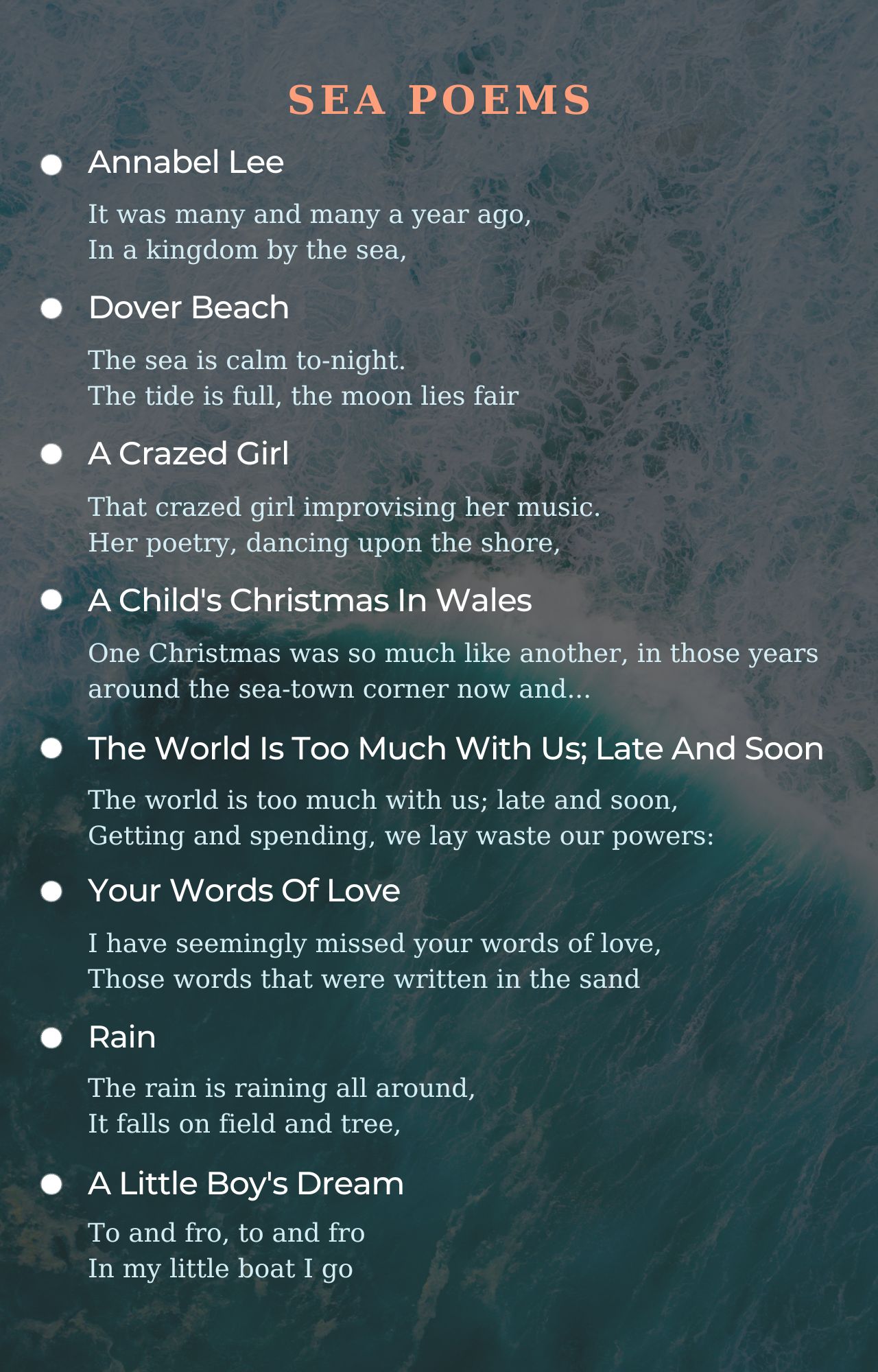
It was many and many a year ago,
In a kingdom by the sea,
That a maiden there lived whom you may know
By the name of ANNABEL LEE;
...
THAT crazed girl improvising her music.
Her poetry, dancing upon the shore,
...
One Christmas was so much like another, in those years around the sea-town corner now and out of all sound except the distant speaking of the voices I sometimes hear a moment before sleep, that I can never remember whether it snowed for six days and six nights when I was twelve or whether it snowed for twelve days and twelve nights when I was six.
...
The world is too much with us; late and soon,
Getting and spending, we lay waste our powers:
Little we see in Nature that is ours;
We have given our hearts away, a sordid boon!
...
Full fathom five thy father lies;
Of his bones are coral made;
Those are pearls that were his eyes:
Nothing of him that doth fade
...
To and fro, to and fro
In my little boat I go
Sailing far across the sea
All alone, just little me.
...
He clasps the crag with crooked hands;
Close to the sun in lonely lands,
Ring'd with the azure world, he stands.
The wrinkled sea beneath him crawls;
...
Leaning into the afternoons I cast my sad nets
towards your oceanic eyes.
There in the highest blaze my solitude lengthens and flames,
...
Break, break, break,
On thy cold gray stones, O Sea!
And I would that my tongue could utter
...
The rain is raining all around,
It falls on field and tree,
It rains on the umbrellas here,
And on the ships at sea.
...
There is no magic any more,
We meet as other people do,
You work no miracle for me
Nor I for you.
...
The moon whispered to the sea,
'Tell me your deepest secrets.'
And the sea, with its waves dancing,
Revealed tales of lost ships,
...
Rise, brothers, rise; the wakening skies pray to the morning light,
The wind lies asleep in the arms of the dawn like a child that has cried all night.
Come, let us gather our nets from the shore and set our catamarans free,
To capture the leaping wealth of the tide, for we are the kings of the sea!
...
Out of the starless night that covers me,
(O tribulation of the wind that rolls!)
Black as the cloud of some tremendous spell,
...
Where are your monuments, your battles, martyrs?
Where is your tribal memory? Sirs,
in that gray vault. The sea. The sea
has locked them up. The sea is History.
...
All day long in fog and wind,
The waves have flung their beating crests
Against the palisades of adamant.
My boy, he went to sea, long and long ago,
...
Lie back daughter, let your head
be tipped back in the cup of my hand.
Gently, and I will hold you. Spread
your arms wide, lie out on the stream
...
O tower of light, sad beauty
that magnified necklaces and statues in the sea,
calcareous eye, insignia of the vast waters, cry
of the mourning petrel, tooth of the sea, wife
...
The people along the sand
All turn and look one way.
They turn their back on the land.
They look at the sea all day.
...
My house is near a sea
The sea is my neighbour
I understand the sea
But the sea does not understand me,
...
NEW POEMS ABOUT SEA
Far see, farther sea. Farther the hem of the big blue sea. Come with me so we could walk on the sea and farther see the doors of the world across the sea. A country I see. In habited by folks like me. Farther, across the deep blue sea. Count few more paces and come to the beautiful places. There, some wear pink laces and bright faces. Look they are casting their gaze to the chrome of the star night sea. Bet you will everlastingly see the one who's been named from the Letter 'C'. Shut your dreamy eyes to the starry sea. See, beauty and grace are the waters of the sea. Travel.
...
EARLY POEMS: JUVENILIA
by Michael R. Burch
These are my early poems, or juvenilia, most of them written between the ages of 11-18 and some published in my high school literary journal, THE LANTERN, and others in my college literary journal, HOMESPUN.
...
How valiant he lies tonight: great is his Monument!
Yet Ares cares not, neither does War relent.
by Anacreon, loose translation/interpretation by Michael R. Burch
...
Hello See's Candy Executive Team!
My name is Genice Lorraine,
Hi there!
Please forward this message to:
...
Hello See's Candy Executive Team!
My name is Genice Lorraine,
Hi there!
Please forward this message to:
...
Here is the sea very much deep,
And see the sea so blue;
I wonder how much water it keeps,
Look, here is the sea
...
When dark grey sea
With its surging stormy waves,
Turns blue! A beautiful blue!
Then, it is certain!
...
Mermaid
by Michael R. Burch
Memories flood the sand's unfolding scroll;
...
EARLY POEMS: JUVENILIA
by Michael R. Burch
These are early poems, most of them written between the ages of 11-18 and some published in my high school literary journal, THE LANTERN. Other poems were written later and several of those were published in my college literary journal, HOMESPUN.
...
Wulf and Eadwacer (circa 960-990 AD)
loose translation by Michael R. Burch
To my people, he's prey, a pariah.
...
Writing a poem is not about bringing some words together to create some charming sentences. It's so much deeper than that. Writing poetry is a bridge that allows people to express their feelings and make others live every single word they read. Poetry is to educate people, to lead them away from hate to love, from violence to mercy and pity. Writing poetry is to help this community better understand life and live it more passionately. PoemHunter.com contains an enormous number of famous poems from all over the world, by both classical and modern poets. You can read as many as you want, and also submit your own poems to share your writings with all our poets, members, and visitors.
Sea Poets
Sea Poets From Members




Delivering Poems Around The World
Poems are the property of their respective owners. All information has been reproduced here for educational and informational purposes to benefit site visitors, and is provided at no charge...
10/11/2026 2:17:00 PM # rel_20260925T122446Z_7d6ee41