
Hair Poems
Hair poems from famous poets and best beautiful poems to feel good. Best hair poems ever written. Read all poems about hair.
BEST POEMS ABOUT HAIR
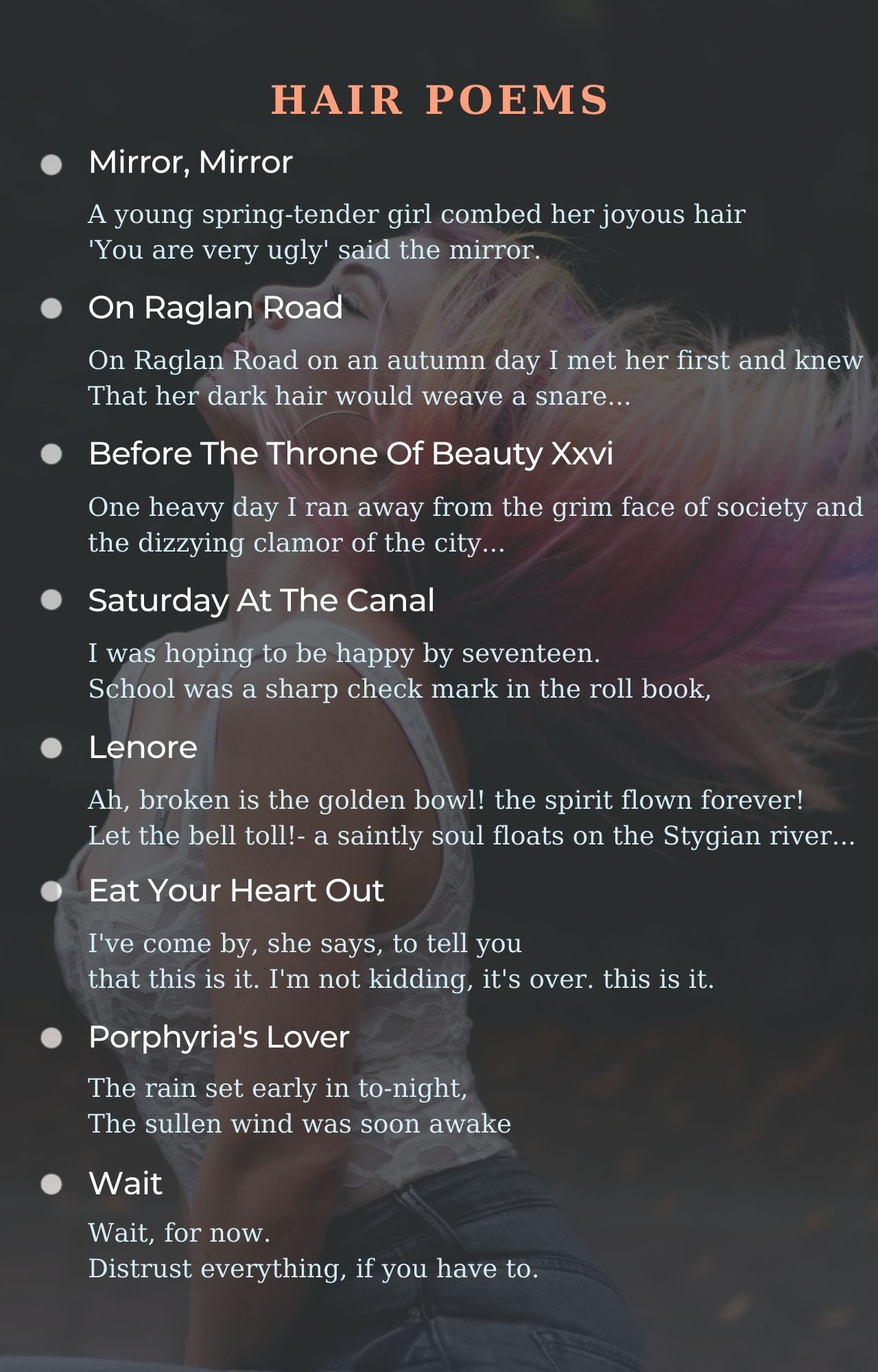
A young spring-tender girl
combed her joyous hair
'You are very ugly' said the mirror.
But,
...
On Raglan Road on an autumn day I met her first and knew
That her dark hair would weave a snare that I might one day rue;
I saw the danger, yet I walked along the enchanted way,
And I said, let grief be a fallen leaf at the dawning of the day.
...
I was hoping to be happy by seventeen.
School was a sharp check mark in the roll book,
An obnoxious tuba playing at noon because our team
Was going to win at night. The teachers were
...
One heavy day I ran away from the grim face of society and the dizzying clamor of the city and directed my weary step to the spacious alley. I pursued the beckoning course of the rivulet and the musical sounds of the birds until I reached a lonely spot where the flowing branches of the trees prevented the sun from the touching the earth.
I stood there, and it was entertaining to my soul - my thirsty soul who had seen naught but the mirage of life instead of its sweetness.
...
Ah, broken is the golden bowl! the spirit flown forever!
Let the bell toll!- a saintly soul floats on the Stygian river;
And, Guy de Vere, hast thou no tear?- weep now or nevermore!
See! on yon drear and rigid bier low lies thy love, Lenore!
...
The rain set early in to-night,
The sullen wind was soon awake,
It tore the elm-tops down for spite,
And did its worst to vex the lake:
...
'I thought you loved me.' 'No, it was only fun.'
'When we stood there, closer than all?' 'Well, the harvest moon
Was shining and queer in your hair, and it turned my head.'
'That made you?' 'Yes.' 'Just the moon and the light it made
...
Wait, for now.
Distrust everything, if you have to.
But trust the hours. Haven't they
carried you everywhere, up to now?
...
Who are these? Why sit they here in twilight?
Wherefore rock they, purgatorial shadows,
Drooping tongues from jays that slob their relish,
Baring teeth that leer like skulls' teeth wicked?
...
I've come by, she says, to tell you
that this is it. I'm not kidding, it's
over. this is it.
I sit on the couch watching her arrange
...
Even the man who is happy
glimpses something
or a hair of sound touches him
...
Two knights rode forth at early dawn
A-seeking maids to wed,
Said one, "My lady must be fair,
With gold hair on her head."
...
And the weaver said, 'Speak to us of Clothes.'
And he answered:
...
Well my friends are gone and my hair is grey
I ache in the places where I used to play
And I'm crazy for love but I'm not coming on
I'm just paying my rent every day
...
1. Take a shower you don't want to smell.
2. Pick out an outfit that will blend in with the latest trends and won't make you a laughing stock of the school more than you already are
3. Put on some makeup so you can't even recognize yourself and your face tingles with an unbelievable issue. You can't satisfy otherwise you'll have ruined the hours of meticulous painting you apply to your face.
...
I loved you in the morning, our kisses deep and warm,
your hair upon the pillow like a sleepy golden storm,
yes, many loved before us, I know that we are not new,
in city and in forest they smiled like me and you,
...
Your hair is lost in the forest,
your feet touching mine.
Asleep you are bigger than the night,
but your dream fits within this room.
...
When the moon was full they came to the water.
some with pitchforks, some with rakes,
some with sieves and ladles,
and one with a silver cup.
...
My skin is kind of sort of brownish
Pinkish yellowish white.
My eyes are greyish blueish green,
But I'm told they look orange in the night.
...
NEW POEMS ABOUT HAIR
I am not my hair, it does not define me
For it's only a fraction of who I can be
It flows and it shines, but it's just a facade
For my true self is much more than a simple facade
...
Life isn't perfect
But your hair can be
Good hair good mood good day
Beautiful hair beautiful life
...
Ovid Love Poems, Vietnamese Tales (Pamphlet no 204)
The Troot
Fin the troot lowpit
...
she is a moving wind.....beautiful long hair
Tonight, we're the sea and the rhythm there.
The waves and the wind and night are black.
Tonight, we're the scent of your long black hair.
...
Another lilly,
In her hair,
And with love,
she dances,
...
I've been cutting Peter's hair for a year. When covid lockdown occurred, I learned to cut my brother's hair - and yes, he still has two ears. When I first met Peter, he had a great thick tangle of unkempt black and, in certain light, blue hair. It was sexy as hell, in a lost puppy way.
Then, one Saturday morning last year, as summer began to settle in, he buzz cut it - out of the blue - you might say. When he showed up that morning for breakfast with Lisa and I (we were at Stillman) , Lisa saw him first and turned just in time to see me, see him. She saw my squint as the sign of trouble it was.
...
I said goodbye to the fields of the Summertime, The loud cries of the village fair. The mist in the vale by the rising sun, To the Girl with the Titian Hair. I said farewell to the Brooks and the Cottage near, To the birds and the songs they do share. The walks in the dusk after long sultry days, To the Girl with the Titian Hair. A lasting look to the Larkspur and the Rose, And the scent that give all to the air, The Oak by the lane where I spoke of the Heart, To the Girl with the Titian Hair. I said goodbye to the Sun setting far in the West, For the Eve's were all burnished and rare. Where she told of her Love for another in wait, For the Girl with the Titian Hair. Now when the frost and the snow of the wintertime come, To strip the dress of the Countryside bare, I will think of a love one Summer Time past. To the Girl with the Titian Hair.
...
Desert storms still blow today.
Today desert storm blew some sand to where my heads at, I'm once again reminded I'm still there, with sun scorched skin and sand stuck in my hair.
I breathed the dust from Beau Gests lost, I paid the price for Blairs cost, I wish I wasn't here with sun scorched skin and sand still in my hair.
They blew the storm and wont be wrong, my friends and I no longer strong but do they really care for sun scorched toms sand forever in their hair.
...
You get lost in her hair
You get lost in her hair
You get lost in her hair
In its waves of vineyard
...
Writing a poem is not about bringing some words together to create some charming sentences. It's so much deeper than that. Writing poetry is a bridge that allows people to express their feelings and make others live every single word they read. Poetry is to educate people, to lead them away from hate to love, from violence to mercy and pity. Writing poetry is to help this community better understand life and live it more passionately. PoemHunter.com contains an enormous number of famous poems from all over the world, by both classical and modern poets. You can read as many as you want, and also submit your own poems to share your writings with all our poets, members, and visitors.
Hair Poets
Hair Poets From Members




Delivering Poems Around The World
Poems are the property of their respective owners. All information has been reproduced here for educational and informational purposes to benefit site visitors, and is provided at no charge...
10/10/2026 2:12:08 AM # rel_20260925T122446Z_7d6ee41


