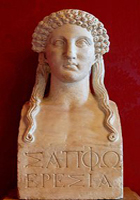
Sappho (c. 600 BCE / Greece)
|
||||||||||||||||||||||||||||||||||||||||||||||||||||||||||||
On what is best
Some celebrate the beauty
of knights, or infantry,
or billowing flotillas
at battle on the sea.
Warfare has its glory,
but I place far above
these military splendors
the one thing that you love.
For proof of this contention
examine history:
we all remember Helen,
who left her family,
her child, and royal husband,
to take a stranger's hand:
her beauty had no equal,
but bowed to love's command.
As love then is the power
that none can disobey,
so too my thoughts must follow
my darling far away:
the sparkle of her laughter
would give me greater joy
than all the bronze-clad heroes
Read poems about / on: history, husband, family, laughter, beauty, remember, power, child, joy, sea, love, hero, children
PoemHunter.com Updates
-
HIV Vaccine Awareness Day
observed annually on May 18
-
International Museum Day
memory + creativity = social change
-
Happy Birthday Omar Khayyam!
(1048-1131) Persian mathematician, poet, and philosopher
-
Happy Birthday Friedrich Rückert!
(1788-1866) German poet, translator, and professor of Oriental languages.
Top 500 Poems
-
Phenomenal Woman
Maya Angelou
-
The Road Not Taken
Robert Frost
-
Still I Rise
Maya Angelou
-
If You Forget Me
Pablo Neruda
-
Dreams
Langston Hughes
-
Annabel Lee
Edgar Allan Poe
-
If
Rudyard Kipling
-
A Dream Within A Dream
Edgar Allan Poe
-
Stopping by Woods on a Snowy Evening
Robert Frost
-
I Know Why The Caged Bird Sings
Maya Angelou

The following is a translation by Josephine Balmer -
Some an army of horsemen, some an army on foot
and some say a fleet of ships is the loveliest sight
on this dark earth; but I say it is what-
ever you desire:
and it is possible to make this perfectly clear
to all; for the woman who far surpassed all others
in her beauty, Helen, left her husband-
the best of all men -
behind and sailed far away to Troy; she did not spare
a single thought for her child nor for her dear parents
but the goddess of love led her astray
which
reminds me now of Anactoria
although far away.
Whether or not God is love in this draycart of a poem by a poet who lived and died centuries before Christianity I leave to the scholars! The translation posted here is probably as good as one can expect given time and circumstance. The poem is indeed economical in its use of language and imagery. From the glory of war in such epic poetry as Homer's ILIAD and ODYSSEY, alluded to in the second stanza by the reference to Troy and Helen, the symbol of beauty and sexual attraction throughout literature to the present. The speaker's darling far away may be her daughter if we consider the speaker to be the woman who lived in Lesbos and was married and had a daughter, or the speaker is fictional and is addressing one of the young girls to whom Sappho taught music and poetry and the devotion to the goddess of erotic love and marriage!
Love conquers all, since GOD is love.
Surely the original cannot have been as bad as this translation. It clumps along like a drayhorse. There's a line missing from the third verse.
I surely don`t know Creek, but the English version says it`s fantastic poem and translation. I can only guess, that love was supposed to bring only joy and happiness, i mean a true love from God... so, if it makes a woman to leave her husband and... child! to hold a stranger`s hand... i think it`s not love, but true punishment
Indeed there is nothing fair or foul both in war and love. But love is supreme power over war and life in the world!
Beautfully written great imagery stucture and form.
Thank You for sharing
Smiles
Carole Cookie Arnold