
PoemHunter.com   
The Widening Spell of the Leaves by Larry Levis   
Search:     
Home Poets Poems Lyrics Quotations Music Forum Member Area Poetry E-Books
 
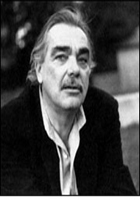
Larry Levis
Larry Levis (1946 - 1996 / California / United States)
Biography   Poems   Comments   More Info   Stats  
Larry Levis was born in Fresno, California, on September 30, 1946. The son of a grape grower, he grew up driving a tractor, picking grapes, and prunin .. more >>
10 poems of Larry Levis
File Size:201 k 
File Format: Acrobat Reader
To download the eBook right-Click on the title and select "Save Target As".
 
<< prev. poem Poems by Larry Levis : 8 / 9 next poem >>
  
 
Share |

 
The Widening Spell of the Leaves

User Rating:

-- /10
(0 votes)


  --The Carpathian Frontier, October, 1968
--for my brother

Once, in a foreign country, I was suddenly ill.
I was driving south toward a large city famous
For so little it had a replica, in concrete,
In two-thirds scale, of the Arc de Triomphe stuck
In the midst of traffic, & obstructing it.
But the city was hours away, beyond the hills
Shaped like the bodies of sleeping women.
Often I had to slow down for herds of goats
Or cattle milling on those narrow roads, & for
The narrower, lost, stone streets of villages
I passed through. The pains in my stomach had grown
Gradually sharper & more frequent as the day
Wore on, & now a fever had set up house.
In the villages there wasn't much point in asking
Anyone for help. In those places, where tanks
Were bivouacked in shade on their way back
From some routine exercise along
The Danube, even food was scarce that year.
And the languages shifted for no clear reason
From two hard quarries of Slavic into German,
Then to a shred of Latin spliced with oohs
And hisses. Even when I tried the simplest phrases,
The peasants passing over those uneven stones
Paused just long enough to look up once,
Uncomprehendingly. Then they turned
Quickly away, vanishing quietly into that
Moment, like bark chips whirled downriver.
It was autumn. Beyond each village the wind
Threw gusts of yellowing leaves across the road.
The goats I passed were thin, gray; their hind legs,
Caked with dried shit, seesawed along--
Not even mild contempt in their expressionless,
Pale eyes, & their brays like the scraping of metal.
Except for one village that had a kind
Of museum where I stopped to rest, & saw
A dead Scythian soldier under glass,
Turning to dust while holding a small sword
At attention forever, there wasn't much to look at.
Wind, leaves, goats, the higher passes
Locked in stone, the peasants with their fate
Embroidering a stillness into them,
And a spell over all things in that landscape,
Like . . .
That was the trouble; it couldn't be
Compared to anything else, not even the sleep
Of some asylum at a wood's edge with the sound
Of a pond's spillway beside it. But as each cramp
Grew worse & lasted longer than the one before,
It was hard to keep myself aloof from the threadbare
World walking on that road. After all,
Even as they moved, the peasants, the herds of goats
And cattle, the spiralling leaves, at least were part
Of that spell, that stillness.
After a while,
The villages grew even poorer, then thinned out,
Then vanished entirely. An hour later,
There were no longer even the goats, only wind,
Then more & more leaves blown over the road, sometimes
Covering it completely for a second.
And yet, except for a random oak or some brush
Writhing out of the ravine I drove beside,
The trees had thinned into rock, into large,
Tough blonde rosettes of fading pasture grass.
Then that gave out in a bare plateau. . . . And then,
Easing the Dacia down a winding grade
In second gear, rounding a long, funneled curve--
In a complete stillness of yellow leaves filling
A wide field--like something thoughtlessly,
Mistakenly erased, the road simply ended.
I stopped the car. There was no wind now.
I expected that, & though I was sick & lost,
I wasn't afraid. I should have been afraid.
To this day I don't know why I wasn't.
I could hear time cease, the field quietly widen.
I could feel the spreading stillness of the place
Moving like something I'd witnessed as a child,
Like the ancient, armored leisure of some reptile
Gliding, gray-yellow, into the slightly tepid,
Unidentical gray-brown stillness of the water--
Something blank & unresponsive in its tough,
Pimpled skin--seen only a moment, then unseen
As it submerged to rest on mud, or glided just
Beneath the lustreless, calm yellow leaves
That clustered along a log, or floated there
In broken ringlets, held by a gray froth
On the opaque, unbroken surface of the pond,
Which reflected nothing, no one.
And then I remembered.
When I was a child, our neighbors would disappear.
And there wasn't a pond of crocodiles at all.
And they hadn't moved. They couldn't move. They
Lived in the small, fenced-off backwater
Of a canal. I'd never seen them alive. They
Were in still photographs taken on the Ivory Coast.
I saw them only once in a studio when
I was a child in a city I once loved.
I was afraid until our neighbor, a photographer,
Explained it all to me, explained how far
Away they were, how harmless; how they were praised
In rituals as "powers." But they had no "powers,"
He said. The next week he vanished. I thought
Someone had cast a spell & that the crocodiles
Swam out of the pictures on the wall & grew
Silently & multiplied & then turned into
Shadows resting on the banks of lakes & streams
Or took the shapes of fallen logs in campgrounds
In the mountains. They ate our neighbor, Mr. Hirata.
They ate his whole family. That is what I believed,
Then. . .that someone had cast a spell. I did not
Know childhood was a spell, or that then there
Had been another spell, too quiet to hear,
Entering my city, entering the dust we ate. . . .
No one knew it then. No one could see it,
Though it spread through lawnless miles of housing tracts,
And the new, bare, treeless streets; it slipped
Into the vacant rows of warehouses & picked
The padlocked doors of working-class bars
And union halls & shuttered, empty diners.
And how it clung! (forever, if one had noticed)
To the brothel with the pastel tassels on the shade
Of an unlit table lamp. Farther in, it feasted
On the decaying light of failing shopping centers;
It spilled into the older, tree-lined neighborhoods,
Into warm houses, sealing itself into books
Of bedtime stories read each night by fathers--
The books lying open to the flat, neglected
Light of dawn; & it settled like dust on windowsills
Downtown, filling the smug cafés, schools,
Banks, offices, taverns, gymnasiums, hotels,
Newsstands, courtrooms, opium parlors, Basque
Restaurants, Armenian steam baths,
French bakeries, & two of the florists' shops--
Their plate glass windows smashed forever.
Finally it tried to infiltrate the exact
Center of my city, a small square bordered
With palm trees, olives, cypresses, a square
Where no one gathered, not even thieves or lovers.
It was a place which no longer had any purpose,
But held itself aloof, I thought, the way
A deaf aunt might, from opinions, styles, gossip.
I liked it there. It was completely lifeless,
Sad & clear in what seemed always a perfect,
Windless noon. I saw it first as a child,
Looking down at it from that as yet
Unvandalized, makeshift studio.
I remember leaning my right cheek against
A striped beach ball so that Mr. Hirata--
Who was Japanese, who would be sent the next week
To a place called Manzanar, a detention camp
Hidden in stunted pines almost above
The Sierra timberline--could take my picture.
I remember the way he lovingly relished
Each camera angle, the unwobbling tripod,
The way he checked each aperture against
The light meter, in love with all things
That were not accidental, & I remember
The care he took when focusing; how
He tried two different lens filters before
He found the one appropriate for that
Sensual, late, slow blush of afternoon
Falling through the one broad bay window.
I remember holding still & looking down
Into the square because he asked me to;
Because my mother & father had asked me please
To obey & be patient & allow the man--
Whose business was failing anyway by then--
To work as long as he wished to without any
Irritations or annoyances before
He would have to spend these years, my father said,
Far away, in snow, & without his cameras.
But Mr. Hirata did not work. He played.
His toys gleamed there. That much was clear to me . . . .
That was the day I decided I would never work.
It felt like a conversion. Play was sacred.
My father waited behind us on a sofa made
From car seats. One spring kept nosing through.
I remember the camera opening into the light . . . .
And I remember the dark after, the studio closed,
The cameras stolen, slivers of glass from the smashed
Bay window littering the unsanded floors,
And the square below it bathed in sunlight . . . . All this
Before Mr. Hirata died, months later,
From complications following pneumonia.
His death, a letter from a camp official said,
Was purely accidental. I didn't believe it.
Diseases were wise. Diseases, like the polio
My sister had endured, floating paralyzed
And strapped into her wheelchair all through
That war, seemed too precise. Like photographs . . .
Except disease left nothing. Disease was like
And equation that drank up light & never ended,
Not even in summer. Before my fever broke,
And the pains lessened, I could actually see
Myself, in the exact center of that square.
How still it had become in my absence, & how
Immaculate, windless, sunlit. I could see
The outline of every leaf on the nearest tree,
See it more clearly than ever, more clearly than
I had seen anything before in my whole life:
Against the modest, dark gray, solemn trunk,
The leaves were becoming only what they had to be--
Calm, yellow, things in themselves & nothing
More--& frankly they were nothing in themselves,
Nothing except their little reassurance
Of persisting for a few more days, or returning
The year after, & the year after that, & every
Year following--estranged from us by now--& clear,
So clear not one in a thousand trembled; hushed
And always coming back--steadfast, orderly,
Taciturn, oblivious--until the end of Time.

Larry Levis


Share |


Read poems about / on: city, remember, child, father, car, wind, work, light, shopping, tree, soldier, beach, lost, dark, sister, autumn, family, sick, brother, food

 
  Comments about this poem (The Widening Spell of the Leaves by Larry Levis )

There is no comment submitted by members..

Click here to write your comments about this poem (The Widening Spell of the Leaves by Larry Levis )
 
 
  People who read Larry Levis


  More classic poets:

      The complete list >>

 
  Top 500 Poems

  1. Phenomenal Woman by Maya Angelou
  2. Still I Rise by Maya Angelou
  3. If You Forget Me by Pablo Neruda
  4. Where the Sidewalk Ends by Shel Silverstein
  5. Dreams by Langston Hughes
  6. i carry your heart with me by ee cummings
  7. I Do Not Love You Except Because I Love You by Pablo Neruda
  8. Annabel Lee by Edgar Allan Poe
  9. The Road Not Taken by Robert Frost
  10. I Crave Your Mouth, Your Voice, Your Hair by Pablo Neruda
  11. Television by Roald Dahl
  12. One Inch Tall by Shel Silverstein
  13. Warning by Jenny Joseph
  14. As I Grew Older by Langston Hughes
  15. A Dream Within A Dream by Edgar Allan Poe
  16. Fire and Ice by Robert Frost
  17. If by Rudyard Kipling
  18. On the Ning Nang Nong by Spike Milligan
  19. Dream Deferred by Langston Hughes
  20. "I Wandered Lonely as a Cloud" by William Wordsworth
  21. Alone by Edgar Allan Poe
  22. Stopping by Woods on a Snowy Evening by Robert Frost
  23. The Highwayman by Alfred Noyes
  24. Do Not Go Gentle Into That Good Night by Dylan Thomas
  25. All That is Gold Does Not Glitter by JRR Tolkien
The complete list of Top 500 Poems >>
  Top 500 Poets

  1. Pablo Neruda
  2. Langston Hughes
  3. Maya Angelou
  4. Charles Bukowski
  5. ee cummings
  6. Shel Silverstein
  7. William Shakespeare
  8. Dylan Thomas
  9. Spike Milligan
  10. Billy Collins
  11. Emily Dickinson
  12. Khalil Gibran
  13. Sylvia Plath
  14. Dorothy Parker
  15. Elizabeth Bishop
  16. Ted Hughes
  17. Roald Dahl
  18. Robert Frost
  19. Walt Whitman
  20. Allen Ginsberg
  21. William Blake
  22. Edgar Allan Poe
  23. Mary Oliver
  24. Robert Browning
  25. William Wordsworth
The complete list of Top 500 Poets >>
 
 
  E-MAIL THIS PAGE TO A FRIEND
Found this page interesting? Recommend it to your friend!     Your E-mail:    Friend's Email:      
 

(c) Poems are the property of their respective owners. All information has been reproduced here for educational and informational purposes to benefit site visitors, and is provided at no charge..  About Us | Copyright notice | Privacy statement | Help
2/9/2010 5:12:01 PM. #.26# You Are Here: The Widening Spell of the Leaves by Larry Levis

Home | Poets | Poems | Free Poetry eBooks | Contests | Sites | Submit a Poem | Manage Your Poems | GameGar | Contact Us

Christmas Poems | Love Poems | Pablo Neruda | Death Poems | Sad Poems | Birthday Poems | Wedding Poems | Annabel Lee | Sorry Poems




