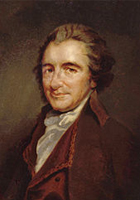

Thomas Paine Biography
Thomas Paine (February 9, 1737 – June 8, 1809) was an author, pamphleteer, radical, inventor, intellectual, revolutionary, and one of the Founding Fathers of the United States. Born in Thetford, in the English county of Norfolk, Paine emigrated to the British American colonies in 1774 in time to participate in the American Revolution. His principal contributions were the powerful, widely read pamphlet Common Sense (1776), advocating colonial America's independence from the Kingdom of Great Britain, and The American Crisis (1776–1783), a pro-revolutionary pamphlet series. The historian Saul K. Padover in the biography Jefferson: A Great American's Life and Ideas, refers to Paine as "a corsetmaker by trade, a journalist by profession, and a propagandist by inclination."
Paine was deeply involved in the early stages of the French Revolution. He wrote the Rights of Man (1791), in part a defence of the French Revolution[5] against its critics, in particular the British statesman Edmund Burke. Despite not speaking French, he was elected to the French National Convention in 1792. The Girondists regarded him as an ally, so, the Montagnards, especially Robespierre, regarded him as an enemy. In December of 1793, he was arrested and imprisoned in Paris, then released in 1794. He became notorious because of The Age of Reason (1793–94), his book advocating deism, promoting reason and freethinking, and arguing against institutionalized religion and Christian doctrines. He also wrote the pamphlet Agrarian Justice (1795), discussing the origins of property, and introduced the concept of a guaranteed minimum income.
Paine remained in France during the early Napoleonic era, but condemned Napoleon's dictatorship, calling him "the completest charlatan that ever existed".[6] In 1802, at President Jefferson's invitation, he returned to America where he died on June 8, 1809. Only six people attended his funeral as he had been ostracized for his criticisms and ridicule of Christianity.
In a chariot of light from the regions of day,
The Goddess of Liberty came;
Ten thousand celestials directed the way
...
O could we always live and love,
And always be sincere,
I would not wish for heaven above,
My heaven would be here.
...
In a mouldering cave where the wretched retreat,
Britannia sat wasted with care;
She mourned for her Wolfe, and exclaim'd against fate
...
Ye sons of Columbia who bravely have fought,
For those rights which unstain'd from your sires have descended.
...
Three Justices (so says my tale)
Once met upon the public weal.
For learning, law, and parts profound,
Their fame was spread the county round;
...




Delivering Poems Around The World
Poems are the property of their respective owners. All information has been reproduced here for educational and informational purposes to benefit site visitors, and is provided at no charge...
12/27/2025 12:37:49 AM # 1.0.0