
William Wordsworth
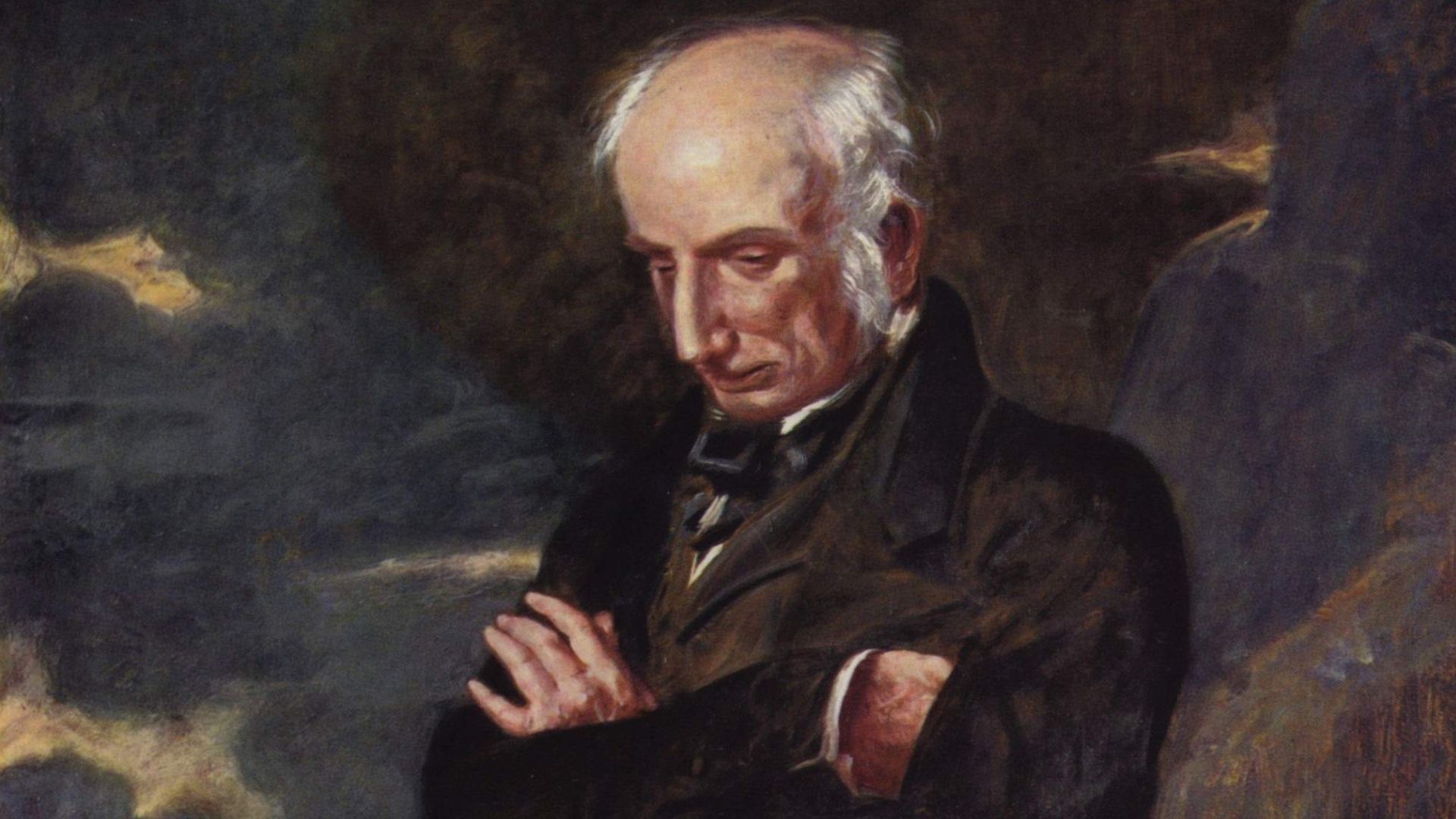

William Wordsworth Poems
I wandered lonely as a cloud
That floats on high o'er vales and hills,
When all at once I saw a crowd,
A host, of golden daffodils;
...
I marvel how Nature could ever find space
For so many strange contrasts in one human face:
There's thought and no thought, and there's paleness and bloom
And bustle and sluggishness, pleasure and gloom.
...
She dwelt among the untrodden ways
Beside the springs of Dove,
Maid whom there were none to praise
And very few to love:
...
Lo! where the Moon along the sky
Sails with her happy destiny;
Oft is she hid from mortal eye
Or dimly seen,
...
A narrow girdle of rough stones and crags,
A rude and natural causeway, interposed
Between the water and a winding slope
Of copse and thicket, leaves the eastern shore
...
The world is too much with us; late and soon,
Getting and spending, we lay waste our powers:
Little we see in Nature that is ours;
We have given our hearts away, a sordid boon!
...
Calm is all nature as a resting wheel.
The kine are couched upon the dewy grass;
The horse alone, seen dimly as I pass,
Is cropping audibly his later meal:
...
Five years have past; five summers, with the length
Of five long winters! and again I hear
These waters, rolling from their mountain-springs
With a soft inland murmur.--Once again
...
It was an April morning: fresh and clear
The Rivulet, delighting in its strength,
Ran with a young man's speed; and yet the voice
Of waters which the winter had supplied
...
------The sky is overcast
With a continuous cloud of texture close,
Heavy and wan, all whitened by the Moon,
Which through that veil is indistinctly seen,
...
There is a change- and I am poor;
Your love hath been, nor long ago,
A fountain at my fond heart's door,
Whose only business was to flow;
...
A Whirl-Blast from behind the hill
Rushed o'er the wood with startling sound;
Then--all at once the air was still,
And showers of hailstones pattered round.
...
Behold her, single in the field,
Yon solitary Highland Lass!
Reaping and singing by herself;
Stop here, or gently pass!
...
Strange fits of passion have I known:
And I will dare to tell,
But in the lover's ear alone,
What once to me befell.
...
A slumber did my spirit seal
I had no human fears:
She seemed a thing that could not feel
The touch of earthly years.
...
My heart leaps up when I behold
A rainbow in the sky:
So was it when my life began;
So is it now I am a man;
...
There was a time when meadow, grove, and stream,
The earth, and every common sight,
To me did seem
Apparelled in celestial light,
The glory and the freshness of a dream.
...
Earth has not anything to show more fair:
Dull would he be of soul who could pass by
A sight so touching in its majesty:
This City now doth, like a garment, wear
...
FAREWELL, thou little Nook of mountain-ground,
Thou rocky corner in the lowest stair
Of that magnificent temple which doth bound
...
Art thou a Statist in the van
Of public conflicts trained and bred?
- First learn to love one living man;
'Then' may'st thou think upon the dead.
...
William Wordsworth Biography
William Wordsworth (1770-1850) was an English poet who is often considered one of the founders of the Romantic movement in English literature. He was born in Cockermouth, England, and grew up in the Lake District, a region that would become the inspiration for much of his poetry. Wordsworth began writing poetry in his early teens, and he went on to attend Cambridge University, where he became friends with fellow poet Samuel Taylor Coleridge. Together, they published Lyrical Ballads (1798), a collection of poems that helped to define the Romantic movement. Wordsworth's poetry is characterized by its focus on nature and the inner lives of individuals, and his use of everyday language and vivid imagery helped to revolutionize the way that poetry was written and read. Some of his most famous works include "I Wandered Lonely as a Cloud," "Tintern Abbey," and "Ode: Intimations of Immortality." In addition to his work as a poet, Wordsworth was also a social and political activist who advocated for radical change during a time of great social upheaval in England. He served as a member of Parliament and supported the abolition of slavery and other progressive causes. Wordsworth died in 1850 at the age of 80. His work has had a profound influence on English literature and on the way that poetry is written and read, and his legacy as one of the greatest poets in the English language continues to be celebrated and studied today. Wordsworth died in 1850 at the age of 80. His work has had a profound influence on English literature and on the way that poetry is written and read, and his legacy as one of the greatest poets in the English language continues to be celebrated and studied today. Wordsworth fell in love twice in France: once with Annette Vallon, a young French lady who later bore him a daughter, and then again with the French Revolution. When he returned to England, he penned his Letter to the Bishop of Llandaff, a treatise in support of the French Revolutionary cause, but it was never published. Following the receipt of a bequest in 1795, Wordsworth moved to Alfoxden, Dorset, near Coleridge, with his sister Dorothy.
Who Was William Wordsworth?
He produced several of his most famous poems at this time, as well as traveling to Germany with Coleridge and Dorothy. In 1802, Wordsworth married Mary Hutchinson, and a year ago, the second and enlarged edition of the Lyrical Ballads was published. Wordsworth's most famous poem, 'I Wandered Lonely as a Cloud' was written at Dove Cottage in 1804. The poems 'Resolution and Independence' and 'Intimations of Immortality from Recollections of Early Childhood' were featured in Poems in Two Volumes, which were published in 1807. He also formed new connections with Walter Scott, Sir G. Beaumont, and De Quincy during this time, produced poetry like "Elegaic Stanzas inspired by a Picture of Peele Castle" (1807). Also he had five children. In 1842, he was an award-winning poet and got a government pension the following year. Wordsworth's poetry is still widely read today. Wordsworth's own remarks on the purpose of poetry, which he termed "the most philosophical of all writing" and whose aim is "truth...carried alive into the heart by passion," may best explain its virtually universal appeal. Wordsworth married Mary Hutchinson, a boyhood friend, in 1802. His personal life became increasingly tough during the following few years. Dorothy had a mental breakdown, his two children died and his brother drowned at sea. Around the turn of the century, his political beliefs shifted, and he became more conservative. He was disillusioned by events in France culminating in Napoleon Bonaparte taking power.
Wordsworth As a Nature Poet
Wordsworth was called by Shelly “Poet of nature”. He, too, called himself “A Worshiper of Nature”. He held a firm faith that nature could enlighten the kindheartedness and universal brotherhood of human being, and only existing in harmony with nature where man could get true happiness. Wordsworth died on April 23, 1850, and was buried in the graveyard of Grasmere.)
The Best Poem Of William Wordsworth
I Wandered Lonely As A Cloud (Daffodils)
I wandered lonely as a cloud
That floats on high o'er vales and hills,
When all at once I saw a crowd,
A host, of golden daffodils;
Beside the lake, beneath the trees,
Fluttering and dancing in the breeze.
Continuous as the stars that shine
And twinkle on the milky way,
They stretched in never-ending line
Along the margin of a bay:
Ten thousand saw I at a glance,
Tossing their heads in sprightly dance.
The waves beside them danced; but they
Out-did the sparkling waves in glee:
A poet could not but be gay,
In such a jocund company:
I gazed- and gazed- but little thought
What wealth the show to me had brought:
For oft, when on my couch I lie
In vacant or in pensive mood,
They flash upon that inward eye
Which is the bliss of solitude;
And then my heart with pleasure fills,
And dances with the daffodils.
William Wordsworth Comments
wordsworth is a great poet and i m a great fan of his poems......his every poem has a different feeling..
The child is farthest from the truth that yens to outgrow its youth. - Arthur Tugman
this is a beautiful poem my aunt use to tell me this poem everyday she tells that in this poem the poet describes a lot about nature and she loves this poem so much but now she is dead the last word on her mouth was daffodils
If you are freedom-minded you can follow me and ready poems.
can't find this poem"What though the radiance which was once so bright……"272503791qq.com
A real spell caster tat save my marriage when my husband left me and the kids to be with another woman. Contact Dr Oniha if you need any relationship help on onihaspelltemplegmail.com or Call/Whatsapp number: +16692213962
William Wordsworth Quotes
Instruct them how the mind of Man becomes A thousand times more beautiful than the earth On which he dwells,
Nuns fret not at their convent's narrow room;
Through love, through hope, and faith's transcendent dower, We feel that we are greater than we know.
Breathing with such suppression of the heart As joy delights in; and, with wise restraint
A voice so thrilling ne'er was heard In spring-time from the Cuckoo-bird, Breaking the silence of the seas Among the farthest Hebrides.
The world is too much with us; late and soon, Getting and spending, we lay waste our powers.
Thou little Child, yet glorious in the might Of heaven-born freedom on thy being's height, Why with such earnest pains dost thou provoke The years to bring the inevitable yoke,
Come, blessed barrier between day and day, Dear mother of fresh thoughts and joyous health!
The thought of our past years in me doth breed Perpetual benediction: not indeed For that which is most worthy to be blest— Delight and liberty, the simple creed Of Childhood, whether busy or at rest, With new-fledged hope still fluttering in his breast:—
Thou hast left behind Powers that will work for thee; air, earth, and skies; There's not a breathing of the common wind That will forget thee; thou hast great allies; Thy friends are exultations, agonies, And love, and man's unconquerable mind.
'But they are dead; those two are dead! Their spirits are in heaven!' 'Twas throwing words away; for still The little maid would have her will, And said, 'Nay, we are seven!'
In the faith that looks through death, In years that bring the philosophic mind.
Who is the happy Warrior? Who is he That every man in arms should wish to be? It is the generous spirit, who, when brought Among the tasks of real life, hath wrought Upon the plan that pleased his boyish thought: Whose high endeavors are an inward light That makes the path before him always bright: Who, with a natural instinct to discern What knowledge can perform, is diligent to learn; And in himself posses his own desire;
And, when she took unto herself a Mate, She must espouse the everlasting Sea.
The light that never was, on sea or land, The consecration, and the Poet's dream;
Choice word and measured phrase, above the reach Of ordinary men; a stately speech; Such as grave livers do in Scotland use,
A deep distress hath humanized my Soul.
The rapt One, of the godlike forehead, The heaven-eyed creature sleeps in earth: And Lamb, the frolic and the gentle, Has vanished from his lonely hearth.
I thought of Chatterton, the marvellous boy, The sleepless soul that perished in his pride; Of him who walked in glory and in joy Following his plough, along the mountain side: By our own spirits are we deified: We poets in our youth begin in gladness; But thereof come in the end despondency and madness.
Our haughty life is crowned with darkness, Like London with its own black wreath,
But how can he expect that others should Build for him, sow for him, and at his call Love him, who for himself will take no heed at all?
No master spirit, no determined road; But equally a want of books and men!
And mighty poets in their misery dead.
Great men have been among us; hands that penn'd And tongues that utter'd wisdom—better none:
The good old rule Sufficeth them, the simple plan, That they should take, who have the power, And they should keep who can.
Milton, in his hand The thing became a trumpet;
Scorn not the sonnet; critic, you have frowned, Mindless of its just honors; with this key Shakespeare unlocked his heart;
I traveled among unknown men, In lands beyond the sea; Nor, England! did I know till then What love I bore to thee.
—I've heard of hearts unkind, kind deeds With coldness still returning; Alas! the gratitude of men Hath oftener left me mourning.
The thought of our past years in me doth breed Perpetual benediction.
That neither present time, nor years unborn Could to my sight that heavenly face restore.
To me the meanest flower that blows can give Thoughts that do often lie too deep for tears.
Love, faithful love, recalled thee to my mind— But how could I forget thee?
Give all thou canst; high Heaven rejects the lore Of nicely-calculated less or more.
Thou liest in Abraham's bosom all the year; And worshipp'st at the Temple's inner shrine, God being with thee when we know it not.
My apprehensions come in crowds; I dread the rustling of the grass; The very shadows of the clouds Have power to shake me as they pass:
Where art thou, my beloved Son, Where art thou, worse to me than dead?
I travelled among unknown men, In lands beyond the sea; Nor, England! did I know till then What love I bore to thee.
Not Chaos, not The darkest pit of lowest Erebus, Nor aught of blinder vacancy, scooped out By help of dreams can breed such fear and awe As fall upon us often when we look Into our Minds, into the Mind of Man.
Three years she grew in sun and shower, Then Nature said, 'A lovelier flower On earth was never sown; This Child I to myself will take;
Neither evil tongues, Rash judgements, nor the sneers of selfish men, Nor greetings where no kindness is, nor all The dreary intercourse of daily life, Shall e'er prevail against us.
the Mind of Man— My haunt, and the main region of my song.
The good die first And they whose hearts are dry as summer dust Burn to the socket.
in the mind of man, A motion and a spirit, that impels All thinking things, all objects of all thought, And rolls through all things.
I heard among the solitary hills Low breathings coming after me,
That blessed mood In which the burthen of the mystery, In which the heavy and the weary weight Of all this unintelligible world Is lightened.
the soul, Remembering how she felt, but what she felt Remembering not, retains an obscure sense Of possible sublimity,
many and many a day he thither went, And never lifted up a single stone.
Caught by the spectacle my mind turned round As with the might of waters; an apt type This label seemed of the utmost we can know, Both of ourselves and of the universe; And, on the shape of that unmoving man, His steadfast face and sightless eyes, I gazed, As if admonished from another world.
Not in Utopia,—subterranean Fields,— Or some secreted Island, Heaven knows where! But in the very world, which is the world Of all of us,—the place where in the end We find our happiness, or not at all!




Delivering Poems Around The World
Poems are the property of their respective owners. All information has been reproduced here for educational and informational purposes to benefit site visitors, and is provided at no charge...
8/30/2026 3:33:10 PM # rel_20260827T145718Z_a0f1bd3



Have a look at my poems... and rate them... i am sure you will like them.... :)
No Experience Needed, No Boss Over il Your FD Shoulder… Say Goodbye To Your Old Job! Limited Number Of Spots Open……. buzz25.com