
Edgar Bowers
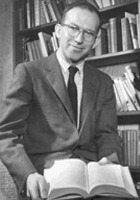

Edgar Bowers Poems
Love is no more.
It died as the mind dies: the pure desire
Relinquishing the blissful form it wore,
The ample joy and clarity expire.
...
How shall a generation know its story
If it will know no other? When, among
The scoffers at the Institute, Pasteur
Heard one deny the cause of child-birth fever,
...
All winter long you listened for the boom
Of distant cannon wheeled into their place.
Sometimes outside beneath a bombers’ moon
...
Before he wrote a poem, he learned the measure
That living in the future gives a farm--
Propinquity of mules and cows, the charmed
Insouciance of hens, the fellowship,
...
I summon up Panofskv from his bed
Among the famous dead
To build a tomb which, since I am not read,
Suffers the stone’s mortality instead;
...
Her unawed face, whose pose so long assumed
Is touched with what reality we feel,
Bends to itself and, to itself resumed,
...
I’ll go among the dead to see my friend.
The place I leave is beautiful: the sea
Repeats the winds’ far swell in its long sound,
...
Walking back to the office after lunch,
I saw Hans. “Mister Isham, Mister Isham,”
He called out in his hurry, “Herr Wegner needs you.
...
With their harsh leaves old rhododendrons fill
The crevices in grave plots' broken stones.
The bees renew the blossoms they destroy,
While in the burning air the pines rise still,
...
1
The autumn shade is thin. Grey leaves lie faint
Where they will lie, and, where the thick green was,
...
The clairvoyante, a major general’s wife,
The secretaries’ sibyl, read the letters
...
The angel of self-discipline, her guardian
Since she first knew and had to go away
From home that spring to have her child with strangers,
...
We, who were long together homeless, raise
Brick walls, wood floors, a roof, and windows up
To what sustained us in those threatening days
...
Every month or so, Sundays, we walked the line,
The limit and the boundary. Past the sweet gum
Superb above the cabin, along the wall—
...
Edgar Bowers Biography
Edgar Bowers was an American poet who won the Bollingen Prize in Poetry in 1989. Bowers was born in Rome, Georgia in 1924. During World War II he joined the military and served in Counter-intelligence against Germany. He graduated from the University of North Carolina at Chapel Hill in 1950 and did graduate work in English literature at Stanford University. Bowers published several books of poetry, including The Form of Loss, For Louis Pasteur, and The Astronomers. He won two fellowships from the Guggenheim Foundation, and taught at Duke University and the University of California, Santa Barbara. In Bowers's obituary, the English poet Clive Wilmer wrote, 'The title poem of his 1990 collection, For Louis Pasteur, announces his key loyalties. He confessed to celebrating every year the birthdays of three heroes: Pasteur, Mozart and Paul Valéry, all of whom suggest admiration for the life of the mind lived at its highest pitch - a concern for science and its social uses, and a love of art that is elegant, cerebral and orderly.' That is one part of Bowers. Another aspect is picked up by Thom Gunn on the back of Bowers's Collected Poems: 'Bowers started with youthful stoicism, but the feeling is now governed by an increasing acceptance of the physical world.' That 'physical world' encompasses sex and love, which are refracted through his restrained and lapidary lines. The effect of this contrast is striking: at once balanced and engaged; detached but acutely aware of sensual satisfactions. The style owes much to the artistic ethos of Yvor Winters, under whom Bowers studied at Stanford, but his achievement far surpasses that of his mentor, and his other students, such as J. V. Cunningham. He often wrote in rhyme, but also produced some of the finest blank verse in the English language. He wrote very little (his Collected Poems weighs in at 168 pages), due no doubt to the careful consideration behind every single line. But that care never forecloses on the wilder aspects of human existence--the needs, joys and violence. Bowers retired in 1991 and died in San Francisco in 2000.)
The Best Poem Of Edgar Bowers
Amor Vincit Omnia
Love is no more.
It died as the mind dies: the pure desire
Relinquishing the blissful form it wore,
The ample joy and clarity expire.
Regret is vain.
Then do not grieve for what you would efface,
The sudden failure of the past, the pain
Of its unwilling change, and the disgrace.
Leave innocence,
And modify your nature by the grief
Which poses to the will indifference
That no desire is permanent in sense.
Take leave of me.
What recompense, or pity, or deceit
Can cure, or what assumed serenity
Conceal the mortal loss which we repeat?
The mind will change, and change shall be relief.
Submitted by Gnute
Edgar Bowers Comments
Another giant, lost in virtual anonymity, but canonical just the same. Great lyrical poetry here, almost on par with Stevens. A joy to read him.




Delivering Poems Around The World
Poems are the property of their respective owners. All information has been reproduced here for educational and informational purposes to benefit site visitors, and is provided at no charge...
10/13/2026 6:19:33 PM # rel_20260925T122446Z_7d6ee41



If Edgar Bowers' art in writing poetry is neglected, it indicts the sinking art of reading poetry.