
John Gillespie Magee
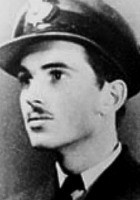

John Gillespie Magee Poems
Oh, I have slipped the surly bonds of earth
And danced the skies on laughter-silvered wings.
Sunward I've climbed and joined the tumbling mirth
Of sun-split clouds - and done a hundred things
...
We laid him in a cool and shadowed grove
One evening in the dreamy scent of thyme
Where leaves were green, and whispered high above —
A grave as humble as it was sublime;
...
John Gillespie Magee Biography
John Gillespie Magee, Jr. was an American aviator and poet who died as a result of a mid-air collision over Lincolnshire during World War II. He was serving in the Royal Canadian Air Force, which he joined before the United States officially entered the war. He is most famous for his poem "High Flight." Early Life John Gillespie Magee, Jr. was born in Shanghai, China, to an American father and a British mother who worked as Anglican missionaries. His father, John Magee Senior, was from a family in Pittsburgh, Pennsylvania of some wealth and influence—there is the Pittsburgh Magee Hospital and the Magee Building. Magee Senior, disregarding family wealth, chose to become an Episcopal priest and was sent as a missionary to China and there met his wife, Faith Emmeline Backhouse. Faith came from Helmingham in Suffolk, England, and was a member of the Church Missionary Society. John and Faith were married in 1921; John Junior was their first-born son in 1922, followed by David, Christopher and Hugh. John began his education at the American School, Nanking (1929–1931). In 1931 he moved with his mother to Britain where he continued his education first at St Clare preparatory school near Walmer, Kent (1931–1935). He was educated at Rugby School from 1935 to 1939. Magee developed his poetry whilst at the school, and in 1938 won the school's Poetry Prize. He was deeply moved by the roll of honour of Rugby students who had fallen in the First World War. This list of the fallen included the celebrated war poet Rupert Brooke (1887–1915), whose work Magee greatly admired and who had also won the school poetry prize 34 years prior to Magee. The poem refers to Brooke's burial, at 11 o'clock at night in an olive grove on the island of Skyros in Greece. "Sonnet to Rupert Brooke" "We laid him in a cool and shadowed grove One evening in the dreamy scent of thyme Where leaves were green, and whispered high above — A grave as humble as it was sublime; There, dreaming in the fading deeps of light — The hands that thrilled to touch a woman's hair; Brown eyes, that loved the Day, and looked on Night, A soul that found at last its answered Prayer... There daylight, as a dust, slips through the trees. And drifting, gilds the fern around his grave — Where even now, perhaps, the evening breeze Steals shyly past the tomb of him who gave New sight to blinded eyes; who sometimes wept — A short time dearly loved; and after, — slept." While at Rugby, Magee met and fell in love with Elinor, the daughter of Headmaster Hugh Lyon. Elinor Lyon was the inspiration for many of John's poems. Though Magee's love was not returned, he remained friends with Elinor and her family through to the end of his life. Magee and his family visited the United States in 1939. However, due to the outbreak of war, he was unable to return to Britain for his final year. Instead he lived with his aunt in Pittsburgh and attended Avon Old Farms School in Avon, Connecticut. He earned a scholarship to Yale University — where his father was then a chaplain — in July 1940 but did not enroll, choosing instead to enlist in the Royal Canadian Air Force in October of that year. Air Force Career Magee joined the RCAF in October 1940 and received flight training in the province of Ontario at No. 9 EFTS (Elementary Flying Training School) located at RCAF Station St. Catharines (St. Catharines), and at No. 2 SFTS (Service Flying Training School) at RCAF Station Uplands (Ottawa). He passed his Wings Test in June 1941. Shortly after being awarded his wings and being promoted to the rank of Pilot Officer Magee was sent to Britain. He was posted to No. 53 Operational Training Unit (OTU) in RAF Llandow, Wales to train on the Supermarine Spitfire. It was while serving with No. 53 OTU that Magee wrote his poem High Flight. After graduating from No. 53 OTU, Magee was assigned to No. 412 (Fighter) Squadron, RCAF, which was formed at RAF Digby, England, on 30 June 1941. The motto of this squadron was and is Promptus ad vindictam (Latin: "Swift to avenge"). Magee was qualified on and flew the Spitfire. Death Magee was killed at the age of 19, while flying Spitfire VZ-H, serial number AD-291. The aircraft was involved in a mid-air collision with an Airspeed Oxford trainer from RAF Cranwell, flown by Leading Aircraftman Ernest Aubrey. The two aircraft collided in cloud cover at about 1,400 feet AGL, at 11:30, over the hamlet of Roxholme, which lies between RAF Cranwell and RAF Digby, in Lincolnshire. Magee was descending at the time. At the inquiry afterwards a farmer testified that he saw the Spitfire pilot struggling to push back the canopy. The pilot stood up to jump from the plane but was too close to the ground for his parachute to open, and died on impact. Magee is buried at Holy Cross Cemetery, Scopwick in Lincolnshire, England. On his grave are inscribed the first and last lines from his poem High Flight: "Oh! I have slipped the surly bonds of Earth – Put out my hand and touched the Face of God." Part of the official letter to his parents read: "Your son's funeral took place at Scopwick Cemetery, near Digby Aerodrome, at 2:30 P.M. on Saturday, 13 December 1941, the service being conducted by Flight Lieutenant S. K. Belton, the Canadian padre of this Station. He was accorded full Service Honours, the coffin being carried by pilots of his own Squadron." A biography, Sunward I've Climbed, The Story of John Magee, Poet and Soldier, 1922–1941 was written by Hermann Hagedorn in 1942. "High Flight" Magee's posthumous fame rests mainly on his sonnet "High Flight", started on 18 August 1941, just a few months before his death, while he was based at No. 53 OTU. He had flown up to 33,000 feet in a Spitfire Mk I, his seventh flight in a Spitfire. As he orbited and climbed upward, he was struck with the inspiration of a poem — "To touch the face of God." He completed it later that day after landing. Purportedly, the first person to read this poem later that same day was fellow Pilot Officer Michael Le Bas (later Air Vice-Marshal M H Le Bas, Air Officer Commanding No. 1 Group RAF), with whom Magee had trained, in the officers' mess. Magee enclosed the poem on the back of a letter to his parents. His father, then curate of Saint John's Episcopal Church in Washington, DC, reprinted it in church publications. The poem became more widely known through the efforts of Archibald McLeish, then Librarian of Congress, who included it in an exhibition of poems called "Faith and Freedom" at the Library of Congress in February 1942. The manuscript copy of the poem remains at the Library of Congress. The poem "High Flight" Oh! I have slipped the surly bonds of Earth And danced the skies on laughter-silvered wings; Sunward I’ve climbed, and joined the tumbling mirth of sun-split clouds, — and done a hundred things You have not dreamed of — wheeled and soared and swung High in the sunlit silence. Hov’ring there, I’ve chased the shouting wind along, and flung My eager craft through footless halls of air.... Up, up the long, delirious, burning blue I’ve topped the wind-swept heights with easy grace. Where never lark, or even eagle flew — And, while with silent lifting mind I have trod The high untrespassed sanctity of space, - Put out my hand, and touched the face of God. Sources of inspiration for poem The same words that conclude "High Flight" - "And touched the face of God" - also conclude a poem by Cuthbert Hicks published three years earlier in Icarus: An Anthology of the Poetry of Flight (Macmillan, London, 1938) compiled by R de la Bere and three flight cadets of the Royal Air Force College, Cranwell. In fact the last two lines in the Hicks poem are: For I have danced the streets of heaven, And touched the face of God. This was in the poem "The Blind Man Flies". Of the many poets in this book, Hicks was one of only four that de la Bere was unable to trace and contact. The same book contains the poem "New World" by G. W. M. Dunn, which contains the phrase "on laughter-silvered wings." Dunn also wrote of "the lifting mind", another phrase that Magee uses in "High Flight." Dunn also refers to "the shouting of the air"; Magee has "chased the shouting wind". Finally, Magee's penultimate line, "The high untrespassed sanctity of space", closely resembles "Across the unpierced sanctity of space", which appears in the same volume in a poem by C. A. F. B. entitled "Dominion over Air", also previously published in the RAF College Journal. These many coincidences of borrowed phrases from the same source book suggest that Magee was heavily influenced by it. Modern use of the poem "High Flight" has endured as a favourite poem among aviators and, more recently, astronauts. Today it serves as the official poem of the Royal Canadian Air Force and Royal Air Force. It must be recited from memory by fourth class cadets (freshmen) at the United States Air Force Academy (USAFA) where it is also on display in the Cadet Field House. Portions of this poem appear on many headstones in Arlington National Cemetery. The poem itself also appears as part of display panels at the Canadian War Museum, Ottawa, the National Air Force Museum of Canada, Trenton, Ontario, and is the subject of a permanent display at the National Museum of the United States Air Force, Dayton, Ohio. Gen. Robert Lee Scott, Jr. included it in his book God is My Co-Pilot. Astronaut Michael Collins brought an index card with the poem typed on it on his Gemini 10 flight and included the complete poem in his autobiography Carrying The Fire. Former NASA Flight Director Gene Kranz quoted the first line of the poem in his book Failure Is Not An Option, at the end of Chapter 16, which deals with the Apollo 11 moon landing. Ronald Reagan quoted from "High Flight" in his speech (written by Peggy Noonan) that followed the Challenger disaster on January 28, 1986. He quoted: ..."slipped the surly bonds of Earth" to "touch the face of God." By 1950 there was a primary school reader in Ontario, Canada called High Flight which featured this poem. It had to be memorized by all students in Grade 8. Musical Adaptations Songs and symphonic compositions have been based on Magee's text (including Bob Chilcott's 2008 setting, premiered on 1 May 2008 by the King's Singers). The poem was set to music and adapted by John Denver on his 1983 album It's About Time. The poem was set to music (SATB choir and saxophone) by composer Christopher Marshall. The piece was commissioned and premiered by The Orlando Chorale (Orlando, Florida) in March 2009 under the direction of Gregory Ruffer with saxophonist George Weremchuk. The first performance of a setting of words, known as "Even Such Is Time" from Fauré’s Requiem plus additional non-liturgical texts including “High Flight” was performed by the Nantwich Choral Society, conducted by John Naylor on Saturday 26 March 2011 in St Mary’s Church, Nantwich, Cheshire, UK. The music was written by Andrew Mildinhall, the former organist at the church, who accompanied the performance with the Northern Concordia Orchestra. American composer James Curnow was commissioned by the Graduates Association of Tenri High School Band in Nara, Japan to write a piece for concert band in honor of the 50th anniversary of its association. The piece is entitled Where Never Lark or Eagle Flew with the subtitle "Based on a poem by John Gillespie Magee, Jr." Other Use in The Media Many U.S. television viewers were introduced to "High Flight" when some TV stations ended (and sometimes also began) their programming day with short films based on it. For example, the sign-off film occasionally used by KCRA-TV in Sacramento, California featured the spoken poem played to music and film of Air Force footage. In episode three, season seven of British archaeology documentary series Time Team the poem is read during the end credits. The episode focuses on the excavation of a downed Spitfire. In an episode of The West Wing ("The Crackpots and These Women," Season One Episode 5), President Josiah Bartlet references the last line ("touched the face of God") while discussing America's ventures into outer space and pondering what the country's next great achievement might be. The poem is paraphrased in the penultimate episode "Daybreak" of Battlestar Galactica. In an episode of AMC's Mad Men ("Maidenform", Season Two Episode 6), showing the signoff footage of a television station, used in a scene to establish the late night hour of a tryst. The poem also features in the 1993 Russell Crowe movie For the Moment, in which it is recited by Crowe's character, Lachlan Curry, while wooing the character Lil. Slipstream, a 1989 post-apocalyptic science fiction adventure film, makes frequent use of the poem, most notably by Mark Hamill and Bob Peck, and in line with the film's predominant theme of aviation. Actor James Cromwell recites this poem in its entirety in the film The Snow Walker. Novelist Arthur Hailey quoted its first two lines as an epigraph for his bestselling novel Airport. A full transcript of the poem can be found in the preceding page of chapter one of Scott O'Grady's book Return With Honor. "Per Ardua" — the last poem? Shortly after Magee's first combat action on November 8, 1941, Magee sent his family another poem ("... another trifle which may interest you."). Or rather, the beginnings of a poem, never quite finished. Although it is not certain, this poem is quite possibly the last that Magee wrote. Per ardua ad astra is the motto of the Royal Air Force and other Commonwealth air forces such as the RAAF, RNZAF, and the RCAF. It dates from 1912 and was used by the newly-formed Royal Flying Corps, and is translated as "Through struggles to the stars". "Per Ardua" (To those who gave their lives to England during the Battle of Britain and left such a shining example to us who follow, these lines are dedicated.) "They that have climbed the white mists of the morning; They that have soared, before the world's awake, To herald up their foeman to them, scorning The thin dawn's rest their weary folk might take; Some that have left other mouths to tell the story Of high, blue battle, quite young limbs that bled, How they had thundered up the clouds to glory, Or fallen to an English field stained red. Because my faltering feet would fail I find them Laughing beside me, steadying the hand That seeks their deadly courage – Yet behind them The cold light dies in that once brilliant Land .... Do these, who help the quickened pulse run slowly, Whose stern, remembered image cools the brow, Till the far dawn of Victory, know only Night's darkness, and Valhalla's silence now?")
The Best Poem Of John Gillespie Magee
High Flight (An Airman's Ecstasy)
Oh, I have slipped the surly bonds of earth
And danced the skies on laughter-silvered wings.
Sunward I've climbed and joined the tumbling mirth
Of sun-split clouds - and done a hundred things
You have not dreamed of - wheeled and soared and swung
High in the sunlit silence. Hov'ring there,
I've chased the shouting wind along and flung
My eager craft through footless halls of air
Up, up the long, delirious, burning blue
I've topped the windswept heights with easy grace
Where never lark, or even eagle flew.
And, while with silent, lifting mind I've trod
The high untrespassed sanctity of space,
Put out my hand, and touched the face of God.
John Gillespie Magee Comments
Additionally, while an American pilot, he was not American-born. He was born in Shanghai, which again, is noted on this page elsewhere. High Flight, in its entirety, is as follows: Oh! I have slipped the surly bonds of Earth And danced the skies on laughter-silvered wings; Sunward I’ve climbed, and joined the tumbling mirth of sun-split clouds, — and done a hundred things You have not dreamed of — wheeled and soared and swung High in the sunlit silence. Hov’ring there, I’ve chased the shouting wind along, and flung My eager craft through footless halls of air.... Up, up the long, delirious, burning blue I’ve topped the wind-swept heights with easy grace. Where never lark, or even eagle flew — And, while with silent, lifting mind I've trod The high untrespassed sanctity of space, - Put out my hand, and touched the face of God. An alternate version reads: Oh! I have slipped the surly bonds of earth And danced the skies on laughter-silvered wings; Sunward I’ve climbed, and joined the tumbling mirth Of sun-split clouds - and done a hundred things You have not dreamed of, Wheeled and soared and swung High in the sunlit silence. Hovering there, I’ve chased the shouting wind along, and flung My eager craft through footless halls of air. Up, up the long, delirious, burning blue I’ve topped the wind-swept heights with easy grace, Where never lark, or even eagle flew; And, while with silent, lifting mind I've trod The high untrespassed sanctity of space, Put out my hand, and touched the face of God. Additionally, his epitaph is taken from High Flight: Oh! I have slipped the surly bonds of Earth – Put out my hand and touched the Face of God.
The sonnet quotation is taken from the fuller version of high flight. The italics also identify his place and cause of death erroneously; he was not on a bombing raid over Germany, but instead in an accidental collision over Lincolnshire, England. The biography states so itself, but the quote is wrong in those two respects.
I am still waiting for your answer to my questions dated 10-28-08 on why there is a difference between the poem I have & the one you have on 'High Flight' by John Gillespie Magee. Thanks, Margaret
John Gillespie Magee Popularity
John Gillespie Magee Popularity




Delivering Poems Around The World
Poems are the property of their respective owners. All information has been reproduced here for educational and informational purposes to benefit site visitors, and is provided at no charge...
9/19/2024 5:39:27 PM # 1.0.0.1119



this is very good he is a inspiration to other poets ! very good 😀