
Philip Levine
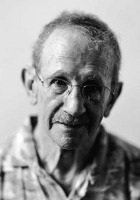

Philip Levine Poems
The gates are chained, the barbed-wire fencing stands,
An iron authority against the snow,
And this grey monument to common sense
Resists the weather. Fears of idle hands,
...
April, and the last of the plum blossoms
scatters on the black grass
before dawn. The sycamore, the lime,
the struck pine inhale
...
We stand in the rain in a long line
waiting at Ford Highland Park. For work.
You know what work is—if you're
old enough to read this you know what
...
I bought a dollar and a half's worth of small red potatoes,
took them home, boiled them in their jackets
and ate them for dinner with a little butter and salt.
Then I walked through the dried fields
...
Look, the eucalyptus, the Atlas pine,
the yellowing ash, all the trees
are gone, and I was older than
all of them. I am older than the moon,
...
Here in February, the fine
dark branches of the almond
begin to sprout tiny clusters
of leaves, sticky to the touch.
...
Some days I catch a rhythm, almost a song
in my own breath. I'm alone here
in Brooklyn Heights, late morning, the sky
above the St. George Hotel clear, clear
...
She wakens early remembering
her father rising in the dark
lighting the stove with a match
scraped on the floor. Then measuring
...
I walk among the rows of bowed heads--
the children are sleeping through fourth grade
so as to be ready for what is ahead,
the monumental boredom of junior high
...
Early March.
The cold beach deserted. My kids
home in a bare house, bundled up
and listening to rock music
...
It's wonderful how I jog
on four honed-down ivory toes
my massive buttocks slipping
like oiled parts with each light step.
...
My father and mother, two tiny figures,
side by side, facing the clouds that move
in from the Atlantic. August, '33.
The whole weight of the rain to come, the weight
...
Take this quiet woman, she has been
standing before a polishing wheel
for over three hours, and she lacks
twenty minutes before she can take
...
Words go on travelling from voice
to voice while the phones are still
and the wires hum in the cold. Now
and then dark winter birds settle
...
Four bright steel crosses,
universal joints, plucked
out of the burlap sack --
"the heart of the drive train,"
...
Still sober, César Vallejo comes home and finds a black ribbon
around the apartment building covering the front door.
He puts down his cane, removes his greasy fedora, and begins
to untangle the mess. His neighbors line up behind him
...
19 years old and going nowhere,
I got a ride to Bessemer and walked
the night road toward Birmingham
passing dark groups of men cursing
...
Two young men—you just might call them boys—
waiting for the Woodward streetcar to get
them downtown. Yes, they’re tired, they’re also
dirty, and happy. Happy because they’ve
...
Philip Levine Biography
a Pulitzer Prize-winning American poet best known for his poems about working-class Detroit. He taught for over thirty years at the English Department of California State University, Fresno and held teaching positions at other universities as well. He is appointed to serve as the Poet Laureate of the United States for 2011–2012. Biography Philip Levine grew up in industrial Detroit, the second of three sons and the first of identical twins of Jewish immigrant parents. His father, Harry Levine, owned a used auto parts business, his mother, Esther Priscol (Prisckulnick) Levine, was a bookseller. When Levine was five years old, his father died. Growing up, he faced the anti-Semitism embodied by the pro-Hitler radio priest Father Coughlin. Levine started to work in car manufacturing plants at the age of 14. He graduated from Detroit Central High School in 1946 and went to college at Wayne University (now Wayne State University) in Detroit, where he began to write poetry, encouraged by his mother, to whom he later dedicated the book of poems The Mercy. Levine got his A.B. in 1950 and went to work for Chevrolet and Cadillac in what he calls "stupid jobs". He married his first wife Patty Kanterman in 1951. The marriage lasted until 1953. In 1953 he went to the University of Iowa without registering, studying among others with poets Robert Lowell and John Berryman, the latter of which Levine called his "one great mentor". In 1954 he graduated with a mail-order masters degree with a thesis on John Keats' "Ode to Indolence", and married actress Frances J. Artley. He returned to the University of Iowa teaching technical writing, completing his Master of Fine Arts degree in 1957. The same year, he was awarded the Jones Fellowship in Poetry at Stanford University. In 1958 he joined the English Department at California State University in Fresno, where he taught until his retirement in 1992. He has also taught at many other universities, among them New York University as Distinguished Writer-in-Residence, at Columbia, Princeton, Brown, Tufts, and the University of California at Berkeley. Levine and his wife live in Fresno and Brooklyn. Work The familial, social, and economic world of 20th century Detroit is one of the major subjects of Levine's life work. His portraits of working class Americans and his continuous examination of his Jewish immigrant inheritance (both based on real life and described through fictional characters) has left a testimony of mid-20th century American life. Levine's working experience lent his poetry a profound skepticism in regard to conventional American ideals. In his first two books, On the Edge (1963) and Not This Pig (1968), the poetry dwells on those who suddenly become aware they are trapped in some murderous processes not of their own making. In 1968, Levine signed the “Writers and Editors War Tax Protest” pledge, vowing to refuse tax payments in protest against the Vietnam War. In his first two books, Levine was somewhat traditional in form and relatively constrained in expression. Beginning with They Feed They Lion, Levine's poems are typically free-verse monologues tending toward trimeter or tetrameter. The music of Levine's poetry depends on tension between his line-breaks and his syntax. The title poem of Levine's book 1933 (1974) is an example of the cascade of clauses and phrases one finds in his poetry. Other collections include the National Book Award-winning What Work Is, A Walk with Tom Jefferson, and in his New Selected Poems. On November 29, 2007 a tribute was held in New York City in anticipation of Levine's 80th birthday. Among those celebrating Levine's career by reading Levine's work were Yusef Komunyakaa, Galway Kinnell, E. L. Doctorow, Charles Wright, Jean Valentine, and Sharon Olds. Levine himself read several new poems. He thanked his students and asked them to refrain from asking for any more letters of recommendation. Awards 2011 Appointed Poet Laureate Consultant in Poetry to the Library of Congress (United States Poet Laureate) 1995 Pulitzer Prize for Poetry – The Simple Truth (1994) 1991 National Book Award, Los Angeles Times Book Prize – What Work Is 1987 Ruth Lilly Poetry Prize from the Modern Poetry Association and the American Council for the Arts 1981 Levinson Prize from Poetry magazine 1980 American Book Award (National Book Award) for Poetry – Ashes: Poems New and Old, Guggenheim Foundation fellowship 1979 National Book Critics Circle Award – Ashes: Poems New and Old – 7 Years from Somewhere 1978 Harriet Monroe Memorial Prize from Poetry 1977 Lenore Marshall Poetry Prize – The Names of the Lost (1975) 1973 American Academy of Arts and Letters Award, Frank O'Hara Prize, Guggenheim Foundation fellowship)
The Best Poem Of Philip Levine
An Abandoned Factory, Detroit
The gates are chained, the barbed-wire fencing stands,
An iron authority against the snow,
And this grey monument to common sense
Resists the weather. Fears of idle hands,
Of protest, men in league, and of the slow
Corrosion of their minds, still charge this fence.
Beyond, through broken windows one can see
Where the great presses paused between their strokes
And thus remain, in air suspended, caught
In the sure margin of eternity.
The cast-iron wheels have stopped; one counts the spokes
Which movement blurred, the struts inertia fought,
And estimates the loss of human power,
Experienced and slow, the loss of years,
The gradual decay of dignity.
Men lived within these foundries, hour by hour;
Nothing they forged outlived the rusted gears
Which might have served to grind their eulogy.
Philip Levine Comments
Finally discovered the beauty of Philip Levine's poetry in his poem, 'A Sign.' Quiet, not flashy stuff, but deeply resonant.
Phillip Levine is not the first author I found just moments after their death. The first was not officially a poet, I guess, but Ayn Rand's work has the same epic aspects. I find Mr. Levine to be more realistic than my own favorite poet Billy Collins. He has the same accessibility...I like accessibility. Sorry I missed him...but then that is also something of a trademark among artists...
I love his Unholy Saturday and don't see it on your site.Is it that new?




Delivering Poems Around The World
Poems are the property of their respective owners. All information has been reproduced here for educational and informational purposes to benefit site visitors, and is provided at no charge...
7/17/2026 1:49:58 AM # 1.0.0



Hello to whoever is reading this. I have recently come upon Mr. Philip Levine, and I to say the least, am impressed. I don't want to seem like a con artist, as I am only experiencing Philips because of a research essay. I