Silver Poems
Silver poems from famous poets and best beautiful poems to feel good. Best silver poems ever written. Read all poems about silver.
BEST POEMS ABOUT SILVER
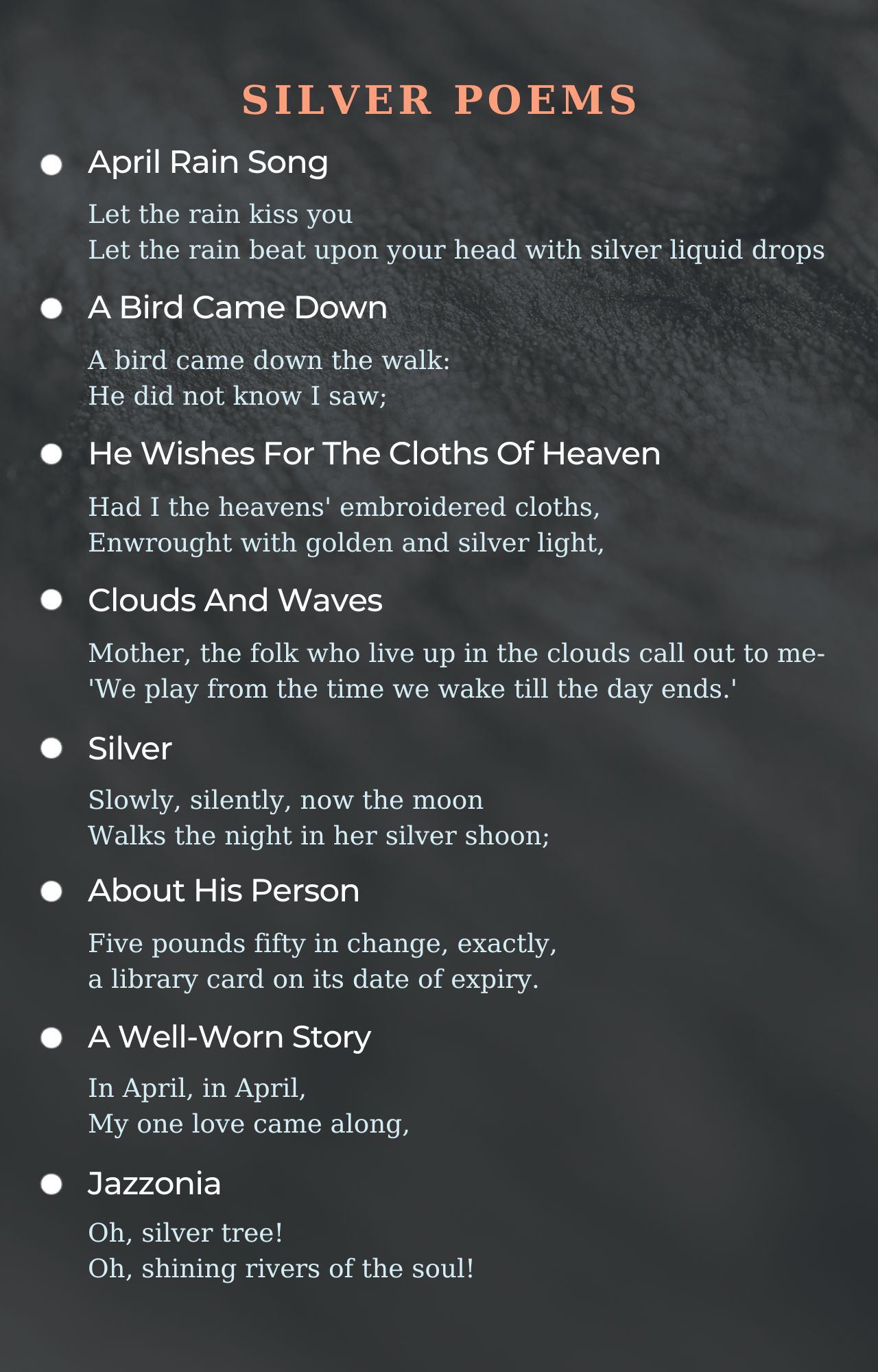
Let the rain kiss you
Let the rain beat upon your head with silver liquid drops
Let the rain sing you a lullaby
The rain makes still pools on the sidewalk
...
A bird came down the walk:
He did not know I saw;
He bit an angle-worm in halves
And ate the fellow, raw.
...
HAD I the heavens' embroidered cloths,
Enwrought with golden and silver light,
The blue and the dim and the dark cloths
Of night and light and the half-light,
...
Slowly, silently, now the moon
Walks the night in her silver shoon;
This way, and that, she peers, and sees
Silver fruit upon silver trees;
...
Mother, the folk who live up in the clouds call out to me-
'We play from the time we wake till the day ends.
We play with the golden dawn, we play with the silver moon.'
I ask, 'But how am I to get up to you? '
...
My heart is like a singing bird
Whose nest is in a water'd shoot;
My heart is like an apple-tree
Whose boughs are bent with thickset fruit;
...
Oh, silver tree!
Oh, shining rivers of the soul!
In a Harlem cabaret
...
In April, in April,
My one love came along,
And I ran the slope of my high hill
To follow a thread of song.
...
Awed by her splendor
stars near the lovely
moon cover their own
bright faces
...
Five pounds fifty in change, exactly,
a library card on its date of expiry.
A postcard stamped,
...
Then a woman said, 'Speak to us of Joy and Sorrow.'
And he answered:
...
Tonight the moon is a cracker,
with a bite out of it
floating in the night,
...
As the Sun withdrew his rays from the garden, and the moon threw cushioned beams upon the flowers, I sat under the trees pondering upon the phenomena of the atmosphere, looking through the branches at the strewn stars which glittered like chips of silver upon a blue carpet; and I could hear from a distance the agitated murmur of the rivulet singing its way briskly into the valley.
...
Had I the heavens' embroidered cloths,
Enwrought with golden and silver light,
The blue and the dim and the dark cloths
Of night and light and the half-light,
...
The moon whispered to the sea,
'Tell me your deepest secrets.'
And the sea, with its waves dancing,
Revealed tales of lost ships,
...
WHEN by my solitary hearth I sit,
And hateful thoughts enwrap my soul in gloom;
When no fair dreams before my "mind's eye" flit,
And the bare heath of life presents no bloom;
...
Celebrate our anniversary - can't you see
tonight the snowy night of our first winter
comes back again in every road and tree -
that winter night of diamantine splendour.
...
In the pathway of the sun,
In the footsteps of the breeze,
Where the world and sky are one,
He shall ride the silver seas,
...
Thou fair-haired angel of the evening,
Now, whilst the sun rests on the mountains, light
Thy bright torch of love; thy radiant crown
Put on, and smile upon our evening bed!
...
Young palmer sun, that to these shining sands
Pourest thy pilgrim's tale, discoursing still
Thy silver passages of sacred lands,
With news of Sepulchre and Dolorous Hill,
...
NEW POEMS ABOUT SILVER
Silver and gold, precious and rare
Shimmering in the sun, beyond compare
Glistening like stars in the night sky
A sight that catches every eye
...
Fragile wings, oh how they shine
Glistening silver, they're truly divine
Holding onto them, with all my might
For they carry the melody of tomorrow's sight
...
Nothing touches your touch or your lust.
The cusp of a kiss, the press of your lips
Skin to skin, what a halleluiah unfolds.
Into an alchemy of silver and gold
...
'Silver bells, hear them ring' - Andrew W.K. Yip
Ding-dong, Ding-dong,
Silver bells, loud and strong,
...
In moonlit night, in silver shine
From heavens I in this world peep
In my soul silver intervine
With body on the earth it leap
...
purple lotus blooms, on a glassy, silver lake ~ gold sun, lustrous moon
...
When the Lone Ranger has his finger on his gun's trigger, he constantly has to pull it.
When the moon is full, he hunts and kills werewolves, that's why he uses silver bullets.
He also uses silver bullets to stop outlaws from committing crimes.
But he uses those bullets to kill werewolves the majority of the time.
...
Silver! !
Insight of silver!
Love of silver,
Very clear with nature!
...
Silver are the bellies of fish bargaining with their weight,
trying to discard it in the pawnshops of th sky,
Silver are the backs of waves, telling the rocks where
they've come from, and what they've experienced on the way,
but they never finish the story; because, short of breath,
sentences fall apart again and again on formations of salt,
Silver is the kindness of olive tress unlocking their shadows
and placing them in three tone levels of braying,
Silver is the scent of rosemary, that with the same care
pastes the juice from a wound on a baked fish, and on a gradual
leave-taking of the day,
Silver is noon, ordering everyone to keep still,
to measure the volume of their happiness with slow breathing,
to journey in their thoughts to the harbor
from which their childhood sailed away in a distant dawn,
Silver is the wind, adding to every hour of oblivion
three additional hours of oblivion, the hours that constantly
happen in the present,
Silver are sails, which in truth are white, and are silvery
because of the imagination's needs, and because of the
celebration of their inaudible movement,
Silver is the stillness of the afternoon, fastening its warmth
to the earth and then refusing to give
the seat to the approaching evening,
Silver are the traces of clouds, buildings cities in the air,
where we are invited when, after lunch,
we are buried under the avalanche of sleep,
Silver are the snow-drifts of algae, which have emerged
from the night waves to succumb on the silent indifference of
gravel in the morning,
Silver are the shouts of people who love their bodies,
Silver are the treetops of cypresses etching fugitive letters
on the flexible skin of summer,
Silver are vineyards, where the restless pheasants are preparing
for the shipwreck of the southern wind,
Silver is the flight of a seagull, stitching together the spoken
and the unspoken, making a lasting truce with the banging
of evening bells,
Silver is the movements of dry grass, having forgotten
the true life of the previous spring, and now
its ghosts wrestle day after day with the empty sleeves of wind,
Silver is the ring of moonlight which I place
on your ring-finger as you leave your body and urge
the night to return to you, prematurely dead,
Silver is the moon's rain, stopping
to caress the two of us when we are melting, silvered from
summer sweat,
And silver are the downy seeds
I watch lying on my back,
with eyes etched in the azures of the sky,
watching them falling from nowhere, disappearing to who
knows where.
Silver, the color of my mind!
...
Writing a poem is not about bringing some words together to create some charming sentences. It's so much deeper than that. Writing poetry is a bridge that allows people to express their feelings and make others live every single word they read. Poetry is to educate people, to lead them away from hate to love, from violence to mercy and pity. Writing poetry is to help this community better understand life and live it more passionately. PoemHunter.com contains an enormous number of famous poems from all over the world, by both classical and modern poets. You can read as many as you want, and also submit your own poems to share your writings with all our poets, members, and visitors.
Silver Poets
Silver Poets From Members




Delivering Poems Around The World
Poems are the property of their respective owners. All information has been reproduced here for educational and informational purposes to benefit site visitors, and is provided at no charge...
10/13/2026 4:19:54 AM # rel_20260925T122446Z_7d6ee41