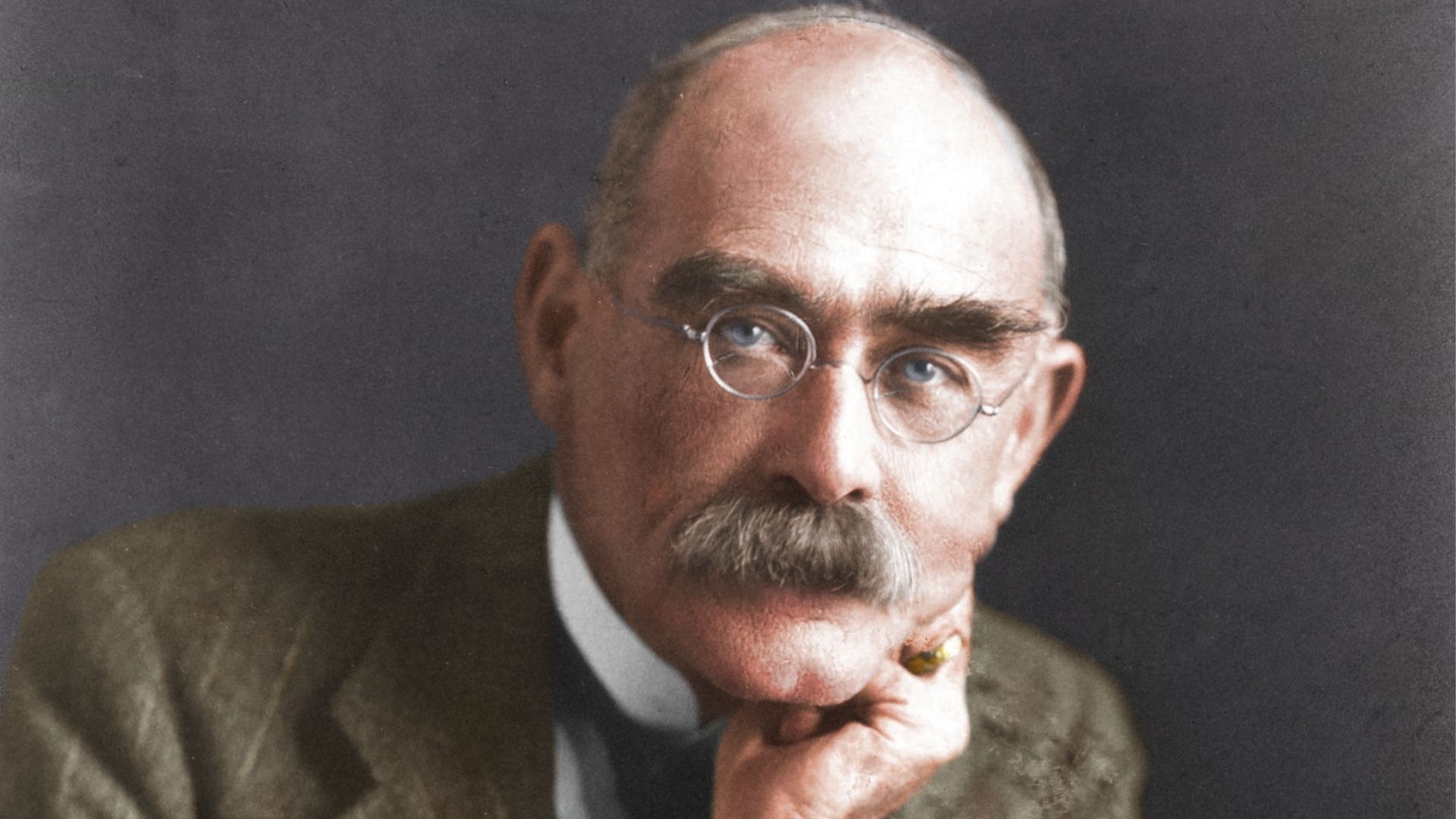

Rudyard Kipling Poems
When Rome was rotten-ripe to her fall,
And the sceptre passed from her hand,
The pestilent Picts leaped over the wall
...
. . . At the close of a winter day,
Their anchors down, by London town, the Three Great Captains lay;
And one was Admiral of the North from Solway Firth to Skye,
...
Our Lord Who did the Ox command
To kneel to Judah's King,
He binds His frost upon the land
To ripen it for Spring --
...
Now the Four-way Lodge is opened, now the Hunting Winds are loose --
Now the Smokes of Spring go up to clear the brain;
Now the Young Men's hearts are troubled for the whisper of the Trues,
Now the Red Gods make their medicine again!
...
"An Unqualified Pilot"
Once a pair of savages found a stranded tree.
...
Rudyard Kipling Poems and Quotes in Hindi & English | About Kipling’s Poetry
Rudyard Kipling was a renowned English poet, novelist, and short-story writer who lived from 1865 to 1936. He is best known for his works that celebrate British imperialism and colonialism, including his most famous poem, "If-".
Kipling's poetry often explores themes such as leadership, duty, honor, and patriotism, and he frequently uses the natural world and animal imagery to convey his messages. His poems also often contain a strong sense of nostalgia and a longing for a simpler, more traditional way of life.
Other notable poems by Kipling include "Gunga Din", "The Ballad of East and West", and "The White Man's Burden". Kipling was awarded the Nobel Prize in Literature in 1907, becoming the first English-language writer to receive the award. Despite his success, however, Kipling's work has been criticized for promoting a colonialist ideology and perpetuating racist stereotypes.
Rudyard Kipling Poems
Here are some of Rudyard Kipling's most famous poems:
"If-": This poem is perhaps Kipling's best-known work and is a meditation on the qualities of leadership and character. It begins: "If you can keep your head when all about you / Are losing theirs and blaming it on you..."
"Gunga Din": This poem tells the story of a faithful Indian water-carrier who saves the lives of British soldiers during a battle in colonial India. It includes the famous lines: "You're a better man than I am, Gunga Din!"
"The Ballad of East and West": This poem explores the divide between the East and the West and ends with the famous line: "East is East, and West is West, and never the twain shall meet."
"The White Man's Burden": This poem was written in 1899 as a call to the United States to take up the mantle of imperialism and civilize the "savage" peoples of the world.
"Mandalay": This poem tells the story of a British soldier who longs to return to the city of Mandalay in Burma. It includes the famous lines: "On the road to Mandalay / Where the flying-fishes play..."
"If We Must Die": This poem was written in response to the racial violence that was taking place in the United States in the early 20th century. It includes the famous lines: "If we must die, let it not be like hogs / Hunted and penned in an inglorious spot..."
"Tommy": This poem is a tribute to the British soldiers who fought in the Boer War in South Africa. It includes the famous lines: "For it's Tommy this, an' Tommy that, an' 'Chuck him out, the brute!' / But it's 'Saviour of 'is country' when the guns begin to shoot..."
These are just a few examples of Kipling's many poems, which span a wide range of themes and styles.
Rudyard Kipling Poems in Hindi
Rudyard Kipling's poems have been translated into many languages, including Hindi. Here are a few examples of Kipling's poems that have been translated into Hindi:
"If-" (Hindi translation: "अगर तू"): This poem has been translated into Hindi by several translators, including Vaidya Nath Mishra and Shyam Narayan Pandey. It is one of Kipling's most famous works and is a meditation on the qualities of leadership and character.
"Gunga Din" (Hindi translation: "गंगा दीन"): This poem tells the story of a faithful Indian water-carrier who saves the lives of British soldiers during a battle in colonial India. It has been translated into Hindi by several translators, including Harivansh Rai Bachchan and Kamleshwar.
"The Ballad of East and West" (Hindi translation: "पूर्व और पश्चिम का गीत"): This poem explores the divide between the East and the West and has been translated into Hindi by several translators, including Anand Kumar and Raghuvir Sahay.
"Mandalay" (Hindi translation: "मण्डले"): This poem tells the story of a British soldier who longs to return to the city of Mandalay in Burma. It has been translated into Hindi by several translators, including Kamleshwar and Raghuvir Sahay.
These are just a few examples of Kipling's poems that have been translated into Hindi. His works continue to be read and appreciated by Hindi-speaking readers around the world.
Rudyard Kipling Quotes
Here are some famous quotes by Rudyard Kipling:
"If history were taught in the form of stories, it would never be forgotten."
"Gardens are not made by singing 'Oh, how beautiful!' and sitting in the shade."
"Words are, of course, the most powerful drug used by mankind."
"I am by nature a dealer in words, and words are the most powerful drug known to humanity."
"For the strength of the Pack is the Wolf, and the strength of the Wolf is the Pack."
"The first condition of understanding a foreign country is to smell it."
"Never look backwards or you'll fall down the stairs."
"If you can keep your head when all about you are losing theirs and blaming it on you..."
"A people always ends by resembling its shadow."
"All the people like us are we, and everyone else is They."
Rudyard Kipling Biography
Rudyard Kipling was born on December 30, 1865, in Bombay, India, to British parents. He spent his early years in India, where his father worked as a professor of architectural sculpture. At the age of six, Kipling was sent to boarding school in England, where he endured a difficult and unhappy childhood.
Kipling returned to India as a young man and worked as a journalist for several newspapers. His experiences in India provided much of the material for his early works, including his first collection of stories, "Plain Tales from the Hills" (1888).
In 1892, Kipling married Caroline Balestier, the sister of an American friend. The couple settled in Vermont, where Kipling wrote many of his most famous works, including "The Jungle Book" (1894) and "Kim" (1901). Kipling and his wife had three children, but only one survived to adulthood.
Kipling was a prolific writer, and his works include novels, short stories, and poetry. He was awarded the Nobel Prize in Literature in 1907, becoming the first English-language writer to receive the award. Despite his success, Kipling's work has been criticized for promoting a colonialist ideology and perpetuating racist stereotypes.
Kipling died on January 18, 1936, in London, England. Today, he is remembered as one of the most important writers of the late Victorian and early Edwardian eras, and his works continue to be read and studied around the world.




Delivering Poems Around The World
Poems are the property of their respective owners. All information has been reproduced here for educational and informational purposes to benefit site visitors, and is provided at no charge...
6/11/2026 5:44:47 AM # 1.0.0