
Geoffrey Chaucer
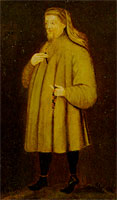

Geoffrey Chaucer Poems
Your two great eyes will slay me suddenly;
Their beauty shakes me who was once serene;
Straight through my heart the wound is quick and keen.
...
The firste stock-father of gentleness,
What man desireth gentle for to be,
Must follow his trace, and all his wittes dress,
Virtue to love, and vices for to flee;
...
Fle fro the pres, and dwelle with sothefastnesse,
Suffise thin owen thing, thei it be smal;
For hord hath hate, and clymbyng tykelnesse,
Prees hath envye, and wele blent overal.
...
Compleyne ne koude, ne might myn herte never,
My peynes halve, ne what torment I have,
Though that I sholde in your presence ben ever,
Myn hertes lady, as wisly he me save
...
This wrecched worldes transmutacioun,
As wele or wo, now povre and now honour,
Withouten ordre or wys discrecioun
Governed is by Fortunes errour.
...
Adam Scrivener, if ever it thee befall
Boece or Troilus for to write anew,
Under thy long locks thou may'st have the scall
But after my making thou write more true!
...
Almighty and al merciable queene,
To whom that al this world fleeth for socour,
To have relees of sinne, of sorwe, and teene,
Glorious virgine, of alle floures flour,
...
HYD, Absolon, thy gilte tresses clere;
Ester, ley thou thy meknesse al a-doun;
Hyd, Jonathas, al thy frendly manere;
Penalopee, and Marcia Catoun,
...
Flee from the press, and dwell with soothfastness;
Suffice thee thy good, though it be small;
For hoard hath hate, and climbing tickleness,
Press hath envy, and weal is blent o'er all,
...
What shul these clothes thus manyfold,
Lo this hote somers day?
After grete hete cometh cold;
...
Now welcome Summer with thy sunne soft,
That hast this winter`s weathers overshake,
And driven away the longe nighties black.
...
The firste stok, fader of gentilesse --
What man that desireth gentil for to be
Must folowe his trace, and alle his wittes dresse
Vertu to love and vyces for to flee.
...
Somtyme the world was so stedfast and stable
That mannes word was obligacioun,
And now it is so fals and deceivable
...
Here bygynneth the Book of the tales of Caunterbury.
Whan that Aprille, with hise shoures soote,
The droghte of March hath perced to the roote
And bathed every veyne in swich licour,
Of which vertu engendred is the flour;
...
Sometime this world was so steadfast and stable,
That man's word was held obligation;
And now it is so false and deceivable,
That word and work, as in conclusion,
...
Madame, for youre newefangelnesse,
Many a servant have ye put out of grace.
I take my leve of your unstedefastnesse,
For wel I woot, whil ye have lives space,
...
I have gret wonder, be this lighte,
How that I live, for day ne nighte
I may nat slepe wel nigh noght,
...
1. CAPTIVITY
YOUR eyen two wol slee me sodenly,
I may the beaute of hem not sustene,
...
A.
Almighty and all-merciable Queen,
To whom all this world fleeth for succour,
...
Adam scriveyn, if ever it thee bifalle
Boece or Troylus for to wryten newe,
Under thy long lokkes thou most have the scalle
...
Geoffrey Chaucer Biography
Geoffrey Chaucer known as the Father of English literature, is widely considered the greatest English poet of the Middle Ages and was the first poet to have been buried in Poet's Corner of Westminster Abbey. While he achieved fame during his lifetime as an author, philosopher, alchemist and astronomer, composing a scientific treatise on the astrolabe for his ten year-old son Lewis, Chaucer also maintained an active career in the civil service as a bureaucrat, courtier and diplomat. Among his many works, which include The Book of the Duchess, the House of Fame, the Legend of Good Women and Troilus and Criseyde, he is best known today for The Canterbury Tales. Chaucer is a crucial figure in developing the legitimacy of the vernacular, Middle English, at a time when the dominant literary languages in England were French and Latin. Life Geoffrey Chaucer was born in London sometime around 1343, though the precise date and location of his birth remain unknown. His father and grandfather were both London vintners; several previous generations had been merchants in Ipswich. (His family name derives from the French chausseur, meaning "shoemaker".) In 1324 John Chaucer, Geoffrey's father, was kidnapped by an aunt in the hope of marrying the twelve-year-old boy to her daughter in an attempt to keep property in Ipswich. The aunt was imprisoned and the £250 fine levied suggests that the family was financially secure—bourgeois, if not elite. John Chaucer married Agnes Copton, who, in 1349, inherited properties including 24 shops in London from her uncle, Hamo de Copton, who is described in a will dated April 3, 1354 and listed in the City Hustings Roll as "moneyer"; he was said to be moneyer at the Tower of London. In the City Hustings Roll 110, 5, Ric II, dated June 1380, Geoffrey Chaucer refers to himself as me Galfridum Chaucer, filium Johannis Chaucer, Vinetarii, Londonie' . While records concerning the lives of his contemporary poets, William Langland and the Pearl Poet are practically non-existent, since Chaucer was a public servant, his official life is very well documented, with nearly five hundred written items testifying to his career. The first of the "Chaucer Life Records" appears in 1357, in the household accounts of Elizabeth de Burgh, the Countess of Ulster, when he became the noblewoman's page through his father's connections. She was married to Lionel, Duke of Clarence, the second surviving son of the king, Edward III, and the position brought the teenage Chaucer into the close court circle, where he was to remain for the rest of his life. He also worked as a courtier, a diplomat, and a civil servant, as well as working for the king, collecting and inventorying scrap metal. In 1359, in the early stages of the Hundred Years' War, Edward III invaded France and Chaucer travelled with Lionel of Antwerp, 1st Duke of Clarence, Elizabeth's husband, as part of the English army. In 1360, he was captured during the siege of Rheims. Edward paid £16 for his ransom, a considerable sum, and Chaucer was released. After this, Chaucer's life is uncertain, but he seems to have travelled in France, Spain, and Flanders, possibly as a messenger and perhaps even going on a pilgrimage to Santiago de Compostela. Around 1366, Chaucer married Philippa (de) Roet. She was a lady-in-waiting to Edward III's queen, Philippa of Hainault, and a sister of Katherine Swynford, who later (ca. 1396) became the third wife of John of Gaunt. It is uncertain how many children Chaucer and Philippa had, but three or four are most commonly cited. His son, Thomas Chaucer, had an illustrious career, as chief butler to four kings, envoy to France, and Speaker of the House of Commons. Thomas's daughter, Alice, married the Duke of Suffolk. Thomas's great-grandson (Geoffrey's great-great-grandson), John de la Pole, Earl of Lincoln, was the heir to the throne designated by Richard III before he was deposed. Geoffrey's other children probably included Elizabeth Chaucy, a nun at Barking Abbey. Agnes, an attendant at Henry IV's coronation; and another son, Lewis Chaucer. Chaucer probably studied law in the Inner Temple (an Inn of Court) at this time. He became a member of the royal court of Edward III as a varlet de chambre, yeoman, or esquire on 20 June 1367, a position which could entail a wide variety of tasks. His wife also received a pension for court employment. He travelled abroad many times, at least some of them in his role as a valet. In 1368, he may have attended the wedding of Lionel of Antwerp to Violante Visconti, daughter of Galeazzo II Visconti, in Milan. Two other literary stars of the era were in attendance: Jean Froissart and Petrarch. Around this time, Chaucer is believed to have written The Book of the Duchess in honour of Blanche of Lancaster, the late wife of John of Gaunt, who died in 1369. Chaucer travelled to Picardy the next year as part of a military expedition, and visited Genoa and Florence in 1373. Numerous scholars such as Skeat, Boitani, and Rowland suggested that, on this Italian trip, he came into contact with Petrarch or Boccaccio. They introduced him to medieval Italian poetry, the forms and stories of which he would use later. The purposes of a voyage in 1377 are mysterious, as details within the historical record conflict. Later documents suggest it was a mission, along with Jean Froissart, to arrange a marriage between the future King Richard II and a French princess, thereby ending the Hundred Years War. If this was the purpose of their trip, they seem to have been unsuccessful, as no wedding occurred. In 1378, Richard II sent Chaucer as an envoy (secret dispatch) to the Visconti and to Sir John Hawkwood, English condottiere (mercenary leader) in Milan. It has been speculated that it was Hawkwood on whom Chaucer based his character the Knight in the Canterbury Tales, for a description matches that of a fourteenth-century condottiere. A possible indication that his career as a writer was appreciated came when Edward III granted Chaucer "a gallon of wine daily for the rest of his life" for some unspecified task. This was an unusual grant, but given on a day of celebration, St George's Day, 1374, when artistic endeavours were traditionally rewarded, it is assumed to have been another early poetic work. It is not known which, if any, of Chaucer's extant works prompted the reward, but the suggestion of him as poet to a king places him as a precursor to later poets laureate. Chaucer continued to collect the liquid stipend until Richard II came to power, after which it was converted to a monetary grant on 18 April 1378. Chaucer obtained the very substantial job of Comptroller of the Customs for the port of London, which he began on 8 June 1374. He must have been suited for the role as he continued in it for twelve years, a long time in such a post at that time. His life goes undocumented for much of the next ten years, but it is believed that he wrote (or began) most of his famous works during this period. He was mentioned in law papers of 4 May 1380, involved in the raptus of Cecilia Chaumpaigne. What raptus means is unclear, but the incident seems to have been resolved quickly and did not leave a stain on Chaucer's reputation. It is not known if Chaucer was in the city of London at the time of the Peasants' Revolt, but if he was, he would have seen its leaders pass almost directly under his apartment window at Aldgate. While still working as comptroller, Chaucer appears to have moved to Kent, being appointed as one of the commissioners of peace for Kent, at a time when French invasion was a possibility. He is thought to have started work on The Canterbury Tales in the early 1380s. He also became a Member of Parliament for Kent in 1386. There is no further reference after this date to Philippa, Chaucer's wife, and she is presumed to have died in 1387. He survived the political upheavals caused by the Lords Appellants, despite the fact that Chaucer knew some of the men executed over the affair quite well. On 12 July 1389, Chaucer was appointed the clerk of the king's works, a sort of foreman organising most of the king's building projects. No major works were begun during his tenure, but he did conduct repairs on Westminster Palace, St. George's Chapel, Windsor, continue building the wharf at the Tower of London, and build the stands for a tournament held in 1390. It may have been a difficult job, but it paid well: two shillings a day, more than three times his salary as a comptroller. Chaucer was also appointed keeper of the lodge at the King’s park in Feckenham, which was a largely honorary appointment. In September 1390, records say that he was robbed, and possibly injured, while conducting the business, and it was shortly after, on 17 June 1391, that he stopped working in this capacity. Almost immediately, on 22 June, he began as deputy forester in the royal forest of North Petherton, Somerset. This was no sinecure, with maintenance an important part of the job, although there were many opportunities to derive profit. He was granted an annual pension of twenty pounds by Richard II in 1394. It is believed that Chaucer stopped work on the Canterbury Tales sometime towards the end of this decade. Not long after the overthrow of his patron, Richard II, in 1399, Chaucer's name fades from the historical record. The last few records of his life show his pension renewed by the new king, and his taking of a lease on a residence within the close of Westminster Abbey on 24 December 1399. Although Henry IV renewed the grants assigned to Chaucer by Richard, Chaucer's own The Complaint of Chaucer to his Purse hints that the grants might not have been paid. The last mention of Chaucer is on 5 June 1400, when some monies owed to him were paid. He is believed to have died of unknown causes on 25 October 1400, but there is no firm evidence for this date, as it comes from the engraving on his tomb, erected more than one hundred years after his death. There is some speculation—most recently in Terry Jones' book Who Murdered Chaucer? : A Medieval Mystery—that he was murdered by enemies of Richard II or even on the orders of his successor Henry IV, but the case is entirely circumstantial. Chaucer was buried in Westminster Abbey in London, as was his right owing to his status as a tenant of the Abbey's close. In 1556, his remains were transferred to a more ornate tomb, making Chaucer the first writer interred in the area now known as Poets' Corner. Works Chaucer's first major work, The Book of the Duchess, was an elegy for Blanche of Lancaster (who died in 1369). It is possible that this work was commissioned by her husband John of Gaunt, as he granted Chaucer a £10 annuity on 13 June 1374. This would seem to place the writing of The Book of the Duchess between the years 1369 and 1374. Two other early works by Chaucer were Anelida and Arcite and The House of Fame. Chaucer wrote many of his major works in a prolific period when he held the job of customs comptroller for London (1374 to 1386). His Parlement of Foules, The Legend of Good Women and Troilus and Criseyde all date from this time. Also it is believed that he started work on The Canterbury Tales in the early 1380s. Chaucer is best known as the writer of The Canterbury Tales, which is a collection of stories told by fictional pilgrims on the road to the cathedral at Canterbury; these tales would help to shape English literature. The Canterbury Tales contrasts with other literature of the period in the naturalism of its narrative, the variety of stories the pilgrims tell and the varied characters who are engaged in the pilgrimage. Many of the stories narrated by the pilgrims seem to fit their individual characters and social standing, although some of the stories seem ill-fitting to their narrators, perhaps as a result of the incomplete state of the work. Chaucer drew on real life for his cast of pilgrims: the innkeeper shares the name of a contemporary keeper of an inn in Southwark, and real-life identities for the Wife of Bath, the Merchant, the Man of Law and the Student have been suggested. The many jobs that Chaucer held in medieval society—page, soldier, messenger, valet, bureaucrat, foreman and administrator—probably exposed him to many of the types of people he depicted in the Tales. He was able to shape their speech and satirise their manners in what was to become popular literature among people of the same types. Chaucer's works are sometimes grouped into first a French period, then an Italian period and finally an English period, with Chaucer being influenced by those countries' literatures in turn. Certainly Troilus and Criseyde is a middle period work with its reliance on the forms of Italian poetry, little known in England at the time, but to which Chaucer was probably exposed during his frequent trips abroad on court business. In addition, its use of a classical subject and its elaborate, courtly language sets it apart as one of his most complete and well-formed works. In Troilus and Criseyde Chaucer draws heavily on his source, Boccaccio, and on the late Latin philosopher Boethius. However, it is The Canterbury Tales, wherein he focuses on English subjects, with bawdy jokes and respected figures often being undercut with humour, that has cemented his reputation. Chaucer also translated such important works as Boethius' Consolation of Philosophy and The Romance of the Rose by Guillaume de Lorris (extended by Jean de Meun). However, while many scholars maintain that Chaucer did indeed translate part of the text of Roman de la Rose as The Romaunt of the Rose, others claim that this has been effectively disproved. Many of his other works were very loose translations of, or simply based on, works from continental Europe. It is in this role that Chaucer receives some of his earliest critical praise. Eustache Deschamps wrote a ballade on the great translator and called himself a "nettle in Chaucer's garden of poetry". In 1385 Thomas Usk made glowing mention of Chaucer, and John Gower, Chaucer's main poetic rival of the time, also lauded him. This reference was later edited out of Gower's Confessio Amantis and it has been suggested by some that this was because of ill feeling between them, but it is likely due simply to stylistic concerns. One other significant work of Chaucer's is his Treatise on the Astrolabe, possibly for his own son, that describes the form and use of that instrument in detail and is sometimes cited as the first example of technical writing in the English language. Although much of the text may have come from other sources, the treatise indicates that Chaucer was versed in science in addition to his literary talents. Another scientific work discovered in 1952, Equatorie of the Planetis, has similar language and handwriting compared to some considered to be Chaucer's and it continues many of the ideas from the Astrolabe. Furthermore, it contains an example of early European encryption. The attribution of this work to Chaucer is still uncertain. Influence Linguistic Chaucer wrote in continental accentual-syllabic meter, a style which had developed since around the twelfth century as an alternative to the alliterative Anglo-Saxon metre. Chaucer is known for metrical innovation, inventing the rhyme royal, and he was one of the first English poets to use the five-stress line, a decasyllabic cousin to the iambic pentameter, in his work, with only a few anonymous short works using it before him. The arrangement of these five-stress lines into rhyming couplets, first seen in his The Legend of Good Women, was used in much of his later work and became one of the standard poetic forms in English. His early influence as a satirist is also important, with the common humorous device, the funny accent of a regional dialect, apparently making its first appearance in The Reeve's Tale. The poetry of Chaucer, along with other writers of the era, is credited with helping to standardise the London Dialect of the Middle English language from a combination of the Kentish and Midlands dialects. This is probably overstated; the influence of the court, chancery and bureaucracy—of which Chaucer was a part—remains a more probable influence on the development of Standard English. Modern English is somewhat distanced from the language of Chaucer's poems owing to the effect of the Great Vowel Shift some time after his death. This change in the pronunciation of English, still not fully understood, makes the reading of Chaucer difficult for the modern audience. The status of the final -e in Chaucer's verse is uncertain: it seems likely that during the period of Chaucer's writing the final -e was dropping out of colloquial English and that its use was somewhat irregular. Chaucer's versification suggests that the final -e is sometimes to be vocalised, and sometimes to be silent; however, this remains a point on which there is disagreement. When it is vocalised, most scholars pronounce it as a schwa. Apart from the irregular spelling, much of the vocabulary is recognisable to the modern reader. Chaucer is also recorded in the Oxford English Dictionary as the first author to use many common English words in his writings. These words were probably frequently used in the language at the time but Chaucer, with his ear for common speech, is the earliest manuscript source. Acceptable, alkali, altercation, amble, angrily, annex, annoyance, approaching, arbitration, armless, army, arrogant, arsenic, arc, artillery and aspect are just some of the many English words first attested in Chaucer. Literary Widespread knowledge of Chaucer's works is attested by the many poets who imitated or responded to his writing. John Lydgate was one of the earliest poets to write continuations of Chaucer's unfinished Tales while Robert Henryson's Testament of Cresseid completes the story of Cressida left unfinished in his Troilus and Criseyde. Many of the manuscripts of Chaucer's works contain material from these poets and later appreciations by the romantic era poets were shaped by their failure to distinguish the later "additions" from original Chaucer. Seventeenth and eighteenth century writers, such as John Dryden, admired Chaucer for his stories, but not for his rhythm and rhyme, as few critics could then read Middle English and the text had been butchered by printers, leaving a somewhat unadmirable mess. It was not until the late 19th century that the official Chaucerian canon, accepted today, was decided upon, largely as a result of Walter William Skeat's work. Roughly seventy-five years after Chaucer's death, The Canterbury Tales was selected by William Caxton to be one of the first books to be printed in England. English Chaucer is sometimes considered the source of the English vernacular tradition and the "father" of modern English literature. His achievement for the language can be seen as part of a general historical trend towards the creation of a vernacular literature, after the example of Dante, in many parts of Europe. A parallel trend in Chaucer's own lifetime was underway in Scotland through the work of his slightly earlier contemporary, John Barbour and was likely to have been even more general, as is evidenced by the example of the Pearl Poet in the north of England. Although Chaucer's language is much closer to modern English than the text of Beowulf, it differs enough that most publications modernise his idiom. Following is a sample from the prologue of "The Summoner's Tale" that compares Chaucer's text to a modern translation: Original Text Modern Translation This frere bosteth that he knoweth helle, This friar boasts that he knows hell, And God it woot, that it is litel wonder; And God knows that it is little wonder; Freres and feendes been but lyte asonder. Friars and fiends are seldom far apart. For, pardee, ye han ofte tyme herd telle For, by God, you have ofttimes heard tell How that a frere ravyshed was to helle How a friar was taken to hell In spirit ones by a visioun; In spirit, once by a vision; And as an angel ladde hym up and doun, And as an angel led him up and down, To shewen hym the peynes that the were, To show him the pains that were there, In al the place saugh he nat a frere; In all the place he saw not a friar; Of oother folk he saugh ynowe in wo. Of other folk he saw enough in woe. Unto this angel spak the frere tho: Unto this angel spoke the friar thus: Now, sire, quod he, han freres swich a grace "Now sir", said he, "Have friars such a grace That noon of hem shal come to this place? That none of them come to this place?" Yis, quod this aungel, many a millioun! "Yes", said the angel, "many a million!" And unto sathanas he ladde hym doun. And unto Satan the angel led him down. --And now hath sathanas,--seith he,--a tayl "And now Satan has", he said, "a tail, Brodder than of a carryk is the sayl. Broader than a galleon's sail. Hold up thy tayl, thou sathanas!--quod he; Hold up your tail, Satan!" said he. --shewe forth thyn ers, and lat the frere se "Show forth your arse, and let the friar see Where is the nest of freres in this place!-- Where the nest of friars is in this place!" And er that half a furlong wey of space, And before half a furlong of space, Right so as bees out swarmen from an hyve, Just as bees swarm out from a hive, Out of the develes ers ther gonne dryve Out of the devil's arse there were driven Twenty thousand freres on a route, Twenty thousand friars on a rout, And thurghout helle swarmed al aboute, And throughout hell swarmed all about, And comen agayn as faste as they may gon, And came again as fast as they could go, And in his ers they crepten everychon. And every one crept into his arse. He clapte his tayl agayn and lay ful stille. He shut his tail again and lay very still. Critical reception Early criticism The poet Thomas Hoccleve, who may have met Chaucer and considered him his role model, hailed Chaucer as "the firste fyndere of our fair langage." John Lydgate referred to Chaucer within his own text The Fall of Princes as the "lodesterre ... off our language". Around two centuries later, Sir Philip Sidney greatly praised Troilus and Criseyde in his own Defence of Poesie. Manuscripts and audience The large number of surviving manuscripts of Chaucer's works is testimony to the enduring interest in his poetry prior to the arrival of the printing press. There are 83 surviving manuscripts of the Canterbury Tales (in whole or part) alone, along with sixteen of Troilus and Criseyde, including the personal copy of Henry IV. Given the ravages of time, it is likely that these surviving manuscripts represent hundreds since lost. Chaucer's original audience was a courtly one, and would have included women as well as men of the upper social classes. Yet even before his death in 1400, Chaucer's audience had begun to include members of the rising literate, middle and merchant classes, which included many Lollard sympathisers who may well have been inclined to read Chaucer as one of their own, particularly in his satirical writings about friars, priests, and other church officials. In 1464, John Baron, a tenant farmer in Agmondesham, was brought before John Chadworth, the Bishop of Lincoln, on charges he was a Lollard heretic; he confessed to owning a "boke of the Tales of Caunterburie" among other suspect volumes. Printed editions William Caxton, the first English printer, was responsible for the first two folio editions of The Canterbury Tales which were published in 1478 and 1483. Caxton's second printing, by his own account, came about because a customer complained that the printed text differed from a manuscript he knew; Caxton obligingly used the man's manuscript as his source. Both Caxton editions carry the equivalent of manuscript authority. Caxton's edition was reprinted by his successor, Wynkyn de Worde, but this edition has no independent authority. Richard Pynson, the King's Printer under Henry VIII for about twenty years, was the first to collect and sell something that resembled an edition of the collected works of Chaucer, introducing in the process five previously printed texts that we now know are not Chaucer's. (The collection is actually three separately printed texts, or collections of texts, bound together as one volume.) There is a likely connection between Pynson's product and William Thynne's a mere six years later. Thynne had a successful career from the 1520s until his death in 1546, when he was one of the masters of the royal household. His editions of Chaucers Works in 1532 and 1542 were the first major contributions to the existence of a widely recognised Chaucerian canon. Thynne represents his edition as a book sponsored by and supportive of the king who is praised in the preface by Sir Brian Tuke. Thynne's canon brought the number of apocryphal works associated with Chaucer to a total of 28, even if that was not his intention. As with Pynson, once included in the Works, pseudepigraphic texts stayed within it, regardless of their first editor's intentions. In the sixteenth and seventeenth centuries, Chaucer was printed more than any other English author, and he was the first author to have his works collected in comprehensive single-volume editions in which a Chaucer canon began to cohere. Some scholars contend that sixteenth-century editions of Chaucer's Works set the precedent for all other English authors in terms of presentation, prestige and success in print. These editions certainly established Chaucer's reputation, but they also began the complicated process of reconstructing and frequently inventing Chaucer's biography and the canonical list of works which were attributed to him. Probably the most significant aspect of the growing apocrypha is that, beginning with Thynne's editions, it began to include medieval texts that made Chaucer appear as a proto-Protestant Lollard, primarily the Testament of Love and The Plowman's Tale. As "Chaucerian" works that were not considered apocryphal until the late nineteenth century, these medieval texts enjoyed a new life, with English Protestants carrying on the earlier Lollard project of appropriating existing texts and authors who seemed sympathetic—or malleable enough to be construed as sympathetic—to their cause. The official Chaucer of the early printed volumes of his Works was construed as a proto-Protestant as the same was done, concurrently, with William Langland and Piers Plowman. The famous Plowman's Tale did not enter Thynne's Works until the second, 1542, edition. Its entry was surely facilitated by Thynne's inclusion of Thomas Usk's Testament of Love in the first edition. The Testament of Love imitates, borrows from, and thus resembles Usk's contemporary, Chaucer. (Testament of Love also appears to borrow from Piers Plowman.) Since the Testament of Love mentions its author's part in a failed plot (book 1, chapter 6), his imprisonment, and (perhaps) a recantation of (possibly Lollard) heresy, all this was associated with Chaucer. (Usk himself was executed as a traitor in 1388.) Interestingly, John Foxe took this recantation of heresy as a defence of the true faith, calling Chaucer a "right Wiclevian" and (erroneously) identifying him as a schoolmate and close friend of John Wycliffe at Merton College, Oxford. (Thomas Speght is careful to highlight these facts in his editions and his "Life of Chaucer.") No other sources for the Testament of Love exist—there is only Thynne's construction of whatever manuscript sources he had. John Stow (1525–1605) was an antiquarian and also a chronicler. His edition of Chaucer's Works in 1561 brought the apocrypha to more than 50 titles. More were added in the seventeenth century, and they remained as late as 1810, well after Thomas Tyrwhitt pared the canon down in his 1775 edition. The compilation and printing of Chaucer's works was, from its beginning, a political enterprise, since it was intended to establish an English national identity and history that grounded and authorised the Tudor monarchy and church. What was added to Chaucer often helped represent him favourably to Protestant England. In his 1598 edition of the Works, Speght (probably taking cues from Foxe) made good use of Usk's account of his political intrigue and imprisonment in the Testament of Love to assemble a largely fictional "Life of Our Learned English Poet, Geffrey Chaucer." Speght's "Life" presents readers with an erstwhile radical in troubled times much like their own, a proto-Protestant who eventually came around the king's views on religion. Speght states that "In the second year of Richard the second, the King tooke Geffrey Chaucer and his lands into his protection. The occasion wherof no doubt was some daunger and trouble whereinto he was fallen by favouring some rash attempt of the common people." Under the discussion of Chaucer's friends, namely John of Gaunt, Speght further explains: Yet it seemeth that [Chaucer] was in some trouble in the daies of King Richard the second, as it may appeare in the Testament of Loue: where hee doth greatly complaine of his owne rashnesse in following the multitude, and of their hatred of him for bewraying their purpose. And in that complaint which he maketh to his empty purse, I do find a written copy, which I had of Iohn Stow (whose library hath helped many writers) wherein ten times more is adjoined, then is in print. Where he maketh great lamentation for his wrongfull imprisonment, wishing death to end his daies: which in my iudgement doth greatly accord with that in the Testament of Love. Moreover we find it thus in Record. Later, in "The Argument" to the Testament of Love, Speght adds: Chaucer did compile this booke as a comfort to himselfe after great griefs conceiued for some rash attempts of the commons, with whome he had ioyned, and thereby was in feare to loose the fauour of his best friends. Speght is also the source of the famous tale of Chaucer being fined for beating a Franciscan friar in Fleet Street, as well as a fictitious coat of arms and family tree. Ironically—and perhaps consciously so—an introductory, apologetic letter in Speght's edition from Francis Beaumont defends the unseemly, "low", and bawdy bits in Chaucer from an elite, classicist position. Francis Thynne noted some of these inconsistencies in his Animadversions, insisting that Chaucer was not a commoner, and he objected to the friar-beating story. Yet Thynne himself underscores Chaucer's support for popular religious reform, associating Chaucer's views with his father William Thynne's attempts to include The Plowman's Tale and The Pilgrim's Tale in the 1532 and 1542 Works. The myth of the Protestant Chaucer continues to have a lasting impact on a large body of Chaucerian scholarship. Though it is extremely rare for a modern scholar to suggest Chaucer supported a religious movement that didn't exist until more than a century after his death, the predominance of this thinking for so many centuries left it for granted that Chaucer was at least extremely hostile toward Catholicism. This assumption forms a large part of many critical approaches to Chaucer's works, including neo-Marxism. Alongside Chaucer's Works, the most impressive literary monument of the period is John Foxe's Acts and Monuments.... As with the Chaucer editions, it was critically significant to English Protestant identity and included Chaucer in its project. Foxe's Chaucer both derived from and contributed to the printed editions of Chaucer's Works, particularly the pseudepigrapha. Jack Upland was first printed in Foxe's Acts and Monuments, and then it appeared in Speght's edition of Chaucer's Works. Speght's "Life of Chaucer" echoes Foxe's own account, which is itself dependent upon the earlier editions that added the Testament of Love and The Plowman's Tale to their pages. Like Speght's Chaucer, Foxe's Chaucer was also a shrewd (or lucky) political survivor. In his 1563 edition, Foxe "thought it not out of season ... to couple ... some mention of Geoffrey Chaucer" with a discussion of John Colet, a possible source for John Skelton's character Colin Clout. Probably referring to the 1542 Act for the Advancement of True Religion, Foxe said that he "marvel[s] to consider ... how the bishops, condemning and abolishing all manner of English books and treatises which might bring the people to any light of knowledge, did yet authorise the works of Chaucer to remain still and to be occupied; who, no doubt, saw into religion as much almost as even we do now, and uttereth in his works no less, and seemeth to be a right Wicklevian, or else there never was any. And that, all his works almost, if they be thoroughly advised, will testify (albeit done in mirth, and covertly); and especially the latter end of his third book of the Testament of Love ... Wherein, except a man be altogether blind, he may espy him at the full: although in the same book (as in all others he useth to do), under shadows covertly, as under a visor, he suborneth truth in such sort, as both privily she may profit the godly-minded, and yet not be espied of the crafty adversary. And therefore the bishops, belike, taking his works but for jests and toys, in condemning other books, yet permitted his books to be read." It is significant, too, that Foxe's discussion of Chaucer leads into his history of "The Reformation of the Church of Christ in the Time of Martin Luther" when "Printing, being opened, incontinently ministered unto the church the instruments and tools of learning and knowledge; which were good books and authors, which before lay hid and unknown. The science of printing being found, immediately followed the grace of God; which stirred up good wits aptly to conceive the light of knowledge and judgment: by which light darkness began to be espied, and ignorance to be detected; truth from error, religion from superstition, to be discerned." Foxe downplays Chaucer's bawdy and amorous writing, insisting that it all testifies to his piety. Material that is troubling is deemed metaphoric, while the more forthright satire (which Foxe prefers) is taken literally. John Urry produced the first edition of the complete works of Chaucer in a Latin font, published posthumously in 1721. Included were several tales, according to the editors, for the first time printed, a biography of Chaucer, a glossary of old English words, and testimonials of author writers concerning Chaucer dating back to the 16th century. According to A.S.G Edwards, "This was the first collected edition of Chaucer to be printed in roman type. The life of Chaucer prefixed to the volume was the work of the Reverend John Dart, corrected and revised by Timothy Thomas. The glossary appended was also mainly compiled by Thomas. The text of Urry's edition has often been criticised by subsequent editors for its frequent conjectural emendations, mainly to make it conform to his sense of Chaucer's metre. The justice of such criticisms should not obscure his achievement. His is the first edition of Chaucer for nearly a hundred and fifty years to consult any manuscripts and is the first since that of William Thynne in 1534 to seek systematically to assemble a substantial number of manuscripts to establish his text. It is also the first edition to offer descriptions of the manuscripts of Chaucer's works, and the first to print texts of 'Gamelyn' and 'The Tale of Beryn', works ascribed to, but not by, Chaucer." Modern Scholarship Although Chaucer's works were admired for many years, serious scholarly work on his legacy did not begin until the nineteenth century. Scholars such as Frederick James Furnivall, who founded the Chaucer Society in 1868, pioneered the establishment of diplomatic editions of Chaucer's major texts, along with careful accounts of Chaucer's language and prosody. Walter William Skeat, who like Furnivall was closely associated with the Oxford English Dictionary, established the base text of all of Chaucer's works with his edition, published by Oxford University Press. Later editions by John H. Fisher and Larry D. Benson have offered further refinements, along with critical commentary and bibliographies. With the textual issues largely addressed, if not solved, the questions of Chaucer's themes, structure, and audience were addressed. In 1966, the Chaucer Review was founded, and has maintained its position as the preeminent journal of Chaucer studies. Popular Culture Powell and Pressburger's 1944 film A Canterbury Tale opens with a re-creation of Chaucer's Canterbury pilgrims; the film itself takes place on the road to, and in, wartime Canterbury. The plot of the detective novel Landscape with Dead Dons by Robert Robinson centres on the apparent rediscovery of The Book of the Leoun, and a passage from it (eleven lines of good Chaucerian pastiche) turn out to be the vital murder clue as well as proving that the "rediscovered" poem is an elaborate, clever forgery by the murderer (a Chaucer scholar). In Rudyard Kipling's story "Dayspring Mishandled", a writer plans an elaborate revenge on a former friend, a Chaucer expert, who has insulted the woman he loves, by fabricating a "medieval" manuscript sheet containing an alleged fragment of a lost Canterbury Tale (actually his own composition). Both an asteroid and a lunar crater have been named for Chaucer. Chaucer was portrayed by Paul Bettany in the movie A Knight's Tale. Kafka's Soup, a literary pastiche in the form of a cookbook, contains a recipe for onion tart à la Chaucer.
The Best Poem Of Geoffrey Chaucer
Rondel Of Merciless Beauty
Your two great eyes will slay me suddenly;
Their beauty shakes me who was once serene;
Straight through my heart the wound is quick and keen.
Only your word will heal the injury
To my hurt heart, while yet the wound is clean -
Your two great eyes will slay me suddenly;
Their beauty shakes me who was once serene.
Upon my word, I tell you faithfully
Through life and after death you are my queen;
For with my death the whole truth shall be seen.
Your two great eyes will slay me suddenly;
Their beauty shakes me who was once serene;
Straight through my heart the wound is quick and keen.
Geoffrey Chaucer Comments
Some of his work I really love, this one just isn't a favourite, , though his poetry has made me begin to research more about him, brilliant man, very descriptive always
While reading the poetry of Chaucer, one should also read about his expeditions and diplomatic missions that also influenced on his literature and language.
try to write everything in pass tense, only problem with that is that that particular poem is not so easy to do that in...im welcome to anyone else pitching in :)
I need to do a free verse prologue of Rondel Of Merciless Beauty for school, but I cant get it started...any ideas?




Delivering Poems Around The World
Poems are the property of their respective owners. All information has been reproduced here for educational and informational purposes to benefit site visitors, and is provided at no charge...
10/26/2026 12:55:26 PM # rel_20261022T080914Z_e3039d4



Chaucer really was a bellwheter for his time! His work devles deep into characters and sculpts them beautifully for his readers.