
Oscar Wilde
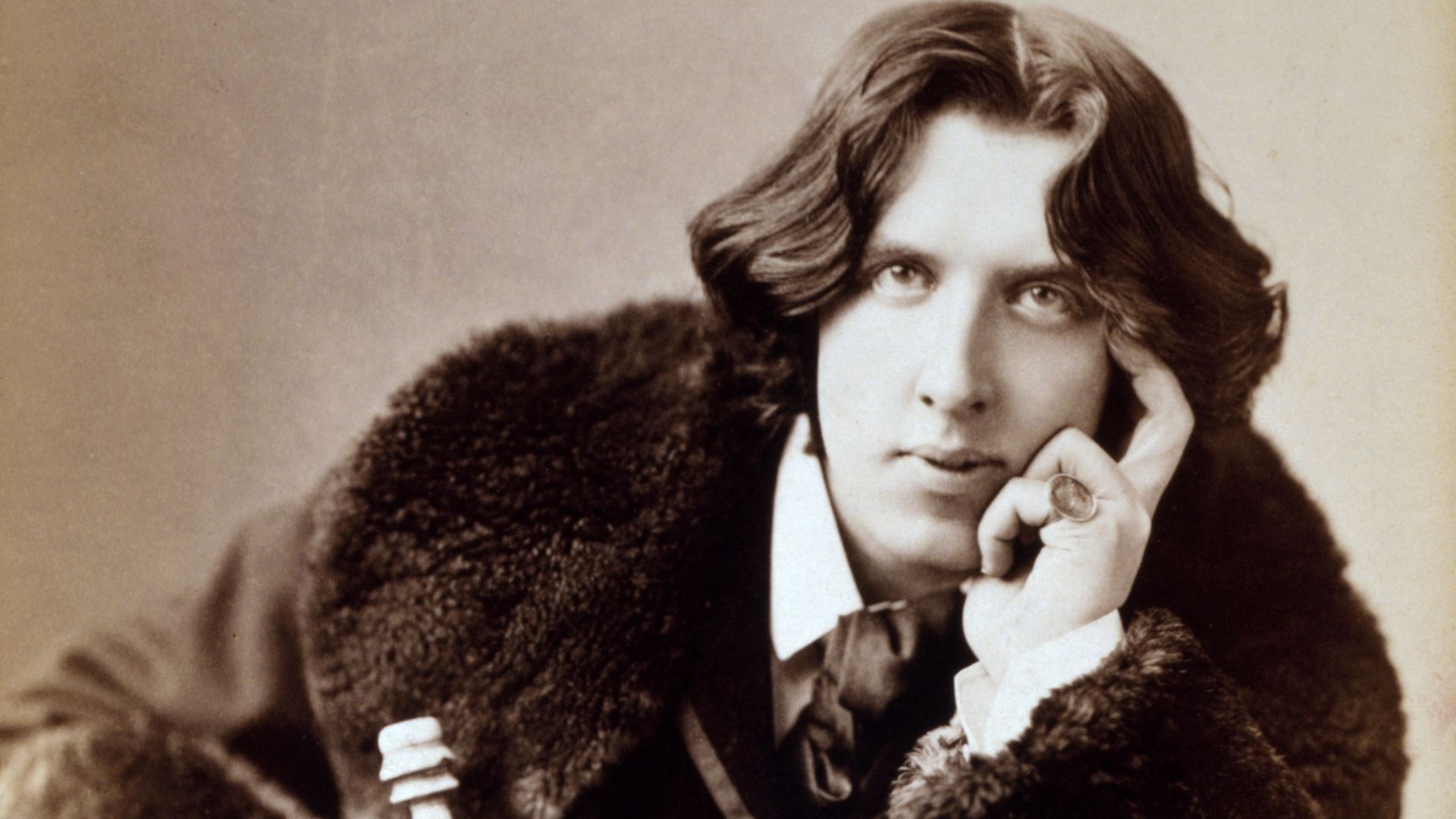

Oscar Wilde Poems
THE wild bee reels from bough to bough
With his furry coat and his gauzy wing.
Now in a lily-cup, and now
Setting a jacinth bell a-swing,
...
Sweet, I blame you not, for mine the fault was, had I not been made of common
clay
I had climbed the higher heights unclimbed yet, seen the fuller air, the
larger day.
...
Two crowned Kings, and One that stood alone
With no green weight of laurels round his head,
But with sad eyes as one uncomforted,
And wearied with man's never-ceasing moan
...
He did not wear his scarlet coat,
For blood and wine are red,
And blood and wine were on his hands
When they found him with the dead,
The poor dead woman whom he loved,
And murdered in her bed.
...
WAS this His coming! I had hoped to see
A scene of wondrous glory, as was told
Of some great God who in a rain of gold
...
OFT have we trod the vales of Castaly
And heard sweet notes of sylvan music blown
From antique reeds to common folk unknown:
...
IS it thy will that I should wax and wane,
Barter my cloth of gold for hodden grey,
And at thy pleasure weave that web of pain
Whose brightest threads are each a wasted day?
...
Out of the mid-wood's twilight
Into the meadow's dawn,
Ivory limbed and brown-eyed,
Flashes my Faun!
...
O well for him who lives at ease
With garnered gold in wide domain,
Nor heeds the splashing of the rain,
...
An omnibus across the bridge
Crawls like a yellow butterfly,
And, here and there a passer-by
Shows like a little restless midge.
...
AS one who poring on a Grecian urn
Scans the fair shapes some Attic hand hath made,
God with slim goddess, goodly man with maid,
And for their beauty's sake is loth to turn
...
THE silver trumpets rang across the Dome:
The people knelt upon the ground with awe:
And borne upon the necks of men I saw,
Like some great God, the Holy Lord of Rome.
...
Beautiful star with the crimson lips
And flagrant daffodil hair,
Come back, come back, in the shaking ships
...
TREAD lightly, she is near
Under the snow,
Speak gently, she can hear
The daisies grow.
...
WITHIN this restless, hurried, modern world
We took our hearts' full pleasure--You and I,
And now the white sails of our ship are furled,
And spent the lading of our argosy.
...
HOW steep the stairs within Kings' houses are
For exile-wearied feet as mine to tread,
And O how salt and bitter is the bread
Which falls from this Hound's table,--better far
...
We caught the tread of dancing feet,
We loitered down the moonlit street,
And stopped beneath the harlot's house.
...
With a Copy of My Poems
I can write no stately proem
As a prelude to my lay;
...
The seasons send their ruin as they go,
For in the spring the narciss shows its head
Nor withers till the rose has flamed to red,
And in the autumn purple violets blow,
...
THE oleander on the wall
Grows crimson in the dawning light,
Though the grey shadows of the night
Lie yet on Florence like a pall.
...
Oscar Wilde Biography
Oscar Fingal O'Flahertie Wills Wilde was born in Dublin, the son of an eye-surgeon and a literary hostess and writer (known under the pseudonym "Speranza"). After studying at Trinity College, Dublin, Wilde went to Magdalen College, Oxford, where he achieved a double first and won the Newdigate prize for a poem Ravenna. While at Oxford he became notorious for his flamboyant wit, talent, charm and aestheticism, and this reputation soon won him a place in London society. Bunthorne, the Fleshly Poet in Gilbert and Sullivan's opera Patience was widely thought to be a caricature of Wilde (though in fact it was intended as a skit of Rosetti) and Wilde seems to have consciously styled himself on this figure. In 1882 Wilde gave a one year lecture tour of America, visiting Paris in 1883 before returning to New York for the opening of his first play Vera. In 1884 he married and had two sons, for whom he probably wrote his first book of fairy tales, The Happy Prince. The next decade was his most prolific and the time when he wrote the plays for which he is best remembered. His writing and particularly his plays are epigramatic and witty and Wilde was not afraid to shock. This period was also haunted by accusations about his personal life, chiefly prompted by the Marquess of Queensberry's fierce opposition to the intense friendship between Wilde and her son, Lord Alfred. These accusations culminated in 1895 in Wilde's imprisonment for homosexual offences. While in prison, Wilde was declared bankrupt, and after his release he lived on the generosity of friends. From prison he wrote a long and bitter letter to Lord Alfred, part of which was afterwards published as De Profundis, but after his release he wrote nothing but the poem The Ballad of Reading Gaol.)
The Best Poem Of Oscar Wilde
Her Voice
THE wild bee reels from bough to bough
With his furry coat and his gauzy wing.
Now in a lily-cup, and now
Setting a jacinth bell a-swing,
In his wandering;
Sit closer love: it was here I trow
I made that vow,
Swore that two lives should be like one
As long as the sea-gull loved the sea,
As long as the sunflower sought the sun,--
It shall be, I said, for eternity
'Twixt you and me!
Dear friend, those times are over and done,
Love's web is spun.
Look upward where the poplar trees
Sway and sway in the summer air,
Here in the valley never a breeze
Scatters the thistledown, but there
Great winds blow fair
From the mighty murmuring mystical seas,
And the wave-lashed leas.
Look upward where the white gull screams,
What does it see that we do not see?
Is that a star? or the lamp that gleams
On some outward voyaging argosy,--
Ah! can it be
We have lived our lives in a land of dreams!
How sad it seems.
Sweet, there is nothing left to say
But this, that love is never lost,
Keen winter stabs the breasts of May
Whose crimson roses burst his frost,
Ships tempest-tossed
Will find a harbour in some bay,
And so we may.
And there is nothing left to do
But to kiss once again, and part,
Nay, there is nothing we should rue,
I have my beauty,--you your Art,
Nay, do not start,
One world was not enough for two
Like me and you.
Oscar Wilde Comments
He was a literary genius. I enjoy his poetry immensely. Conspirative Nature stole his life prematurely.
Every person has some genius-ness in his cells... brain...hands or body... Needs the chance to appear Needs the luck... You have...I have As small as it can be Even very small It is still geniusty...!
His imagery and diction, everything is so extravagant and incredible. He will always remain as one of my favorites.
◄ STAY AT HOME & WORK AT HOME FOR YOUR COUNTRY ►Check it out, and start earning yourself. for more info visit any tab this site Thanks a lot Here……………COPY THIS LINK………….self21★★★
He suffered a lot in jail, merely because of his sexual orientation. Today that is not a crime. I think the Wilde wrote carefully-structured stanzas, which are musical and memorable.
Oscar Wilde Quotes
There's nothing in the world like the devotion of a married woman. It's a thing no married man knows anything about.
As a wicked man I am a complete failure. Why, there are lots of people who say I have never really done anything wrong in the whole course of my life. Of course they only say it behind my back.
Who is that man over there? I don't know him. What is he doing? Is he a conspirator? Have you searched him? Give him till tomorrow to confess, then hang him!—hang him!
Gossip is charming! History is merely gossip. But scandal is gossip made tedious by morality.
If you pretend to be good, the world takes you very seriously. If you pretend to be bad, it doesn't. Such is the astounding stupidity of optimism.
They are horribly tedious when they are good husbands, and abominably conceited when they are not.
She is absolutely inadmissible into society. Many a woman has a past, but I am told that she has at least a dozen, and that they all fit.
My experience is that as soon as people are old enough to know better, they don't know anything at all.
It is only the superficial qualities that last. Man's deeper nature is soon found out.
A kiss may ruin a human life.
All women become like their mothers. That is their tragedy. No man does. That's his.
I adore political parties. They are the only place left to us where people don't talk politics.
Women are never disarmed by compliments. Men always are. That is the difference between the two sexes.
Mr. Whistler always spelt art, and we believe still spells it, with a capital "I."
A man's very highest moment is, I have no doubt at all, when he kneels in the dust, and beats his breast, and tells all the sins of his life.
I always pass on good advice. It is the only thing to do with it. It is never of any use to oneself.
Only dull people are brilliant at breakfast.
No artist has ethical sympathies. An ethical sympathy in an artist is an unpardonable mannerism of style.
What is said of a man is nothing. The point is, who says it.
Nothing makes one so vain as being told that one is a sinner.
Only mediocrities progress. An artist revolves in a cycle of masterpieces, the first of which is no less perfect than the last.
He had that curious love of green, which in individuals is always the sign of a subtle artistic temperament, and in nations is said to denote a laxity, if not a decadence of morals.
Cultivated leisure is the aim of man.
Society often forgives the criminal; it never forgives the dreamer.
A cigarette is the perfect type of a perfect pleasure. It is exquisite, and it leaves one unsatisfied. What more can one want?
I was disappointed in Niagara—most people must be disappointed in Niagara. Every American bride is taken there, and the sight of the stupendous waterfall must be one of the earliest, if not the keenest, disappointments in American married life.
His work was that curious mixture of bad painting and good intentions that always entitles a man to be called a representative British artist.
There is no necessity to separate the monarch from the mob; all authority is equally bad.
The condition of perfection is idleness: the aim of perfection is youth.
The basis of optimism is sheer terror.
I can't help detesting my relations. I suppose it comes from the fact that none of us can stand other people having the same faults as ourselves.
Formerly we used to canonise our heroes. The modern method is to vulgarise them. Cheap editions of great books may be delightful, but cheap editions of great men are absolutely detestable.
The advantage of the emotions is that they lead us astray.
When liberty comes with hands dabbled in blood it is hard to shake hands with her.
Twenty years of romance makes a woman look like a ruin; but twenty years of marriage makes her look like a public building.
Most of our modern portrait painters are doomed to absolute oblivion. They never paint what they see. They paint what the public sees, and the public never sees anything.
It is only the modern that ever becomes old-fashioned.
The critic has to educate the public; the artist has to educate the critic.
Never speak disrespectfully of Society, Algernon. Only people who can't get into it do that.
A man who can dominate a London dinner table can dominate the world. The future belongs to the dandy. It is the exquisites who are going to rule.
Though one can dine in New York, one could not dwell there.
I dislike arguments of any kind. They are always vulgar, and often convincing.
The Americans are certainly hero-worshippers, and always take their heroes from the criminal classes.
Children begin by loving their parents. After a time they judge them. Rarely, if ever, do they forgive them.
On the whole, the great success of marriage in the States is due partly to the fact that no American man is ever idle, and partly to the fact that no American wife is considered responsible for the quality of her husband's dinners.
The amount of women in London who flirt with their own husbands is perfectly scandalous. It looks so bad. It is simply washing one's clean linen in public.
There is nothing so difficult to marry as a large nose.
One knows so well the popular idea of health. The English country gentleman galloping after a fox—the unspeakable in full pursuit of the uneatable.
The liar at any rate recognizes that recreation, not instruction, is the aim of conversation, and is a far more civilised being than the blockhead who loudly expresses his disbelief in a story which is told simply for the amusement of the company.
You should study the Peerage, Gerald. It is the one book a young man about town should know thoroughly, and it is the best thing in fiction the English have ever done.




Delivering Poems Around The World
Poems are the property of their respective owners. All information has been reproduced here for educational and informational purposes to benefit site visitors, and is provided at no charge...
4/6/2026 11:46:21 PM # 1.0.0



Wilde cryptic word spinning to somewhere in nowhere. He was no genius, a bewildered poet who thought he was a genius. Did the poem liberate him or anyone from its cage of flowery words bespeckled with Greek gods and goddesses? I tend to doubt it. A love for his own intellect, displayful of a pruriant pride in pining.