
Sir Thomas Wyatt
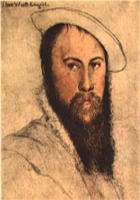

Sir Thomas Wyatt Poems
Is it possible
That so high debate,
So sharp, so sore, and of such rate,
Should end so soon and was begun so late?
Is it possible?
...
Farewell love and all thy laws forever;
Thy baited hooks shall tangle me no more.
Senec and Plato call me from thy lore
To perfect wealth, my wit for to endeavour.
...
My lute awake! perform the last
Labour that thou and I shall waste,
And end that I have now begun;
For when this song is sung and past,
My lute be still, for I have done.
...
I find no peace, and all my war is done.
I fear and hope. I burn and freeze like ice.
I fly above the wind, yet can I not arise;
And nought I have, and all the world I season.
...
And wilt thou leave me thus?
Say nay, say nay, for shame,
To save thee from the blame
Of all my grief and grame;
...
Farewell, Love, and all thy laws for ever:
Thy baited hooks shall tangle me no more.
Senec and Plato call me from thy lore,
To perfect wealth my wit for to endeavour.
...
They flee from me that sometime did me seek
With naked foot, stalking in my chamber.
I have seen them gentle, tame, and meek,
...
Lux, my fair falcon, and your fellows all,
How well pleasant it were your liberty.
Ye not forsake me that fair might ye befall,
But they that sometime liked my company,
...
WHAT should I say?
--Since Faith is dead,
And Truth away
From you is fled?
...
My galley, chargèd with forgetfulness,
Thorough sharp seas in winter nights doth pass
'Tween rock and rock; and eke mine en'my, alas,
That is my lord, steereth with cruelness;
...
FORGET not yet the tried intent
Of such a truth as I have meant;
My great travail so gladly spent,
Forget not yet!
...
My galley chargèd with forgetfulness
Through sharp seas in winter nights doth pass
'Twene rock and rock; and eke mine enemy, alas,
That is my lord, steereth with cruelness.
...
I abide and abide and better abide,
And after the old proverb, the happy day;
And ever my lady to me doth say,
"Let me alone and I will provide."
...
Tagus, farewell! that westward with thy streams
Turns up the grains of gold already tried
With spur and sail, for I go to seek the Thames
Gainward the sun that shewth her wealthy pride,
...
Madam, withouten many words
Once I am sure ye will or no ...
And if ye will, then leave your bourds
And use your wit and show it so,
...
Forget not yet the tried intent
Of such a truth as I have meant;
My great travail so gladly spent,
Forget not yet.
...
Madame, withouten many words,
Once, I am sure, ye will, or no:
And if ye will, then leave your bourds,
And use your wit, and show it so,
...
I abide and abide and better abide,
And after the old proverb, the happy day;
And ever my lady to me doth say,
'Let me alone and I will provide.'
...
Mine own John Poynz, since ye delight to know
The cause why that homeward I me draw,
And flee the press of courts, whereso they go,
Rather than to live thrall under the awe
...
My labor that thou and I shall waste
And end that I have now begun,
For when this song is sung and past,
My lute, be still, for I have done.
...
Sir Thomas Wyatt Biography
Thomas Wyatt was born at Allington Castle in Kent, and educated at St John's College, Cambridge. While travelling as a diplomat for Henry VIII he developed his interest in Continental poetry; he was the first English poet to use the Italian forms of the sonnet and terza rima, and the French rondeau. His translation of the Penitential Psalms is based on a version by the Italian poet Pietro Aretino. In the course of his career Wyatt served his King Henry in a variety of offices, including those of Marshal of Calais, Sheriff of Kent and Ambassador to Spain, and he was also jailed several times. His first imprisonment, in 1534, was for brawling; two years later his relationship with the disgraced Anne Boleyn resulted in a short spell in the Tower of London. Thomas and Anne had been lovers before her marriage to Henry, and his sense of loss at their separation forms the subject of the famous sonnet 'Whoso List To Hunt'. Wyatt was restored to favour and knighted in 1537, and spent the next two years on his embassy to the court of Charles V of Spain. In 1540 however, his trusted patron Thomas Cromwell was executed, leaving him without an ally at court. The following year Wyatt was accused of treason by his enemies and imprisoned in the Tower once more. He managed to secure his own release but died of a fever soon afterwards.
The Best Poem Of Sir Thomas Wyatt
Is It Possible
Is it possible
That so high debate,
So sharp, so sore, and of such rate,
Should end so soon and was begun so late?
Is it possible?
Is it possible
So cruel intent,
So hasty heat and so soon spent,
From love to hate, and thence for to relent?
Is it possible?
Is it possible
That any may find
Within one heart so diverse mind,
To change or turn as weather and wind?
Is it possible?
Is it possible
To spy it in an eye
That turns as oft as chance on die,
The truth whereof can any try?
Is it possible?
It is possible
For to turn so oft,
To bring that lowest which was most aloft,
And to fall highest yet to light soft:
It is possible.
All is possible
Whoso list believe.
Trust therefore first, and after preve,
As men wed ladies by licence and leave.
All is possible.
Sir Thomas Wyatt Comments
sometimes the man is the creator of god's goodness and this man - he was one of them who carried in the writing style of sonnet into the English literary world. Hats off to this man.
Often overshadowed by the larger then life light of William Shakespeare, Wyatt truly lives up to his nickname as the father of the English sonnet!
what a great poet with creative poems. Alas bad time flies but good times crawls




Delivering Poems Around The World
Poems are the property of their respective owners. All information has been reproduced here for educational and informational purposes to benefit site visitors, and is provided at no charge...
10/28/2026 8:26:21 AM # rel_20261026T125300Z_a7741e1



Graven With Diamonds is a very well researched book on the life of Sir Thomas Wyatt. I have read it twice. A fascinating character.