PoemHunter.com   
Ariel by Sylvia Plath   
Search:     
Home Poets Poems Lyrics Quotations Music Forum Member Area Poetry E-Books
 
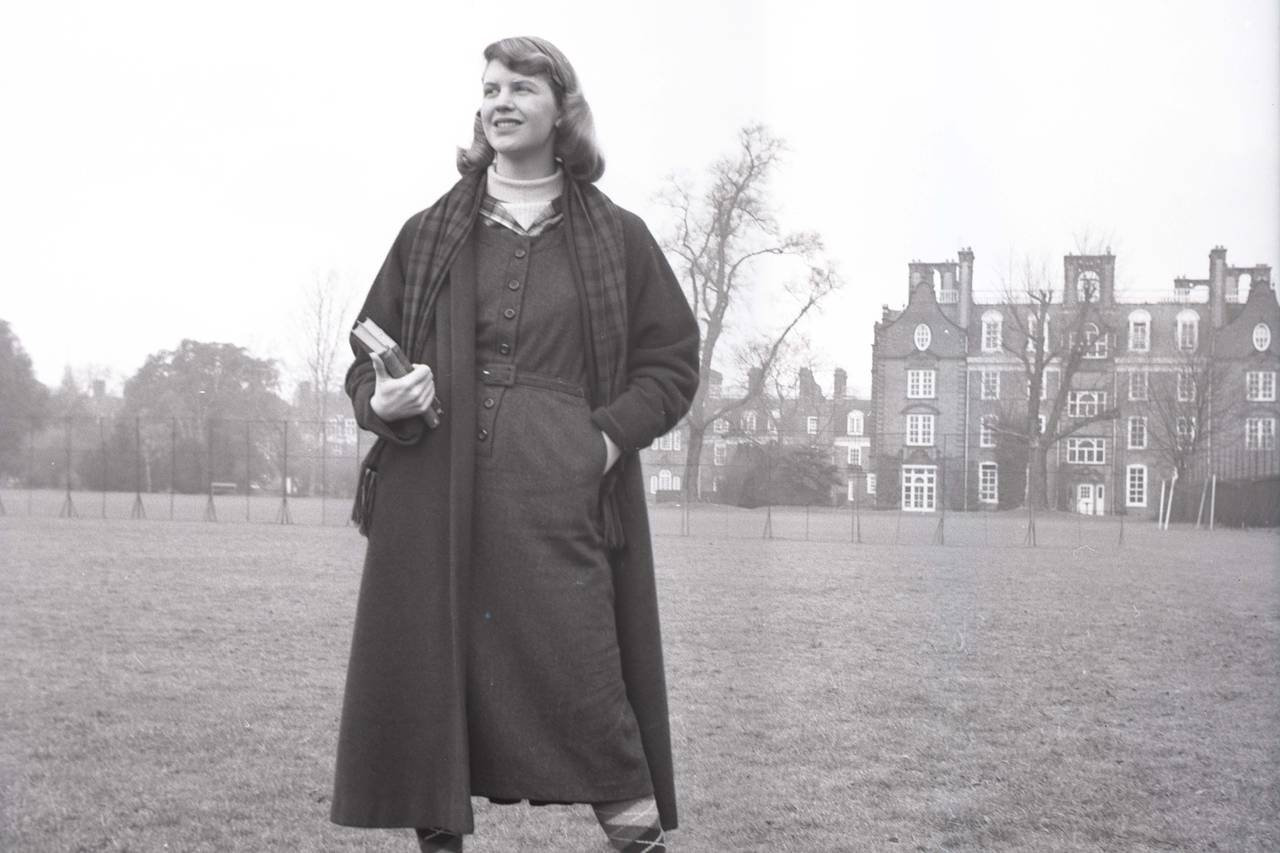
Sylvia Plath
Sylvia Plath (1932 - 1963 / Boston / United States)
Biography   Poems   Quotations   Comments   More Info   Stats  
Born in 1932 to middle class parents in Jamaica Plain, Massachusetts, Sylvia Plath published her first poem at the age of eight. A sensitive person wh .. more >>

File Size:0 k 
File Format: Acrobat Reader
To download the eBook right-Click on the title and select "Save Target As".
 
<< prev. poem Poems by Sylvia Plath : 9 / 121 next poem >>
  
 
Share |

 
Ariel

User Rating:

7.6 /10
(48 votes)


[ The text of this poem could not be published because of Copyright laws. ]


Sylvia Plath


Share |


Read poems about / on: sister, child, hair, red, dark, god, children

 
  Comments about this poem (Ariel by Sylvia Plath )
Click here to write your comments about this poem (Ariel by Sylvia Plath )
 
  Timothy Charles  (6/3/2009 9:05:00 PM)

This poem has stuck with me for 15 after first reading it in high school.

Here's what I think it means literally, but it's my guess only. I also don't know the more symbolic meaning.

Stasis in darkness.
[she's in the stable, it's quiet, still, before sunrise]
Then the substanceless blue
[they are out of the barn, already galloping, the morning is dark blue]
Pour of tor and distances.
[play on torpor - she senseless with the speed of it, and the darkness of morning. she's pouring out into the

night-about-to-be-day]

God's lioness,
[her horse? ]
How one we grow,
[rider and mount move together as one being]
Pivot of heels and knees! - The furrow
[she's riding bareback - her heels and knees lock onto her horse to control it/hold on to it]

Splits and passes, sister to
The brown arc
Of the neck I cannot catch,
[the furrows are arched like the neck of her horse. she can't catch it's because she is riding it so she's always

behind it.]

Nigger-eye
Berries cast dark
Hooks -
[they are riding through berry bushes - thorns]

Black sweet blood mouthfuls,
[black raspberries - when you eat them their juice is like blood in your mouth]
Shadows.
[hmmm? ]
Something else

Hauls me through air -
[not her horse apparently, though her horse is hauling her through air]
Thighs, hair;
[is this her thighs and hair or her horse's? presumably her's given the Godiva reference below -riding naked]
Flakes from my heels.
[literary allusion? no idea]

White
Godiva, I unpeel -
Dead hands, dead stringencies.
[like Godiva, who broke the stringencies of her time by riding naked through the streets. what here is she breaking

free from? or just the exuberance and sense of freedom of riding fast, perhaps naked, on her horse into the sunrise,

through the countryside, feels like peeling away dead hands/constraints]

And now I
Foam to wheat, a glitter of seas.
[wheat is like the waves of the ocean when it blows in the wind. the grain at the top of the stalk is like sea foam.

perhaps she feels in the same rhythm as the blowing grain.]
The child's cry

Melts in the wall.
[no idea on this part! ]
And I
Am the arrow,
[on her horse, fast, like an arrow]

The dew that flies,
Suicidal, at one with the drive
[dew dies when the sun rises. she is at one with the drive into sunrise, her horse. they are galloping into the

sunrise]
Into the red

Eye, the cauldron of morning.
[sunrise]
  Curer Stretham  (3/26/2009 1:15:00 PM)

I find this poem particularily entralling. The ambiguity to the title 'Ariel' is extremely interesting- is it the name of her horse and therefore symbolic of freedom and feminine power and escape? Or in reference to the caged Shakesperian spirit? Both completely opposing views, however Shakespeare's Ariel is finally released to live its own life without the chains its master Prospero had imposed. Is Plath refering to her final release from under male rule of her husband or perhaps life in general?
  Nathaniel Ballesteros  (2/26/2009 7:57:00 PM)

My girlfriend is the best poet ever.
  Ian Fraser  (2/6/2009 5:46:00 PM)

Ariel was the imprisoned spirit in Shakespeare's play, The Tempest. Condemned to serve an unbending and demanding master (her husband?) , he (it) could only be released once the latter's life's work was complete. Clearly this was a key image for Plath, who throughout her life experienced feelings of imprisonment, suffocation and the inability to release herself from the everyday demands of life.
The poem begins with the illusion of release, 'the substancelss blue/ pour of of tor and distances' (a tor is a hill) , but immediately the focus is jerked inward to the body of her partner, lying beside her, 'pivots of heels and knees'. Despite the closeness of the body she feels that there is something about it that she cannot grasp, 'The brown arc of the neck that I cannot catch'. Intimacy rapidly turns to something ugly and unpleasant 'Nigger-eye/ Berries cast dark/ Hooks.' Despite this she cannot prevent herself gaining pleasure from the experience, 'White Godiva/ I unpeel', 'I foam to wheat' and this experience returns her briefly to the illusion of freedom felt at the begnning of the poem, ' a glitter of seas'. She can even briefly forget the cry of her child which 'Melts in the wall'. But ultimately the experience can only be destructive and she becomes 'the dew that flies/ Suicidal at one with the desire/ Into the red/ Eye, the cauldron of the morning.'

Plath's poetry is deceptively simple. It uses simple language and simple, even primitive, forms but fragments them into unusual and sometimes painful combinations often using surprising and occasionally brutal imagery. It has a gut honesty that demands respect, however, and she is perhaps the best of the late 20th century poets.
  Ane Saldana  (8/13/2008 7:15:00 AM)

It is difficult to forget what I have read about Sylvia Plaths suicide when I read this poem. Her head stuck in the gas oven, the cry of her two children trough the wall.

This was written some time before, a year?
  Mary C  (3/13/2008 9:48:00 PM)

It seems as if she's almost having a nightmare of sorts. I think it's very foreboding...
  Deborah Conner  (1/29/2008 1:38:00 PM)

The key to plath's poem is The Tempest.... her personal setting is the loss of her father.

William Shakespeare (1564-1616)

from The Tempest

Ariel's Song

Come unto these yellow sands,
And then take hands:
Curtsied when you have, and kiss'd
The wild waves whist,
Foot it featly here and there;
And, sweet sprites, the burthen bear.
Hark, hark!
Bow-wow.
The watch-dogs bark.
Bow-wow.
Hark, hark! I hear
The strain of strutting chanticleer
Cry, Cock-a-diddle-dow.

Full fathom five thy father lies;
Of his bones are coral made;
Those are pearls that were his eyes:
Nothing of him that doth fade,
But doth suffer a sea-change
Into something rich and strange.
Sea-nymphs hourly ring his knell:
Ding-dong.
Hark! now I hear them—Ding-dong, bell.
  Dh Vidusi  (11/5/2007 8:49:00 AM)

I'm told this is about her horse, do we need to know a poets biography before wecan recognise what on earth they are on about? I found it too obtuse.
  David Gerardino  (4/21/2007 7:30:00 PM)

much darkness in her life....

Read all 9 comments >>
 
  People who read Sylvia Plath


  More classic poets:

      The complete list >>

 
  Top 500 Poems

  1. Phenomenal Woman by Maya Angelou
  2. Still I Rise by Maya Angelou
  3. If You Forget Me by Pablo Neruda
  4. Where the Sidewalk Ends by Shel Silverstein
  5. Dreams by Langston Hughes
  6. i carry your heart with me by ee cummings
  7. I Do Not Love You Except Because I Love You by Pablo Neruda
  8. Annabel Lee by Edgar Allan Poe
  9. The Road Not Taken by Robert Frost
  10. I Crave Your Mouth, Your Voice, Your Hair by Pablo Neruda
  11. Television by Roald Dahl
  12. One Inch Tall by Shel Silverstein
  13. Warning by Jenny Joseph
  14. As I Grew Older by Langston Hughes
  15. A Dream Within A Dream by Edgar Allan Poe
  16. Fire and Ice by Robert Frost
  17. If by Rudyard Kipling
  18. On the Ning Nang Nong by Spike Milligan
  19. Dream Deferred by Langston Hughes
  20. "I Wandered Lonely as a Cloud" by William Wordsworth
  21. Alone by Edgar Allan Poe
  22. Stopping by Woods on a Snowy Evening by Robert Frost
  23. The Highwayman by Alfred Noyes
  24. Do Not Go Gentle Into That Good Night by Dylan Thomas
  25. All That is Gold Does Not Glitter by JRR Tolkien
The complete list of Top 500 Poems >>
  Top 500 Poets

  1. Pablo Neruda
  2. Langston Hughes
  3. Maya Angelou
  4. Charles Bukowski
  5. ee cummings
  6. Shel Silverstein
  7. William Shakespeare
  8. Dylan Thomas
  9. Spike Milligan
  10. Billy Collins
  11. Emily Dickinson
  12. Khalil Gibran
  13. Sylvia Plath
  14. Dorothy Parker
  15. Elizabeth Bishop
  16. Ted Hughes
  17. Roald Dahl
  18. Robert Frost
  19. Walt Whitman
  20. Allen Ginsberg
  21. William Blake
  22. Edgar Allan Poe
  23. Mary Oliver
  24. Robert Browning
  25. William Wordsworth
The complete list of Top 500 Poets >>


 Search in the World Poetry Database => 

 Search:    tips
Hide the search box!
 
 
  E-MAIL THIS PAGE TO A FRIEND
Found this page interesting? Recommend it to your friend!     Your E-mail:    Friend's Email:      
 

(c) Poems are the property of their respective owners. All information has been reproduced here for educational and informational purposes to benefit site visitors, and is provided at no charge..  About Us | Copyright notice | Privacy statement | Help
11/21/2009 6:36:45 AM. #.26# You Are Here: Ariel by Sylvia Plath

Home | Poets | Poems | Free Poetry eBooks | Contests | Sites | Submit a Poem | Manage Your Poems | GameGar | Contact Us

Christmas Poems | Love Poems | Pablo Neruda | Death Poems | Sad Poems | Birthday Poems | Wedding Poems | Annabel Lee | Sorry Poems