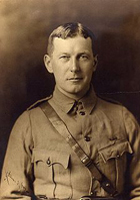
John McCrae (30 November 1872 – 28 January 1918 / Guelph, Ontario)
|
||||||||||||||||||||||||||||||||||||||||||||||||||||||||||||
In Flanders Field
In Flanders fields the poppies blow
Between the crosses, row on row,
That mark our place; and in the sky
The larks, still bravely singing, fly
Scarce heard amid the guns below.
We are the Dead. Short days ago
We lived, felt dawn, saw sunset glow,
Loved and were loved, and now we lie,
In Flanders fields.
Take up our quarrel with the foe:
To you from failing hands we throw
The torch; be yours to hold it high.
If ye break faith with us who die
We shall not sleep, though poppies grow
In Flanders fields.
Read poems about / on: sunset, faith, sleep, sky
PoemHunter.com Updates
-
World Day for Cultural Diversity for Dialogue and Development
celebrated on May 21st every year
-
Your Favorite Poets’ Favorite Books of Poetry
-
Daily Rituals of Famous Authors
Writers seem to be the most prone to unshakeable routines and elaborate superstitions.
-
Incredible Reading Rooms Around the World
Cozy, beautiful places to curl up with a good book...
Top 500 Poems
-
Phenomenal Woman
Maya Angelou
-
The Road Not Taken
Robert Frost
-
Still I Rise
Maya Angelou
-
If You Forget Me
Pablo Neruda
-
Dreams
Langston Hughes
-
Annabel Lee
Edgar Allan Poe
-
If
Rudyard Kipling
-
A Dream Within A Dream
Edgar Allan Poe
-
Stopping by Woods on a Snowy Evening
Robert Frost
-
I Know Why The Caged Bird Sings
Maya Angelou

McCrae, a surgeon on the Western Front, wrote this in 1915 when the terrible slaughter was already taking place, and yet in the third stanza he tells us he wants it to continue. Instead of advocating peace and an end to the senseless waste of lives, the dead are telling those who take their place to continue the carnage. How did a poem expressing such insane sentiments achieve the stature that it enjoys today. In the words of the doctor at the end of Bridge on the River Kwai, Madness!
Someone just does not get it! First of all the British did not start that war, but by jove we ended it, what would you rather we did? give up to the enemy? your stark staring bonkers...and btw we did not use mustard gas unlike the enemy ! ! ! We will never break faith with all our brave Soldiers. John McCrae got it right, spot on!
I like this poem because john had used alot of discribing words in the poem
I am sure Englishness is not a word! This poem is very true, John McCrae wrote this after his best friend Alexis Helmer was killed in World War One.
I don't believe In Flanders Fields is a pro-war poem; nor is it anti-war, it acknowledges the reality of war as a part of the human condition.
Flanders’ Poppies and Armenian Genocide
People remember their wars,
Never feel with others.
Armenian Genocide was not a war
But a real raping slaying with scimitars.
Not recognized, yet by the English race
Only by Welsh and Scots.
So tell me was the Flanders poem
True or False!
If you’re English,
Don't protect your Englishness,
But the fairness!
Scars can’t be forgotten
Remains scars transmitted as genes
From ancestry to ancestries...
Accumulates to be seen as hill
Like the Armenian skeletons’ hillside
In the Syrian desert-Der Zor
After nearly a century
Remains… Lightening phosphorus.
My dears,
If you like to feel like a real human
You can see all in the Internet.
Reminded me of the battle of Gettysburg.50,000 more or less killed in three days of fighting. Same as about in Viet Nam through years.. Some wars have a cause, which men fight. GOD, destroyed the Egyptian army in the Red Sea. Good to have GOD on your side in war.
This is a stirring pro-war poem. It urges the living to remember the dead and what they died for and to continue the fight. The majority of British soldiers thought the war was a just one. I have a small complaint: given the number of guns firing, it is unlikely that larks would have been flying over the battlefield, and even less likely that they would have been even 'scarce heard'.
“In Flanders Field” by John McCrae remains one of the most moving and easily remembered WWI poems ever written. The poppies at many ceremonies and at other graveside cemeteries have touched the hearts of millions. Poppies are the official symbolic emblem, used for the ‘Least We Forget’ theme for remembrance services among ANZAC Day parades and for similar purposes by other western armies. Lines like ‘We are the Dead. Short days ago/ We lived, felt dawn, saw sunset glow, ’ are beautifully penned.
After seventeen days treating injured men in the Ypres salient, surgeon Major McCrae, was particularly affected by the death of a ‘young friend and former student, Lieut. Alexis Helmer’. Helmer was ‘buried later that day in the little cemetery outside McCrae's dressing station, and McCrae had performed the funeral ceremony in the absence of the chaplain.’ McCrae scribbled fifteen lines of verse in a notebook the next day, describing the scene at Helmer's grave.
‘Dissatisfied with it, McCrae tossed the poem away, but a fellow officer retrieved it and sent it to newspapers in England. The Spectator, in London, rejected it, but Punch published it on 8 December 1915.’ The poems survival has helped to inspire and teach generations the meaning of sacrifice and the importance of remembrance.
Cause of the war though not known this poem inspires the continuation of war through the words of the dead soldiers! If cause is mentioned it would have been great to support this poetic output!