
Walt Whitman
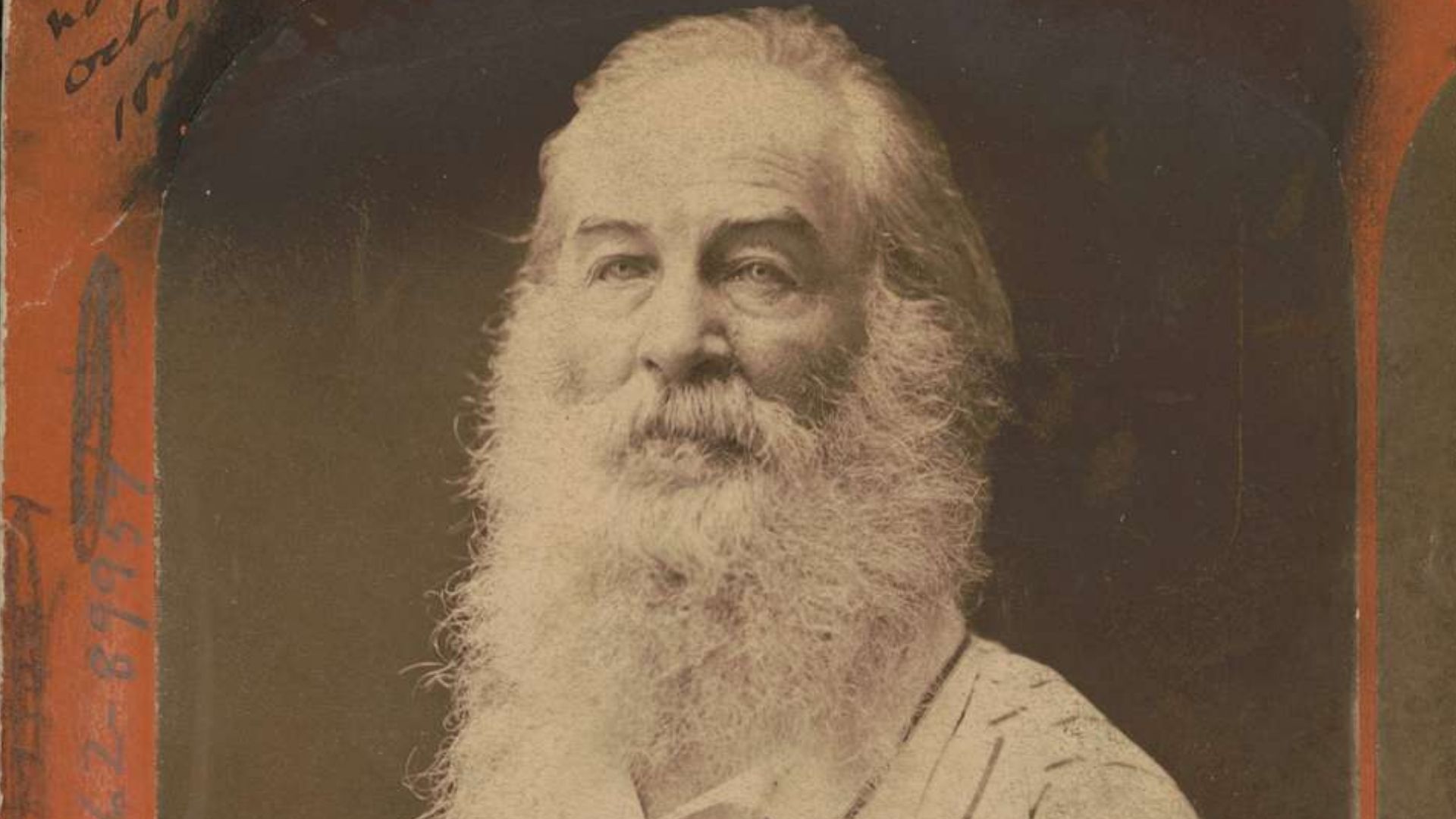

Walt Whitman Poems
O CAPTAIN! my Captain! our fearful trip is done;
The ship has weather'd every rack, the prize we sought is won;
The port is near, the bells I hear, the people all exulting,
...
THIS is thy hour O Soul, thy free flight into the wordless,
Away from books, away from art, the day erased, the lesson done,
Thee fully forth emerging, silent, gazing, pondering the themes thou
lovest best.
...
A child said, What is the grass? fetching it to me with full
hands;
How could I answer the child?. . . .I do not know what it
is any more than he.
...
A noiseless, patient spider,
I mark’d, where, on a little promontory, it stood, isolated;
Mark’d how, to explore the vacant, vast surrounding,
It launch’d forth filament, filament, filament, out of itself;
...
A woman waits for me- she contains all, nothing is lacking,
Yet all were lacking, if sex were lacking, or if the moisture of the
right man were lacking.
...
A GLIMPSE, through an interstice caught,
Of a crowd of workmen and drivers in a bar-room, around the stove,
late of a winter night--And I unremark'd seated in a corner;
...
SILENT and amazed, even when a little boy,
I remember I heard the preacher every Sunday put God in his
statements,
...
ARM’D year! year of the struggle!
No dainty rhymes or sentimental love verses for you, terrible year!
Not you as some pale poetling, seated at a desk, lisping cadenzas
piano;
...
Come, I will make the continent indissoluble;
I will make the most splendid race the sun ever yet shone upon;
I will make divine magnetic lands,
...
HOLD it up sternly! See this it sends back! (Who is it? Is it you?)
Outside fair costume--within ashes and filth,
No more a flashing eye--no more a sonorous voice or springy step;
...
O ME, man of slack faith so long!
Standing aloof--denying portions so long;
Only aware to-day of compact, all-diffused truth;
...
O ME! O life!... of the questions of these recurring;
Of the endless trains of the faithless--of cities fill'd with the
foolish;
...
I Hear America singing, the varied carols I hear;
Those of mechanics- each one singing his, as it should be, blithe and strong;
...
THAT which eludes this verse and any verse,
Unheard by sharpest ear, unform'd in clearest eye or cunningest mind,
Nor lore nor fame, nor happiness nor wealth,
And yet the pulse of every heart and life throughout the world
...
I Celebrate myself, and sing myself,
And what I assume you shall assume,
For every atom belonging to me as good belongs to you.
...
A march in the ranks hard-prest, and the road unknown;
A route through a heavy wood, with muffled steps in the darkness;
Our army foil'd with loss severe, and the sullen remnant retreating;
...
A SONG of the good green grass!
A song no more of the city streets;
A song of farms--a song of the soil of fields.
...
TO get betimes in Boston town, I rose this morning early;
Here's a good place at the corner--I must stand and see the show.
...
Walt Whitman Biography
Walt Whitman was an American poet, essayist, and journalist, born on May 31, 1819, in West Hills, Long Island, New York. He is best known for his collection of poems entitled "Leaves of Grass," which is considered a groundbreaking work of American literature. Whitman grew up in a family of modest means and received little formal education. He began his career as a printer's apprentice and later worked as a teacher, journalist, and editor for various newspapers in New York and Brooklyn. In 1855, Whitman self-published the first edition of "Leaves of Grass," which included twelve poems. The book was notable for its free verse style, which eschewed traditional rhyme and meter, and its celebration of the beauty and dignity of everyday life. Whitman continued to revise and expand the book throughout his life, ultimately producing several different editions that included hundreds of poems. Whitman's work was controversial in its time, both for its unconventional style and for its frank treatment of sexuality and other taboo topics. However, it also attracted a loyal following, and many critics now consider Whitman to be one of the greatest poets in the English language. In addition to his poetry, Whitman was also known for his journalism and essays, which dealt with a wide range of social and political issues, including slavery, democracy, and the nature of American identity. He was a passionate advocate for the abolition of slavery and was active in the Civil War, working as a nurse and visiting soldiers in hospitals. Whitman's health began to decline in the 1870s, and he suffered a stroke in 1888 that left him partially paralyzed. He continued to write and publish until his death on March 26, 1892, at the age of 72. Today, Whitman is widely regarded as one of the most important figures in American literature. His work continues to inspire and challenge readers with its celebration of democracy, diversity, and the beauty of the natural world.
What was Walt Whitman’s early life and career?
The following summer Whitman worked for another printer, Erastus Worthington, in Brooklyn. His family moved back to West Hills in the spring, but Whitman remained and took a job at the shop of Alden Spooner, editor of the leading Whig weekly newspaper the Long-Island Star. While at the Star, Whitman became a regular patron of the local library, joined a town debating society, began attending theater performances, and anonymously published some of his earliest poetry in the New York Mirror. At age 16 in May 1835, Whitman left the Star and Brooklyn. He moved to New York City to work as a compositor though, in later years, Whitman could not remember where. He attempted to find further work but had difficulty in part due to a severe fire in the printing and publishing district and in part due to a general collapse in the economy leading up to the Panic of 1837. In May 1836, he rejoined his family, now living in Hempstead, Long Island. Whitman taught intermittently at various schools until the spring of 1838, though he was not satisfied as a teacher. After his teaching attempts, Whitman went back to Huntington, New York to found his own newspaper, the Long Islander. Whitman served as publisher, editor, pressman, and distributor and even provided home delivery. After ten months, he sold the publication to E. O. Crowell, whose first issue appeared on July 12, 1839. No copies of the Long-Islander published under Whitman survive. By the summer of 1839, he found a job as a typesetter in Jamaica, Queens with the Long Island Democrat, edited by James J. Brenton. He left shortly thereafter, and made another attempt at teaching from the winter of 1840 to the spring of 1841. One story, possibly apocryphal, tells of Whitman being chased away from a teaching job in Southold, New York in 1840. After a local preacher called him a "Sodomite", Whitman was allegedly tarred and feathered. Biographer Justin Kaplan notes that the story is likely untrue because Whitman regularly vacationed in the town thereafter. Biographer Jerome Loving calls the incident a "myth". During this time, Whitman published a series of ten editorials called "Sun-Down Papers—From the Desk of a Schoolmaster" in three newspapers between the winter of 1840 and July 1841. In these essays, he adopted a constructed persona, a technique he would employ throughout his career. Whitman moved to New York City in May, initially working a low-level job at the New World, working under Park Benjamin, Sr. and Rufus Wilmot Griswold. He continued working for short periods of time for various newspapers; in 1842 he was editor of the Aurora and from 1846 to 1848 he was editor of the Brooklyn Eagle. He also contributed freelance fiction and poetry throughout the 1840s. Whitman lost his position at the Brooklyn Eagle in 1848 after siding with the free-soil "Barnburner" wing of the Democratic party against the newspaper's owner, Isaac Van Anden, who belonged to the conservative, or "Hunker", wing of the party. Whitman was a delegate to the 1848 founding convention of the Free Soil Party. Leaves of Grass Whitman claimed that after years of competing for "the usual rewards", he determined to become a poet. He first experimented with a variety of popular literary genres which appealed to the cultural tastes of the period. As early as 1850, he began writing what would become Leaves of Grass, a collection of poetry which he would continue editing and revising until his death. Whitman intended to write a distinctly American epic and used free verse with a cadence based on the Bible. At the end of June 1855, Whitman surprised his brothers with the already-printed first edition of Leaves of Grass. George "didn't think it worth reading". Whitman paid for the publication of the first edition of Leaves of Grass himself and had it printed at a local print shop during their breaks from commercial jobs. A total of 795 copies were printed. No name is given as author; instead, facing the title page was an engraved portrait done by Samuel Hollyer, but 500 lines into the body of the text he calls himself "Walt Whitman, an American, one of the roughs, a kosmos, disorderly, fleshly, and sensual, no sentimentalist, no stander above men or women or apart from them, no more modest than immodest". The inaugural volume of poetry was preceded by a prose preface of 827 lines. The succeeding untitled twelve poems totaled 2315 lines—1336 lines belonging to the first untitled poem, later called "Song of Myself". The book received its strongest praise from Ralph Waldo Emerson, who wrote a flattering five page letter to Whitman and spoke highly of the book to friends. The first edition of Leaves of Grass was widely distributed and stirred up significant interest, in part due to Emerson's approval, but was occasionally criticized for the seemingly "obscene" nature of the poetry. Geologist John Peter Lesley wrote to Emerson, calling the book "trashy, profane & obscene" and the author "a pretentious ass". On July 11, 1855, a few days after Leaves of Grass was published, Whitman's father died at the age of 65. In the months following the first edition of Leaves of Grass, critical responses began focusing more on the potentially offensive sexual themes. Though the second edition was already printed and bound, the publisher almost did not release it. In the end, the edition went to retail, with 20 additional poems, in August 1856. Leaves of Grass was revised and re-released in 1860 again in 1867, and several more times throughout the remainder of Whitman's life. Several well-known writers admired the work enough to visit Whitman, including Bronson Alcott and Henry David Thoreau. During the first publications of Leaves of Grass, Whitman had financial difficulties and was forced to work as a journalist again, specifically with Brooklyn's Daily Times starting in May 1857. As an editor, he oversaw the paper's contents, contributed book reviews, and wrote editorials. He left the job in 1859, though it is unclear if he was fired or chose to leave. Whitman, who typically kept detailed notebooks and journals, left very little information about himself in the late 1850s. Civil War years As the American Civil War was beginning, Whitman published his poem "Beat! Beat! Drums!" as a patriotic rally call for the North. Whitman's brother George had joined the Union army and began sending Whitman several vividly detailed letters of the battle front. On December 16, 1862, a listing of fallen and wounded soldiers in the New York Tribune included "First Lieutenant G. W. Whitmore", which Whitman worried was a reference to his brother George. He made his way south immediately to find him, though his wallet was stolen on the way. "Walking all day and night, unable to ride, trying to get information, trying to get access to big people", Whitman later wrote, he eventually found George alive, with only a superficial wound on his cheek. Whitman, profoundly affected by seeing the wounded soldiers and the heaps of their amputated limbs, left for Washington on December 28, 1862 with the intention of never returning to New York. In Washington, D.C., Whitman's friend Charley Eldridge helped him obtain part-time work in the army paymaster's office, leaving time for Whitman to volunteer as a nurse in the army hospitals. He would write of this experience in "The Great Army of the Sick", published in a New York newspaper in 1863 and, 12 years later, in a book called Memoranda During the War. He then contacted Emerson, this time to ask for help in obtaining a government post. Another friend, John Trowbridge, passed on a letter of recommendation from Emerson to Salmon P. Chase, Secretary of the Treasury, hoping he would grant Whitman a position in that department. Chase, however, did not want to hire the author of such a disreputable book as Leaves of Grass. The Whitman family had a difficult end to 1864. On September 30, 1864, Whitman's brother George was captured by Confederates in Virginia, and another brother, Andrew Jackson, died of tuberculosis compounded by alcoholism on December 3. That month, Whitman committed his brother Jesse to the Kings County Lunatic Asylum. Whitman's spirits were raised, however, when he finally got a better-paying government post as a low-grade clerk in the Bureau of Indian Affairs in the Department of the Interior, thanks to his friend William Douglas O'Connor. O'Connor, a poet, daguerreotypist and an editor at the Saturday Evening Post, had written to William Tod Otto, Assistant Secretary of the Interior, on Whitman's behalf. Whitman began the new appointment on January 24, 1865, with a yearly salary of $1,200. A month later, on February 24, 1865, George was released from capture and granted a furlough because of his poor health. By May 1, Whitman received a promotion to a slightly higher clerkship and published Drum-Taps. Effective June 30, 1865, however, Whitman was fired from his job. His dismissal came from the new Secretary of the Interior, former Iowa Senator James Harlan. Though Harlan dismissed several clerks who "were seldom at their respective desks", he may have fired Whitman on moral grounds after finding an 1860 edition of Leaves of Grass. O'Connor protested until J. Hubley Ashton had Whitman transferred to the Attorney General's office on July 1. O'Connor, though, was still upset and vindicated Whitman by publishing a biased and exaggerated biographical study, The Good Gray Poet, in January 1866. The fifty-cent pamphlet defended Whitman as a wholesome patriot, established the poet's nickname and increased his popularity. Also aiding in his popularity was the publication of "O Captain! My Captain!", a relatively conventional poem on the death of Abraham Lincoln, the only poem to appear in anthologies during Whitman's lifetime. Part of Whitman's role at the Attorney General's office was interviewing former Confederate soldiers for Presidential pardons. "There are real characters among them", he later wrote, "and you know I have a fancy for anything out of the ordinary." In August 1866, he took a month off in order to prepare a new edition of Leaves of Grass which would not be published until 1867 after difficulty in finding a publisher. He hoped it would be its last edition. In February 1868 Poems of Walt Whitman was published in England thanks to the influence of William Michael Rossetti, with minor changes that Whitman reluctantly approved. The edition became popular in England, especially with endorsements from the highly respected writer Anne Gilchrist. Another edition of Leaves of Grass was issued in 1871, the same year it was mistakenly reported that its author died in a railroad accident. As Whitman's international fame increased, he remained at the attorney general's office until January 1872. He spent much of 1872 caring for his mother who was now nearly eighty and struggling with arthritis. He also traveled and was invited to Dartmouth College to give the commencement address on June 26, 1872. Health decline and death
When Did Walt Whitman Die?
After suffering a paralytic stroke in early 1873, Whitman was induced to move from Washington to the home of his brother - George Washington Whitman, an Engineer — at 431 Stevens Street in Camden, New Jersey. His mother, having fallen ill, was also there and died that same year in May. Both events were difficult for Whitman and left him depressed and he would remain at his brothers home until buying his own in 1884. However, before purchasing his own home, he spent the greatest period of his residence in Camden at his brother's home in Stevens Street. While in residence he was very productive publishing three version of Leaves of Grass among other works. He was also last fully physically active in this house, receiving both Oscar Wilde and Thomas Eakins. His other brother, Edward, an "invalid" since birth, also lived in the house. When his brother and sister-in-law were forced to move for business reasons, he bought his own house at 328 Mickle Street (now 330 Mickle Street). First taken care of by tenants, he was completely bed ridden for most of his time in Mickle Street. During this time, he began socializing with Mary Oakes Davis – the widow of a sea captain. She was a neighbor to him boarding with a family in Bridge Avenue just a few blocks from Mickle Street. She moved in with Whitman on February 24, 1885, to serve as his housekeeper in exchange for free rent. She brought with her a cat, a dog, two turtledoves, a canary, and other assorted animals. During this time, Whitman produced further editions of Leaves of Grass in 1876, 1881, and 1889. As the end of 1891 approached, he prepared a final edition of Leaves of Grass, an edition which has been nicknamed the "Deathbed Edition". He wrote, "L. of G. at last complete—after 33 y'rs of hackling at it, all times & moods of my life, fair weather & foul, all parts of the land, and peace & war, young & old". Preparing for death, Whitman commissioned a granite mausoleum shaped like a house for $4,000 and visited it often during construction. In the last week of his life, he was too weak to lift a knife or fork and wrote: "I suffer all the time: I have no relief, no escape: it is monotony — monotony — monotony — in pain." Whitman died on March 26, 1892. An autopsy revealed his lungs had diminished to one-eighth their normal breathing capacity, a result of bronchial pneumonia, and that an egg-sized abscess on his chest had eroded one of his ribs. The cause of death was officially listed as "pleurisy of the left side, consumption of the right lung, general miliary tuberculosis and parenchymatous nephritis." A public viewing of his body was held at his Camden home; over one thousand people visited in three hours and Whitman's oak coffin was barely visible because of all the flowers and wreaths left for him. Four days after his death, he was buried in his tomb at Harleigh Cemetery in Camden . Another public ceremony was held at the cemetery, with friends giving speeches, live music, and refreshments. Whitman's friend, the orator Robert Ingersoll, delivered the eulogy. Later, the remains of Whitman's parents and two of his brothers and their families were moved to the mausoleum. Writing Whitman's work breaks the boundaries of poetic form and is generally prose-like. He also used unusual images and symbols in his poetry, including rotting leaves, tufts of straw, and debris. He also openly wrote about death and sexuality, including prostitution. He is often labeled as the father of free verse, though he did not invent it. Poetic theory Whitman wrote in the preface to the 1855 edition of Leaves of Grass, "The proof of a poet is that his country absorbs him as affectionately as he has absorbed it." He believed there was a vital, symbiotic relationship between the poet and society. This connection was emphasized especially in "Song of Myself" by using an all-powerful first-person narration. As an American epic, it deviated from the historic use of an elevated hero and instead assumed the identity of the common people. Leaves of Grass also responded to the impact that recent urbanization in the United States had on the masses. Lifestyle and beliefs Alcohol Whitman was a vocal proponent of temperance and in his youth rarely drank alcohol. He once claimed he did not taste "strong liquor" until he was thirty and occasionally argued for prohibition. One of his earliest long fiction works, the novel Franklin Evans; or, The Inebriate, first published November 23, 1842, is a temperance novel. Whitman wrote the novel at the height of popularity of the Washingtonian movement though the movement itself was plagued with contradictions, as was Franklin Evans. Years later Whitman claimed he was embarrassed by the book and called it a "damned rot". He dismissed it by saying he wrote the novel in three days solely for money while he was under the influence of alcohol himself. Even so, he wrote other pieces recommending temperance, including The Madman and a short story "Reuben's Last Wish". Later in life he was more liberal with alcohol, enjoying local wines and champagne. Religion Whitman was deeply influenced by deism. He denied any one faith was more important than another, and embraced all religions equally. In "Song of Myself", he gave an inventory of major religions and indicated he respected and accepted all of them – a sentiment he further emphasized in his poem "With Antecedents", affirming: "I adopt each theory, myth, god, and demi-god, / I see that the old accounts, bibles, genealogies, are true, without exception". In 1874, he was invited to write a poem about the Spiritualism movement, to which he responded, "It seems to me nearly altogether a poor, cheap, crude humbug." Whitman was a religious skeptic: though he accepted all churches, he believed in none. God, to Whitman, was both immanent and transcendent and the human soul was immortal and in a state of progressive development. Sexuality Whitman's sexuality is generally assumed to be homosexual or bisexual based on his poetry, though that has been at times disputed. His poetry depicts love and sexuality in a more earthy, individualistic way common in American culture before the medicalization of sexuality in the late 19th century. Though Leaves of Grass was often labeled pornographic or obscene, only one critic remarked on its author's presumed sexual activity: in a November 1855 review, Rufus Wilmot Griswold suggested Whitman was guilty of "that horrible sin not to be mentioned among Christians". Whitman had intense friendships with many men and boys throughout his life. Some biographers have claimed that he may not have actually engaged in sexual relationships with males, while others cite letters, journal entries and other sources which they claim as proof of the sexual nature of some of his relationships. Peter Doyle may be the most likely candidate for the love of Whitman's life, according to biographer David S. Reynolds. Doyle was a bus conductor whom Whitman met around 1866 and the two were inseparable for several years. Interviewed in 1895, Doyle said: "We were familiar at once — I put my hand on his knee — we understood. He did not get out at the end of the trip — in fact went all the way back with me." In his notebooks, Whitman disguised Doyle's initials using the code "16.4". A more direct second-hand account comes from Oscar Wilde. Wilde met Whitman in America in 1882 and wrote to the homosexual rights activist George Cecil Ives that there was "no doubt" about the great American poet's sexual orientation — "I have the kiss of Walt Whitman still on my lips," he boasted. The only explicit description of Whitman's sexual activities is second hand. In 1924 Edward Carpenter, then an old man, described an erotic encounter he had had in his youth with Whitman to Gavin Arthur, who recorded it in detail in his journal. Late in his life, when Whitman was asked outright if his series of "Calamus" poems were homosexual, he chose not to respond. Another possible lover was Bill Duckett. As a young teenage boy he lived in on the same street in Camden and moved in with Whitman, living with him a number of years and serving him in various roles. Duckett was fifteen when Whitman bought his house at 328 Mickle Street. Since, at least 1880, Duckett and his grandmother, Lydia Watson, were boarders subletting space from another family at 334 Mickle Street. Due to this close proximity it is obvious that Duckett and Whitman met as neighbors. Their relationship was close, with the youth sharing Whitman's money when he had it. Whitman described their friendship as "thick." Though some biographers describe him as a boarder, others identify him as a lover. Their photograph is described as "modeled on the conventions of a marriage portrait," part of a series of portraits of the poet with his young male friends, and encrypting male-male desire. Yet another intense relationship with a young man was the one with Harry Stafford, with whose family he stayed when at Timber Creek, and whom he first met when the young man was 18, in 1876. Whitman gave young Stafford a ring, which was returned and given back over the course of a stormy relationship lasting a number of years. Of that ring Stafford wrote to Whitman, "You know when you put it on there was but one thing to part it from me, and that was death." There is also some evidence that Whitman may have had sexual relationships with women. He had a romantic friendship with a New York actress named Ellen Grey in the spring of 1862, but it is not known if it was also sexual. He still had a photo of her decades later when he moved to Camden and referred to her as "an old sweetheart of mine". In a letter dated August 21, 1890 he claimed, "I have had six children — two are dead". This claim has never been corroborated. Toward the end of his life, he often told stories of previous girlfriends and sweethearts and denied an allegation from the New York Herald that he had "never had a love affair". As Whitman biographer Jerome Loving wrote, "the discussion of Whitman's sexual orientation will probably continue in spite of whatever evidence emerges." Shakespeare authorship Whitman was an adherent of the Shakespeare authorship question, refusing to believe in the historic attribution of the works to William Shakespeare of Stratford-upon-Avon. Whitman comments in his November Boughs (1888) regarding Shakespeare's historical plays: Conceiv'd out of the fullest heat and pulse of European feudalism—personifying in unparalleled ways the medieval aristocracy, its towering spirit of ruthless and gigantic caste, with its own peculiar air and arrogance (no mere imitation)—only one of the "wolfish earls" so plenteous in the plays themselves, or some born descendant and knower, might seem to be the true author of those amazing works—works in some respects greater than anything else in recorded literature. Slavery Whitman opposed the extension of slavery in the United States and supported the Wilmot Proviso. At first he was opposed to abolitionism, believing the movement did more harm than good. In 1846, he wrote that the abolitionists had, in fact, slowed the advancement of their cause by their "ultraism and officiousness". His main concern was that their methods disrupted the democratic process, as did the refusal of the Southern states to put the interests of the nation as a whole above their own. In 1856, in his unpublished The Eighteenth Presidency, addressing the men of the South, he wrote "you are either to abolish slavery or it will abolish you". Whitman also subscribed to the widespread opinion that even free African-Americans should not vote and was concerned at the increasing number of African-Americans in the legislature. Legacy and influence Walt Whitman has been claimed as America's first "poet of democracy", a title meant to reflect his ability to write in a singularly American character. A British friend of Walt Whitman, Mary Smith Whitall Costelloe, wrote: "You cannot really understand America without Walt Whitman, without Leaves of Grass... He has expressed that civilization, 'up to date,' as he would say, and no student of the philosophy of history can do without him." Modernist poet Ezra Pound called Whitman "America's poet... He is America."Andrew Carnegie called him "the great poet of America so far". Whitman considered himself a messiah-like figure in poetry. Others agreed: one of his admirers, William Sloane Kennedy, speculated that "people will be celebrating the birth of Walt Whitman as they are now the birth of Christ". The literary critic, Harold Bloom wrote, as the introduction for the 150th anniversary of Leaves of Grass: If you are American, then Walt Whitman is your imaginative father and mother, even if, like myself, you have never composed a line of verse. You can nominate a fair number of literary works as candidates for the secular Scripture of the United States. They might include Melville's Moby-Dick, Twain's Adventures of Huckleberry Finn, and Emerson's two series of Essays and The Conduct of Life. None of those, not even Emerson's, are as central as the first edition of Leaves of Grass. Whitman's vagabond lifestyle was adopted by the Beat movement and its leaders such as Allen Ginsberg and Jack Kerouac in the 1950s and 1960s as well as anti-war poets like Adrienne Rich and Gary Snyder. Lawrence Ferlinghetti numbered himself among Whitman's "wild children", and the title of his 1961 collection Starting from San Francisco is a deliberate reference to Whitman's Starting from Paumanok. Whitman also influenced Bram Stoker, author of Dracula, and was the model for the character of Dracula. Stoker said in his notes that Dracula represented the quintessential male which, to Stoker, was Whitman, with whom he corresponded until Whitman's death. Other admirers included the Eagle Street College, an informal group established in 1885 at the home of James William Wallace in Eagle Street, Bolton, to read and discuss the poetry of Whitman. The group subsequently became known as the Bolton Whitman Fellowship or Whitmanites. Its members held an annual 'Whitman Day' celebration around the poet's birthday. Whitman's poetry has been set to music by a large number of composers; indeed it has been suggested his poetry has been set to music more than any other American poet except for Emily Dickinson and Henry Wadsworth Longfellow. Those who have set his poems to music have included Kurt Weill, Ralph Vaughan Williams, Frederick Delius, Paul Hindemith, Karl Amadeus Hartmann, Benjamin Britten, Leonard Bernstein, Ned Rorem, Ronald Corp, George Crumb, Roger Sessions and John Adams. Whitman is a 2009 inductee of the New Jersey Hall of Fame. The Walt Whitman Bridge crosses the Delaware River near his home in Camden.)
The Best Poem Of Walt Whitman
O Captain! My Captain!
O CAPTAIN! my Captain! our fearful trip is done;
The ship has weather'd every rack, the prize we sought is won;
The port is near, the bells I hear, the people all exulting,
While follow eyes the steady keel, the vessel grim and daring:
But O heart! heart! heart!
O the bleeding drops of red,
Where on the deck my Captain lies,
Fallen cold and dead.
O Captain! my Captain! rise up and hear the bells;
Rise up- for you the flag is flung- for you the bugle trills; 10
For you bouquets and ribbon'd wreaths- for you the shores a-crowding;
For you they call, the swaying mass, their eager faces turning;
Here Captain! dear father!
This arm beneath your head;
It is some dream that on the deck,
You've fallen cold and dead.
My Captain does not answer, his lips are pale and still;
My father does not feel my arm, he has no pulse nor will;
The ship is anchor'd safe and sound, its voyage closed and done;
From fearful trip, the victor ship, comes in with object won; 20
Exult, O shores, and ring, O bells!
But I, with mournful tread,
Walk the deck my Captain lies,
Fallen cold and dead.
Walt Whitman Comments
O what a wordy wordless Whitman. If only he would shut up at the right moment! I note the comments have been removed from the poems of the day, such is the respect the site creators have for their contributors.
Song of Myself is easily THE, American Epic, (along with Moby Dick,) that expresses what a generation felt during that period. Reading it is an exploration into both his world, and your own. It is easily of one of the poems that any avid reader of poetry should read.
In support of the idea of the increasing split between private and public in Whitman's works in the post-war years, as Whitman the lover of men gives way to the iconography of the good gray poet, many emphasize the changes that Whitman made in his Calamus poems after he was fired from his job at the Department of the Interior for moral turpitude. But here again, a close study of the changes that Whitman made in future editions of Leaves of Grass reveals no clear pattern of suppressing or even toning down his love poems to men. In fact, Whitman's decision to delete three poems from ‘Calamus’—‘Who Is Now Reading This? , ’ ‘I Thought That Knowledge Alone Would Suffice, ’ and ‘Hours Continuing Long’—suggests that he sought not to tone down or suppress his expression of manly love but rather to suppress the more negative dimensions of his love for men and to blur the distinction between public poet and private lover he set forth in ’Thought That Knowledge Alone Would Suffice.’
I will always love his beauty and such truthful poetry
My name is Walter my name Hartwell White. I live at 308 Negra Arroyo Lane, Albuquerque, New Mexico,87104
Everything is here, but it will take time for you to accept it. He dares everything, considers every note sprung in the morning light. Perhaps, after all, he was not our father. Melville had claimed that title but Whitman was our uncle, the one who dropped in on a Sunday morning. He showed us how to scrabble eggs, locate our planet, relish the stars, fall in love with everything that we might come upon.
Walt Whitman Quotes
Rugged, mountainous, volcanic, he was himself more a French revolution than any of his volumes.
I will put in my poems, that with you is heroism, upon land and sea—And I will report all heroism from an American point of view.
And I will show that nothing can happen more beautiful than death.
I never see that man without feeling that he is one to become personally attach'd to, for his combination of purest, heartiest tenderness, and native western form of manliness.
The proof of a poet is that his country absorbs him as affectionately as he has absorbed it.
The art of art, the glory of expression and the sunshine of the light of letters, is simplicity.
There is that indescribable freshness and unconsciousness about an illiterate person that humbles and mocks the power of the noblest expressive genius.
The United States themselves are essentially the greatest poem.
As soon as histories are properly told there is no more need of romances.
To have great poets, there must be great audiences too.
I am for those who believe in loose delights, I share the midnight orgies of young men, I dance with the dancers and drink with the drinkers.
I see her close beside me with silent lips sad and tremulous.
And whoever walks a furlong without sympathy walks to his own funeral drest in his shroud.
And there is no trade or employment but the young man following it may become a hero.
I believe a leaf of grass is no less than the journey-work of the stars.
O the joy of the strong-brawn'd fighter, towering in the arena in perfect condition, conscious of power, thirsting to meet his opponent.
I dote on myself, there is that lot of me and all so luscious.
How beggarly appear arguments before a defiant deed!
The beauty of independence, departure, actions that rely on themselves.
To the real artist in humanity, what are called bad manners are often the most picturesque and significant of all.




Delivering Poems Around The World
Poems are the property of their respective owners. All information has been reproduced here for educational and informational purposes to benefit site visitors, and is provided at no charge...
6/12/2026 7:20:57 PM # 1.0.0



The case of Whitman is a complex one. He's among my favorites, yet Kevin Straw has a point: Whitman's major weakness is long-windedness. I have no doubt that his Song of Myself could have been strengthened by a heavy editorial pen. In this regard, I prefer Dickinson because she understood the power of silence and restraint. Yet at his strongest, Whitman displays symphonic exuberance, and he's unquestionably an innovator, which is why the aforementioned weakness can be forgiven. Innovators make a lot of mistakes, and the refiners, though they might produce more polished poems, are less original (generally) . For example, Yeats is more satisfying than Whitman in that his better poems are polished and condensed, but Whitman is still more original.