
Emily Jane Brontë
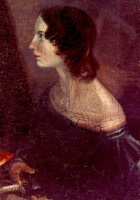

Emily Jane Brontë Poems
A little while, a little while,
The weary task is put away,
And I can sing and I can smile,
Alike, while I have holiday.
...
I am the only being whose doom
No tongue would ask no eye would mourn
I never caused a thought of gloom
A smile of joy since I was born
...
Come, walk with me,
There's only thee
To bless my spirit now -
We used to love on winter nights
...
Fall, leaves, fall; die, flowers, away;
Lengthen night and shorten day;
Every leaf speaks bliss to me
Fluttering from the autumn tree.
...
Hope was but a timid friend;
She sat without the grated den,
Watching how my fate would tend,
Even as selfish-hearted men.
...
Me thinks this heart should rest awhile
So stilly round the evening falls
The veiled sun sheds no parting smile
Nor mirth nor music wakes my Halls
...
Love is like the wild rose-briar,
Friendship like the holly-tree --
The holly is dark when the rose-briar blooms
But which will bloom most contantly?
...
The day is done, the winter sun
Is setting in its sullen sky;
And drear the course that has been run,
And dim the hearts that slowly die.
...
Long neglect has worn away
Half the sweet enchanting smile;
Time has turned the bloom to gray;
Mold and damp the face defile.
...
A little while, a little while,
The noisy crowd are barred away;
And I can sing and I can smile
A little while I've holyday !
...
"O day! he cannot die
When thou so fair art shining!
O Sun, in such a glorious sky,
So tranquilly declining;
...
The winter wind is loud and wild,
Come close to me, my darling child;
Forsake thy books, and mateless play;
And, while the night is gathering grey,
...
If grief for grief can touch thee,
If answering woe for woe,
If any truth can melt thee
Come to me now!
...
The night is darkening round me,
The wild winds coldly blow ;
But a tyrant spell has bound me,
And I cannot, cannot go.
...
Mild the mist upon the hill
Telling not of storms tomorrow;
No, the day has wept its fill,
Spent its store of silent sorrow.
...
How still, how happy! Those are words
That once would scarce agree together;
I loved the plashing of the surge -
The changing heaven the breezy weather,
...
I see around me tombstones grey
Stretching their shadows far away.
Beneath the turf my footsteps tread
Lie low and lone the silent dead -
...
It was a little budding rose,
Round like a fairy globe,
And shyly did its leaves unclose
Hid in their mossy robe,
...
On a sunny brae, alone I lay
One summer afternoon;
It was the marriage-time of May
With her young lover, June.
...
Ah! why, because the dazzling sun
Restored my earth to joy
Have you departed, every one,
And left a desert sky?
...
Emily Jane Brontë Biography
Emily Brontë was an English novelist and poet, best remembered for her only novel, Wuthering Heights, now considered a classic of English literature. Emily was the third eldest of the four surviving Brontë siblings, between the youngest Anne and her brother Branwell. She published under the pen name Ellis Bell. Biography Emily Brontë was born on 30 July 1818 in Thornton, near Bradford in Yorkshire, to Maria Branwell and Patrick Brontë. She was the younger sister of Charlotte Brontë and the fifth of six children. In 1824, the family moved to Haworth, where Emily's father was perpetual curate, and it was in these surroundings that their literary gifts flourished. Early Life and Education After the death of their mother in 1821, when Emily was three years old, the older sisters Maria, Elizabeth and Charlotte were sent to the Clergy Daughters' School at Cowan Bridge, where they encountered abuse and privations later described by Charlotte in Jane Eyre. Emily joined the school for a brief period. When a typhus epidemic swept the school, Maria and Elizabeth caught it. Maria, who may actually have had tuberculosis, was sent home, where she died. Emily was subsequently removed from the school along with Charlotte and Elizabeth. Elizabeth died soon after their return home. The three remaining sisters and their brother Patrick Branwell were thereafter educated at home by their father and aunt Elizabeth Branwell, their mother's sister. In their leisure time the children created a number of paracosms, which were featured in stories they wrote and enacted about the imaginary adventures of their toy soldiers along with the Duke of Wellington and his sons, Charles and Arthur Wellesley. Little of Emily's work from this period survives, except for poems spoken by characters (The Brontës' Web of Childhood, Fannie Ratchford, 1941). When Emily was 13, she and Anne withdrew from participation in the Angria story and began a new one about Gondal, a large island in the North Pacific. With the exception of Emily's Gondal poems and Anne's lists of Gondal's characters and place-names, their writings on Gondal were not preserved. Some "diary papers" of Emily's have survived in which she describes current events in Gondal, some of which were written, others enacted with Anne. One dates from 1841, when Emily was twenty-three: another from 1845, when she was twenty-seven. At seventeen, Emily attended the Roe Head girls' school, where Charlotte was a teacher, but managed to stay only three months before being overcome by extreme homesickness. She returned home and Anne took her place. At this time, the girls' objective was to obtain sufficient education to open a small school of their own. Adulthood Emily became a teacher at Law Hill School in Halifax beginning in September 1838, when she was twenty. Her health broke under the stress of the 17-hour work day and she returned home in April 1839. Thereafter she became the stay-at-home daughter, doing most of the cooking and cleaning and teaching Sunday school. She taught herself German out of books and practised piano. In 1842, Emily accompanied Charlotte to Brussels, Belgium, where they attended a girls' academy run by Constantin Heger. They planned to perfect their French and German in anticipation of opening their school. Nine of Emily's French essays survive from this period. The sisters returned home upon the death of their aunt. They did try to open a school at their home, but were unable to attract students to the remote area. In 1844, Emily began going through all the poems she had written, recopying them neatly into two notebooks. One was labelled "Gondal Poems"; the other was unlabelled. Scholars such as Fannie Ratchford and Derek Roper have attempted to piece together a Gondal storyline and chronology from these poems. In the autumn of 1845, Charlotte discovered the notebooks and insisted that the poems be published. Emily, furious at the invasion of her privacy, at first refused, but relented when Anne brought out her own manuscripts and revealed she had been writing poems in secret as well. In 1846, the sisters' poems were published in one volume as Poems by Currer, Ellis, and Acton Bell. The Brontë sisters had adopted pseudonyms for publication: Charlotte was Currer Bell, Emily was Ellis Bell and Anne was Acton Bell. Charlotte wrote in the "Biographical Notice of Ellis and Acton Bell" that their "ambiguous choice" was "dictated by a sort of conscientious scruple at assuming Christian names positively masculine, while we did not like to declare ourselves women, because... we had a vague impression that authoresses are liable to be looked on with prejudice[.]" Charlotte contributed 20 poems, and Emily and Anne each contributed 21. Although the sisters were told several months after publication that only two copies had sold, they were not discouraged. The Athenaeum reviewer praised Ellis Bell's work for its music and power, and the Critic reviewer recognized "the presence of more genius than it was supposed this utilitarian age had devoted to the loftier exercises of the intellect." Wuthering Heights In 1847, Emily published her novel, Wuthering Heights, as two volumes of a three-volume set (the last volume being Agnes Grey by her sister Anne). Its innovative structure somewhat puzzled critics. Although it received mixed reviews when it first came out, and was often condemned for its portrayal of amoral passion, the book subsequently became an English literary classic. In 1850, Charlotte edited and published Wuthering Heights as a stand-alone novel and under Emily's real name. Although a letter from her publisher indicates that Emily was finalizing a second novel, the manuscript has never been found. Death Emily's health, like her sisters', had been weakened by unsanitary conditions at home, the source of water being contaminated by runoff from the church's graveyard. She became sick during her brother's funeral in September 1848. Though her condition worsened steadily, she rejected medical help and all proffered remedies, saying that she would have "no poisoning doctor" near her. She eventually died of tuberculosis, on 19 December 1848 at about two in the afternoon. She was interred in the Church of St. Michael and All Angels family vault, Haworth, West Yorkshire.)
The Best Poem Of Emily Jane Brontë
"A Little While, A Little While..."
A little while, a little while,
The weary task is put away,
And I can sing and I can smile,
Alike, while I have holiday.
Why wilt thou go, my harassed heart,
What thought, what scene invites thee now?
What spot, or near or far,
Has rest for thee, my weary brow?
There is a spot, mid barren hills,
Where winter howls, and driving rain;
But if the dreary tempest chills,
There is a light that warms again.
The house is old, the trees are bare,
Moonless above bends twilight's dome;
But what on earth is half so dear,
So longed for, as the hearth of home?
The mute bird sitting on the stone,
The dank moss dripping from the wall,
The thorn-trees gaunt, the walks o'ergrown,
I love them, how I love them all!
Still, as I mused, the naked room,
The alien firelight died away,
And from the midst of cheerless gloom
I passed to bright unclouded day.
A little and a lone green lane
That opened on a common wide;
A distant, dreamy, dim blue chain
Of mountains circling every side;
A heaven so clear, an earth so calm,
So sweet, so soft, so hushed an air;
And, deepening still the dream-like charm,
Wild moor-sheep feeding everywhere.
That was the scene, I knew it well;
I knew the turfy pathway's sweep
That, winding o'er each billowy swell,
Marked out the tracks of wandering sheep.
Could I have lingered but an hour,
It well had paid a week of toil;
But Truth has banished Fancy's power:
Restraint and heavy task recoil.
Even as I stood with raptured eye,
Absorbed in bliss so deep and dear,
My hour of rest had fleeted by,
And back came labour, bondage, care.
Emily Jane Brontë Comments
The following poem was written by Emily Brontë; (Born in Irland- 1818- and died at the age of thirty- 1848) . Most of her poetry reflected her life. A passionate woman thou silent, reserved and loner, therefore sad and sorrow. 'I am the only being whose doom' have six stanza; the rhyme and rythem follow a regular scheme; and the use of figures of speech give a particular tender to it. The persona in the poem describes her reflection towards the world. A young girl- eighteen years- who realize youth is more than hopes and dreams. It implies truth and pain. Taking into account the fifth stanza: ' First melted off the hope of youth, then fancy's rainbow fast withdrew; and then experience told me truth in mortal bosoms never grew.' Her life have had more downs than ups, as she continuously mentions unhappy adjetives, such us: (doom, gloom, sad, drear, hollow) . The reader can tell that the persona's lack of affection when it says: ' As lone as on my natal day.' A simile that gives life to the poem. She seems to prefere death than life- ' No tongue would ask, no eye would mourn.'- a strong metaphor to make clear her whole idea; not only death but loneliness. Finally, the last stanza emphasise on a corrupted world- hollow, servile, insencere- which makes us forget our human essence becoming selfisk people; as she is 'friendless'.
I was wrong. the poem 'silent is the house' is on here, its just under the title 'the visionary'.
she had a rough childhood I'm glad she got through it and didn`t give up with her sister
In Emily Jane Bronte's Intro-biography in Wuthering Heights she was born on the 18th of July 1818. Here the dates had been postponed to the 30th, is a misprint?
When I was youth, I loved Emily Jane Bronte so I wanted to marrage with her. I thought that to go bac to the past by time machine. Now I love her.
Emily Jane Brontë Quotes
Having levelled my palace, don't erect a hovel and complacently admire your own charity in giving me that for a home.
Any relic of the dead is precious, if they were valued living.
The tyrant grinds down his slaves and they don't turn against him, they crush those beneath them.
I am now quite cured of seeking pleasure in society, be it country or town. A sensible man ought to find sufficient company in himself.
Proud people breed sad sorrows for themselves.
A good heart will help you to a bonny face, my lad ... and a bad one will turn the bonniest into something worse than ugly.
Emily Jane Brontë Popularity
Emily Jane Brontë Popularity




Delivering Poems Around The World
Poems are the property of their respective owners. All information has been reproduced here for educational and informational purposes to benefit site visitors, and is provided at no charge...
9/19/2024 9:04:50 AM # 1.0.0.1119



No other soul has echoed the feelings of my own heart so consistently as this lady.