
My Last Duchess Poem by Robert Browning
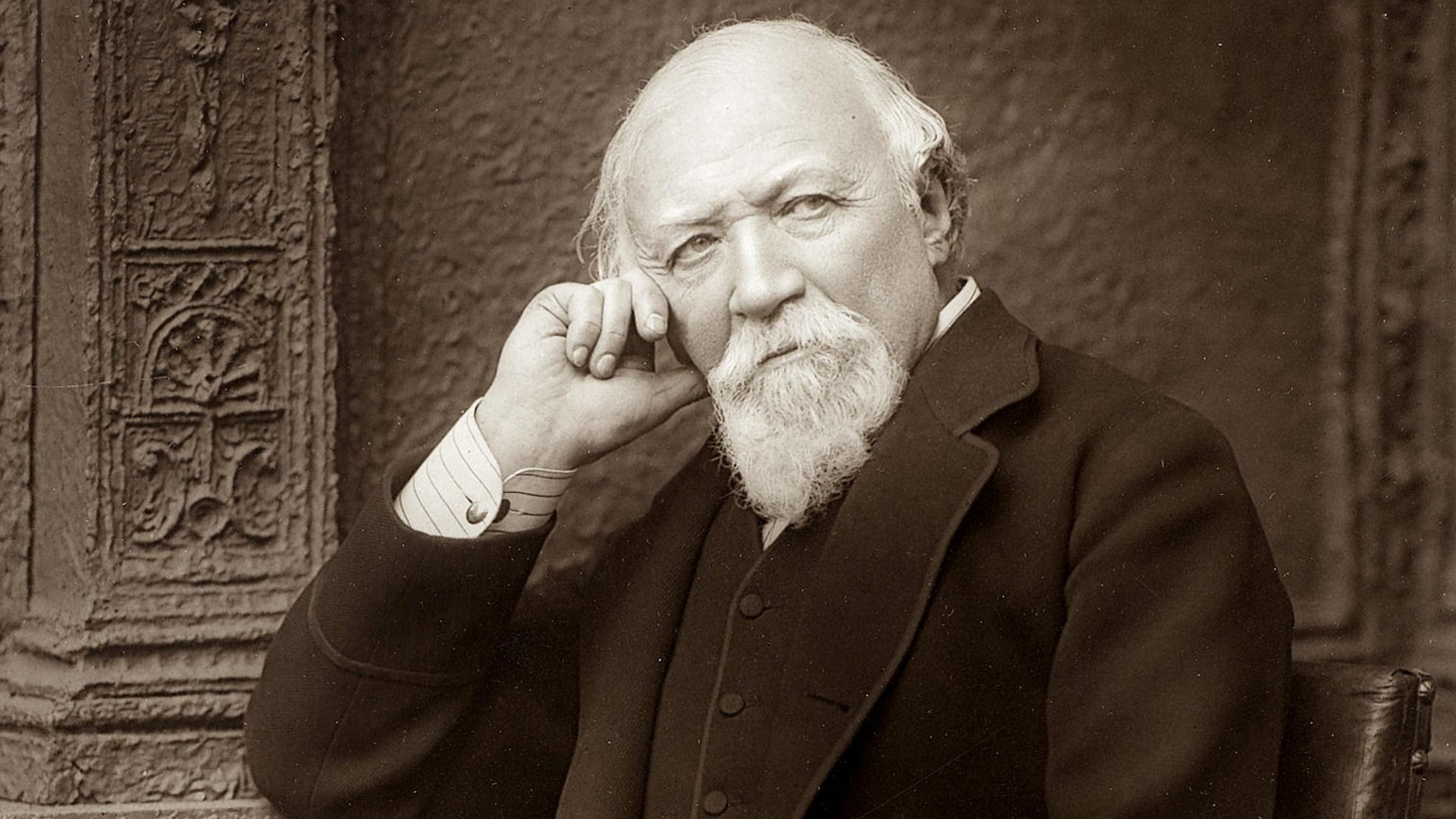

My Last Duchess
FERRARA.
That's my last Duchess painted on the wall,
Looking as if she were alive. I call
That piece a wonder, now: Fr Pandolf's hands
Worked busily a day, and there she stands.
Will't please you sit and look at her? I said
``Fr Pandolf'' by design, for never read
Strangers like you that pictured countenance,
The depth and passion of its earnest glance,
But to myself they turned (since none puts by
The curtain I have drawn for you, but I)
And seemed as they would ask me, if they durst,
How such a glance came there; so, not the first
Are you to turn and ask thus. Sir, 'twas not
Her husband's presence only, called that spot
Of joy into the Duchess' cheek: perhaps
Fr Pandolf chanced to say ``Her mantle laps
``Over my lady's wrist too much,'' or ``Paint
``Must never hope to reproduce the faint
``Half-flush that dies along her throat:'' such stuff
Was courtesy, she thought, and cause enough
For calling up that spot of joy. She had
A heart---how shall I say?---too soon made glad,
Too easily impressed; she liked whate'er
She looked on, and her looks went everywhere.
Sir, 'twas all one! My favour at her breast,
The dropping of the daylight in the West,
The bough of cherries some officious fool
Broke in the orchard for her, the white mule
She rode with round the terrace---all and each
Would draw from her alike the approving speech,
Or blush, at least. She thanked men,---good! but thanked
Somehow---I know not how---as if she ranked
My gift of a nine-hundred-years-old name
With anybody's gift. Who'd stoop to blame
This sort of trifling? Even had you skill
In speech---(which I have not)---to make your will
Quite clear to such an one, and say, ``Just this
``Or that in you disgusts me; here you miss,
``Or there exceed the mark''---and if she let
Herself be lessoned so, nor plainly set
Her wits to yours, forsooth, and made excuse,
---E'en then would be some stooping; and I choose
Never to stoop. Oh sir, she smiled, no doubt,
Whene'er I passed her; but who passed without
Much the same smile? This grew; I gave commands;
Then all smiles stopped together. There she stands
As if alive. Will't please you rise? We'll meet
The company below, then. I repeat,
The Count your master's known munificence
Is ample warrant that no just pretence
Of mine for dowry will be disallowed;
Though his fair daughter's self, as I avowed
At starting, is my object. Nay, we'll go
Together down, sir. Notice Neptune, though,
Taming a sea-horse, thought a rarity,
Which Claus of Innsbruck cast in bronze for me!
Written in 1842 by Robert Browning, 'My Last Duchess' is the dramatic monologue of the duke of Ferrara who is negotiating his second marriage through an agent of the count of Tyrol on the grand staircase of the ducal palace at Ferrara in northern Italy. Executing the elements of a dramatic monologue, the duke reveals his situation and much more than he intends to the both the agent and the reader. Using iambic pentameter AABB couplets Robert Browning reveals the horrifying story of the murder of the duke's previous wife through the duke's conversation with the agent. As the duke attempts to paint an inaccurate picture of himself to the agent, desiring to appear as a nobel, but abused and caring, loving husband who had no choice but to murder his prideful, disrespectful wife, the duke's true controlling, manipulative, jealous nature is revealed. The duke's desire for control is made evident by the structure of the poem, through his appreciation of art, and his response to the trivial incidences that led to the death of his wife. The frequent use of caesura throughout the poem emphasize the duke's control over the conversation. The duke's appreciation of art reveals the control he has over the artists that produce his works of art; the portrait of his last duchess and the statue of Neptune. Although the duke was unable to control the duchess when she was alive, after her death he is in complete control of her. The duke says 'none puts by the curtain I have drawn for you, but I, ' revealing that now he is able to control both the duchess's countenance and who views the portrait by a curtain covering the portrait (10) . The duke's loss of control is also depicted through the rhythm of the poem. The run over lines in the poem, or enjambment in the poem, reveal the duke's nervous uneasiness over his wife's murder. For example, near the end of the poem, the duke loses control. The reader can only imagine the horrified agent rising to go down the staircase, the duke's uneasiness as he loses control, and his desire to regain control of the situation as he says, 'Nay we'll go down together, sir'(53) . The duke wants to appear as a hurt and abused husband whose disrespectful wife left him no alternative but to kill her. However his appreciation of art reveals that he values things that he can control and is contrasted with the images of nature that surround the duchess. The 'daylight in the West.....the bough of cherries, ' and 'the white mule, ' all natural objects that are associated with the duchess' happiness. These images of nature are a sharp contrast to the artificial objects the duke values. His unhappiness over the duchess' association with nature is revealed in the line 'I know not how-as if she ranked my gift of a nine-hundred-years-old-name with anybody's gift'(34) . It is clear that the duke believes that his name, something artificial, is of greater value than the natural objects that cause the duchess joy. In the end it is the duke's loss of control that causes him to kill her. His inability to control the live duchess herself, resulted in her death, and now all that remains is another valued object, which he is in complete control of.
The duke is so selfish but maybe it is because of the duchess attitude towards him.
The poem speaks about the true intentions of the duke in a clever yet twisted way. It's all about the the duke's selfishness and pride. The duke is so obsessed with himself that he didn't like the way the duchess treat him. He want's all the attention from his duchess that he cannot simply handle the duchess attitude. I would say that this poem enchant's the reader's by the twisted plot with a lot of drama. I recommend this poem sothat you can understand the true meaning of love and selfishness.
I will just give a quick summary of what I feel this poem is about. Basically, the way I see this poem is a warning to his future wife and her family. The situtation is that the Duke of Ferrara shows a painting of his previous Duchess that he had killed due to his jealousy. He makes complaints of how other men could make her happy with their gifts, for example the white mule. The Duke is severely jealous that she showed no more appreciation to him for his gifts. This is evident when Browning writes 'Somehow-I know not how-as if she ranked, My gift of a nine-hundred-years-old name, With anybody's gift.' Unable to handle this jealousy and unable to 'stoop' and 'blame this type of trifling' the Duke simply orders his lover to be killed. Then the final few lines give another quick insight into another area of the Dukes somewhat bitter personality. He says 'Together down, sir' after the murder of the Duchess as though it is nothing to him and also, he speaks of the statue of Neptune, taming a seahorse. The Duke likes to see taming, as he wanted to tame the Duchess and make her show less gratitude to people bearing gifts for her.
Most deserving CLASSIC POEM OF THE DAY! CONGRATULATIONS TO THE FAMILY OF THE LATE POET.
I still enjoyed this oh so loveliest Classic Poem Of The Day! A true joy to reread this greatest masterpiece in Dramatic Monologue all times. Only Browning could do this.
A true joy to reread this greatest masterpiece in Dramatic Monologue all times. Only Browning could do this.
Great Classic poem of the day. Only Robert Browning could write such a masterpiece! A true to read this poem time and again. Browning is the greatest dramatic monologue poet all times. Such a fantastic ironic monologue by the duke, his late wife hanging in fresco upon his bed with his new wife.




Delivering Poems Around The World
Poems are the property of their respective owners. All information has been reproduced here for educational and informational purposes to benefit site visitors, and is provided at no charge...
4/27/2024 1:17:44 AM # 1.0.0.1119



One of Robert Browning's greatest poem is the My Last Duchess well known for the most dramatic poem he ever wrote.In the poem the last duchess was killed by her husband the duke who finds himself jealous for her the duchess seducing men by her image and likeness.Even in the portrait of her deceased duchess you can see how beauty can be a sin.The lesson here that love can be also deadly for it can kill someone you love.In my opinion the duke has the right kill her duchess for she is the one to be blame for hatred, jealousy, and pain of the duke.I deny the fact that love is the most good thing to happen but the real thing its not true.You can say that the duke is so selfish and so arrogant but the truth about it really hurts when your not being loved by your love ones.I can even relate my story but time is running out I need to sleep because my eyes really hurts and I need to shut my computer before its too late....