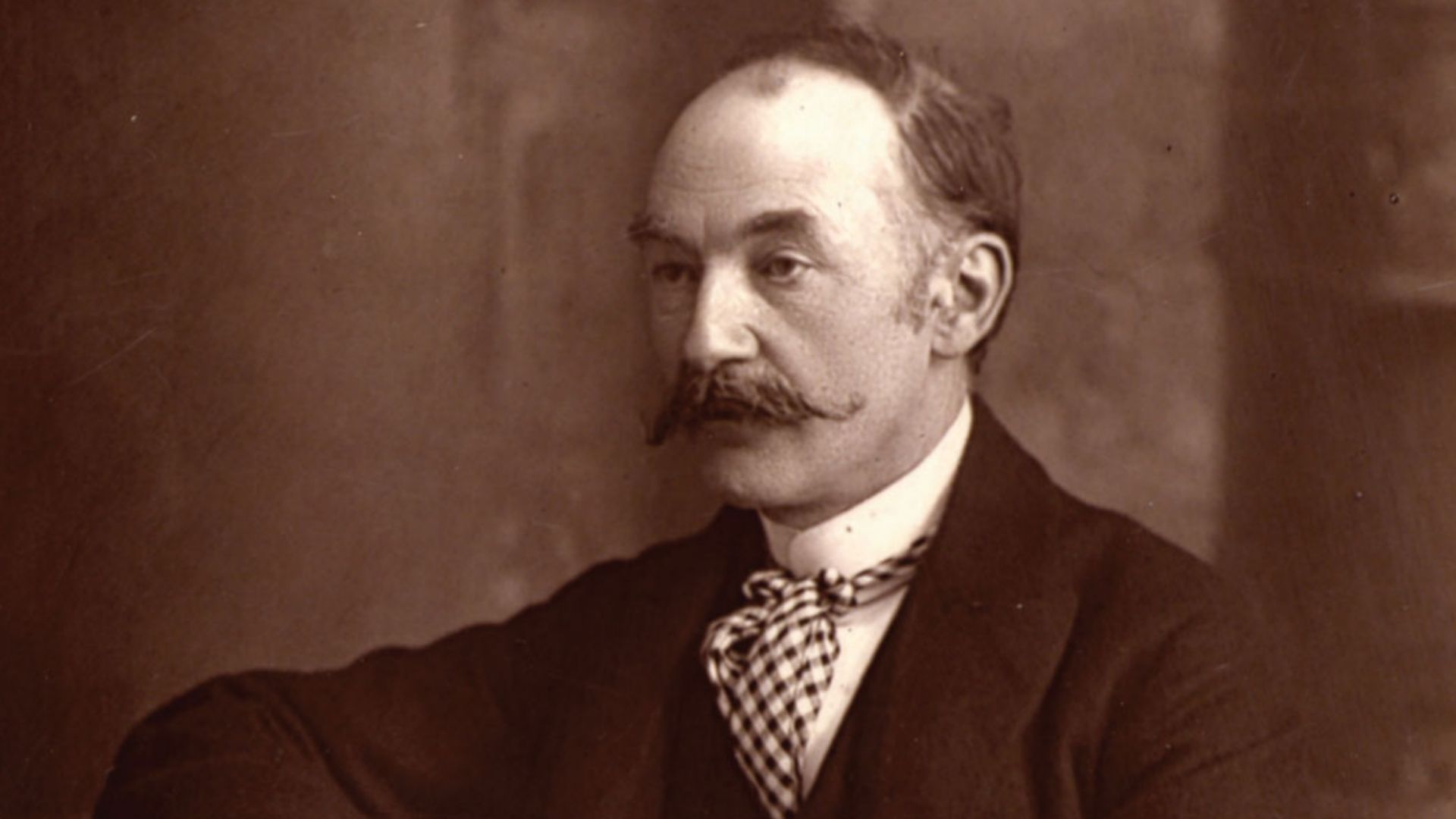
Thomas Hardy (2 June 1840 – 11 January 1928 / Dorchester / England)
|
||||||||||||||||||||||||||||||||||||||||||||||||||||||||||||
Poems by Thomas Hardy : 6 / 328
A Broken Appointment
You did not come,
And marching Time drew on, and wore me numb.
Yet less for loss of your dear presence there
Than that I thus found lacking in your make
That high compassion which can overbear
Reluctance for pure lovingkindness' sake
Grieved I, when, as the hope-hour stroked its sum,
You did not come.
You love not me,
And love alone can lend you loyalty;
-I know and knew it. But, unto the store
Of human deeds divine in all but name,
Was it not worth a little hour or more
To add yet this: Once you, a woman, came
To soothe a time-torn man; even though it be
You love not me.
Thomas Hardy
Submitted: Friday, January 03, 2003
Edited: Saturday, October 21, 2006
Read poems about / on: loss, woman, hope, alone, time, love, women
Poems by Thomas Hardy : 6 / 328
People who read Thomas Hardy also read
Top 500 Poems
-
Phenomenal Woman
Maya Angelou
-
The Road Not Taken
Robert Frost
-
Still I Rise
Maya Angelou
-
If You Forget Me
Pablo Neruda
-
Dreams
Langston Hughes
-
Annabel Lee
Edgar Allan Poe
-
If
Rudyard Kipling
-
A Dream Within A Dream
Edgar Allan Poe
-
Stopping by Woods on a Snowy Evening
Robert Frost
-
I Know Why The Caged Bird Sings
Maya Angelou

The poem is an excellent example of a man with a terrible disappointment over the unkept appointment. All his feelings seem to come to the forefront and he starts to question himself. And also Kevin Straw wrote this opinion last year, and he never said it was not a good poem, he just thought Hardy's approach was clumsy. At least it was an honorable and honest opinion. Unlike others who can't seem to come up with their own.
clumsy indeed- I agree- hurray for Kevin Straw's opinion! ! ! !
Egoistic man's nature is well depicted in this poem! Thomas Hardy is expressing strong flaw of man in this poem too as in all his famous novels!
There is something clumsy about Hardy's style:
'Yet less for loss of your dear presence there
Than that I thus found lacking in your make
That high compassion which can overbear
Reluctance for pure lovingkindness' sake
Grieved I, when, as the hope-hour stroked its sum,
You did not come.'
E.G. 'Grieved I' comes much too late. Also is 'thus' right? He makes it refer to the substance of what he found, when it should refer to the manner of his finding.
Deep poem; I just see, a disillusioned man with broken pieces of life. Never really connecting in life's trials. Yet, the heart of a woman to place compassion, as a band-aid upon the pieces. Hoping a few will stick together on the band-aids adhesive
Some of the comments posted here puzzle this reader, but that's
the nature of the beast, I guess. Consider that Hardy wrote in the 19th century
when certain theories about the nature of life were prominent. One theory
that Hardy espoused and wrote about in both his poetry and in his novels
was the tragic nature of human life. The cards are stacked against us from
birth to death, and the sad fate of his characters bears that point of view out
to the nth degree. 'A Broken Appointment' has been dismissed by some
as much ado about nothing- some woman stood him up, so get over it, man!
She did not make the appointment, though he waited patiently for hours on end.
The speaker grieved that she demonstrated such a lack of compassion for
a man in his straits - a time-torn man at the end of his rope! He recognizes
that she doesn't love him, not even in the kind way one human being cares
for another mortal being in distress. There are actions that one can take to
alleviate the suffering of a time-torn man (or woman!) that are divine. Recall
that Hardy was not a believer in a divine being, but he believed that one has
a duty to respond to the down-and-out (just a little hour or more!) .
What vodka and water have to do with Hardy's poem is beyond me, I admit!
Another modern reader who knows his own mind? I don't know!
point blank there is nothing but beauty of words in this poem!
when vodka tastes like water
and someone is waiting for me on the other side
i would have to believe crying is suffering
that the boundaries of the wilderness what this journey is all about
I love Thomas Hardy poems, enough to memorize this one and also 'Neutral Tones' & 'I look into my glass'. He strikes a deep chord of sympathy in me, it is like I have felt what he is so gifted in expressing; the bitter disappointment in a beloved that 'you love not me'. As I meditate on his poems I see a familiar (because I see it in me) stain of sin, a recurring thread of selfishness, bitterness and vindictiveness running through his powerful prose. Consider, posterity will never know why the appointment was broken, or, in 'Neutral Tones' why the lady grew disenchanted with him, or why no one is paying close attention to his “throbbings of noontide” (“I look into my glass”) but Hardy does not hesitate to repeatedly use his power to create a form of artwork that he knows will damn his subject for the ages. If Hardy was as broody and melancholy in person as his poetry suggests, I can very easily imagine a young fan, initially thrilled at meeting him, becoming more and more disinclined to continue her association with someone who turns out to be an introspective boor, even if the introspective boor is a 'Great Man'. I think Thomas Hardy has the gift of eloquently describing what almost all of us have experienced at one time or another; the painful recognition that someone we have grown to delight in has come into our lives, gotten to know us and has chosen to leave us. We do this to great poets, and our creator, Jesus Christ, to our eternal peril.
I am a time torn man
Who longed for your soothing presence.
But you who don't love me
Lack high compassion.
You didn't come.
And we are human