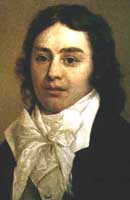
(1772-1834 / Devon / England)

Previous Month June 2013 Next Month
Mo Tu We Th Fr Sa Su
27 28 29 30 31 1 2
3 4 5 6 7 8 9
10 11 12 13 14 15 16
17 18 19 20 21 22 23
24 25 26 27 28 29 30
Poem of the Day
Select a day from the calendar.
Would you like to see the poem of the day in your e-mail box every morning?
Your email address:
  Subscribe FREE
  Unsubscribe
What do you think this poem is about?

The Suicide's Argument

Ere the birth of my life, if I wished it or no
No question was asked me--it could not be so !
If the life was the question, a thing sent to try
And to live on be YES; what can NO be ? to die.

NATURE'S ANSWER

Is't returned, as 'twas sent ? Is't no worse for the wear ?
Think first, what you ARE ! Call to mind what you WERE !
I gave you innocence, I gave you hope,
Gave health, and genius, and an ample scope,
Return you me guilt, lethargy, despair ?
Make out the invent'ry ; inspect, compare !
Then die--if die you dare !

Submitted: Monday, May 14, 2001
Edited: Monday, May 14, 2001


Read poems about / on: innocence, despair, birth, nature, hope, suicide, life

Comments about this poem (The Suicide's Argument by Samuel Taylor Coleridge )

Enter the verification code :

  • Pranab K Chakraborty (6/23/2012 10:48:00 PM)

    Two lines I think emerge violently from the whole writing for the SUICIDER which I consider as the manifesto to take the decision of committing OR not-committing suicide:

    1] Think first, what you ARE! Call to mind what you WERE!

    2] Then die-if die you dare!

    After all suicide is the last weapon to confront the intense adversity for a non-compromising personality. The Poem is a brave work to give suicide an institutional recognition. Nice put from the old master.

    Pranab k chakraborty

    0 person liked.
    0 person did not like.
  • Merry Virgo (6/23/2010 10:00:00 PM)

    wow....Im glad i saw you here my dearest
    ...you are my favorite poet you know that?
    hehe....I am so blessed I found you here...
    now I can read all your poems...
    nice one...
    god bless....
    yours, merrypens

    1 person liked.
    0 person did not like.
  • Joey Valenzuela (6/23/2010 9:57:00 PM)

    Coleridge pointed out: DO NOT COMMIT SUICIDE
    in the line:
    Then die-if die you dare

    and the argument of the creator there interfered.....
    as it says: Think first

    because:
    I gave you innocence, I gave you hope,
    Gave health, and genius, and an ample scope,

    Return you me guilt, lethargy, despair? +++++(think twice if you really wanna hurt me, says nature [or maybe nature represents GOD])

    1 person liked.
    0 person did not like.
  • Undead Perez (6/23/2010 7:52:00 PM)

    Everyone needs to stop over-analyzing the poem. I mean if theres anything to discuss, then do indeed discuss the utterly amazing feeling it leaves behind after reading it. No one will ever know what Samuel Taylor Coleridge meant or was feeling when he wrote this. Maybe, thats a good thing because perhaps its purpose is to help you all find the meaning for yourself on your own accounts not with what you think he was trying to portray. Just relish in the beauty of this awesome poem and be content with that :)

    4 person liked.
    1 person did not like.
  • Terence George Craddock (6/23/2010 3:30:00 PM)

    For the multitudes of humanity who believe in a personal creator, the concept of God having written himself into his creation NATURE, is common throughout many religions. The concept of nature communicating to humanity in nature’s language, is also common in all hunter gatherer and nomadic societies. The Great Spirit communicating to Native American First Nation cultures, through nature as a real-life physical interdependence in relationship, in the web of Creation is one such example. The wilderness instills insists upon a voice in great literature like The Call of the Wild and White Fang by Jack London, where nature definitely imposes survival rules, ignored at our peril.
    Harmon correctly defines Ruskin's 'pathetic fallacy' as descriptions of inanimate objects with human capabilities, sensations or emotions. Coleridge’s lines in “Christabel” ‘The one red leaf, the last of its clan, /That dances as often as dance it can’ is good 'pathetic fallacy'. This personification which the Greeks called prosopopeia, is inanimate objects endowed with life or human feelings and attributes, and this concept imbues Greek philosophy, in a world where pagan gods and such forces were as real as television and radio waves are for us today.

    Ruskin claimed such lines even if incredibly beautiful were false and morbid, therefore Shakespeare, the romantics and almost all poets by Ruskin’s definition would be morbid. Ruskin believed the use of 'pathetic fallacy' was valid only for the greatest poets, upon rare occasions when it would be, to quote M. H. Abrams, ‘inhuman to resist the pressure of powerful feelings to humanize perceived fact’. Ruskin recognized an extraordinary emotive influence of nature.

    A possible rational explanation for suicide, especially youth suicide, is examined in my poem ‘State Of 20th Century Man’, which when written in January 1982; was considered not publishable, due to the consideration it might upset some readers. A violation of sense and sensibility at that time.

    1 person liked.
    0 person did not like.
  • Ethan Clarke (6/23/2010 2:32:00 PM)

    I I I Cant Say Anything That Was So Good..........................

    0 person liked.
    0 person did not like.
  • Herman Chiu (6/23/2010 2:10:00 PM)

    I have to agree with Coleridge. Heck, I reconstructed this argument myself before I ever read this poem.
    What makes you deserve to die? It's fun, if anything.
    Not the point, Mr. Straw... I think you misinterpret Coleridge's idea of 'nature's argument'.
    It's more of an 'everything else' idea rather than a 'mother nature's rules' idea.
    More like half of 'God's' manifestation in Brave New World.

    0 person liked.
    0 person did not like.
  • Kevin Straw (6/23/2010 5:34:00 AM)

    The state of mind in which one actually kills oneself does not admit of reason. I saw a young girl commit suicide - rather I saw the flight of her body from a seventh floor window. I read in the local paper later that she had broken up with her boyfriend the day before she killed herself. I rather think Nature's admonition in Coleridge's poem would have been the last thing on her mind as she jumped.

    If someone commits suicide “rationally”, then it is because there are considerations such as honour which outweigh any other. Shakespeare’s Antony committed suicide because the life he considered worth living was ended and only humiliation and disgrace awaited him. Nature, in Coleridge’s terms would have nothing to say to him.

    There is a huge gulf between contemplating and committing suicide.

    2 person liked.
    0 person did not like.
  • Chamelle Humphries (6/23/2010 4:21:00 AM)

    this realy tugs at the mind...wow

    0 person liked.
    0 person did not like.
  • JOSEPH POEWHIT (6/23/2010 4:08:00 AM)

    Suicide is an escape mechanism from situations. People who attempt suicide, are escaping. Such as being in a burning building on a high floor. Panic invokes and escape predominates the situation. Really rational thoughts are overpowered by panic and fear. His manifest of questions are rational and thus out of context of suicides motives.

    0 person liked.
    0 person did not like.
Read all 24 comments »
[Hata Bildir]