
Tomas Tranströmer
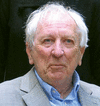

Tomas Tranströmer Poems
Once there was a shock
that left behind a long, shimmering comet tail.
It keeps us inside. It makes the TV pictures snowy.
It settles in cold drops on the telephone wires.
...
It’s spring in 1827, Beethoven
hoists his death-mask and sails off.
The grindstones are turning in Europe’s windmills.
...
They switch off the light and its white shade
glimmers for a moment before dissolving
like a tablet in a glass of darkness. Then up.
...
Men in overalls the same color as earth rise from a ditch.
It's a transitional place, in stalemate, neither country nor city.
Construction cranes on the horizon want to take the big leap,
but the clocks are against it.
...
The Under Secretary leans forward and draws an X
and her ear-drops dangle like swords of Damocles.
...
The almighty cyclop’s-eye clouded over
and the grass shook itself in the coal dust.
Beaten black and blue by the night’s dreams
...
Despondency breaks off its course.
Anguish breaks off its course.
The vulture breaks off its flight.
...
1
The white butterfly in the park is being read by many.
I love that cabbage-moth as if it were a fluttering corner of truth itself!
At dawn the running crowds set our quiet planet in motion.
Then the park fills with people. To each one, eight faces polished like jade, for all
situations, to avoid making mistakes.
To each one, there's also the invisible face reflecting 'something you don't talk about.'
Something that appears in tired moments and is as rank as a gulp of viper schnapps with its long scaly aftertaste.
The carp in the pond move continuously, swimming while they sleep, setting an example for the faithful: always in motion.
2
It's midday. Laundry flutters in the gray sea-wind high over the cyclists
who arrive in dense schools. Notice the labrinths on each side!
I'm surrounded by written characters that I can't interpret, I'm illiterate through and through.
But I've paid what I owe and have receipts for everything.
I've accumulated so many illegible receipts.
I'm an old tree with withered leaves that hang on and can't fall to the ground.
And a gust from the sea gets all these receipts rustling.
3
At dawn the trampling hordes set our quiet planet in motion.
We're all aboard the street, and it's as crammed as the deck of a ferry.
Where are we headed? Are there enough teacups? We should consider ourselves lucky
to have made it aboard this street!
It's a thousand years before the birth of claustrophobia.
Hovering behind each of us who walks here is a cross that wants to catch up with us,
pass us, unite with us.
Something that wants to sneak up on us from behind, put its hands over our eyes and
whisper 'Guess who!'
We look almost happy out in the sun, while we bleed to death from wounds we don't
know about.
...
I
Two old men, father-and son-in-law, Liszt and Wagner, are staying by the Grand Canal
together with the restless woman who is married to King Midas,
he who changes everything he touches to Wagner.
The ocean's green cold pushes up through the palazzo floors.
Wagner is marked, his famous Punchinello profile looks more tired than before,
his face a white flag.
The gondola is heavy-laden with their lives, two round trips and a one-way.
II
A window in the palazzo flies open and everyone grimaces in the sudden draft.
Outside on the water the trash gondola appears, paddled by to one-oared bandits.
Liszt has written down some chords so heavy, they ought to be sent off
to the mineralological institute in Padua for analysis.
Meteorites!
Too heavy to rest, they can only sink and sink straight through the future all the way down to the Brownshirt years.
The gondola is heavy-laden with the future's huddled-up stones.
III
Peep-holdes into 1990.
March 25th. Angst for Lithuania.
Dreamt I visited a large hospital.
No personnel. Everyone was a patient.
In the same dream a newborn girl
who spoke in complete sentences.
IV
Beside the son-in-law, who's a man of the times, Liszt is a moth-eaten grand seigneur.
It's a disguise.
The deep, that tries on and rejects different masks, has chosen this one just for him—
the deep that wants to enter people without ever showing its face.
V
Abbé Liszt is used to carrying his suitcase himself through sleet and sunshine
and when his time comes to die, there will be no one to meet him at the station.
A mild breeze of gifted cognac carries him away in the midst of a commission.
He always has commissions.
Two thousand letters a year!
The schoolboy who writes his misspelled word a hundred times before he's allowed
to go home.
The gondola is heavy-laden with life, it is simple and black.
VI
Back to 1990.
Dreamt I drove over a hundred miles in vain.
Then everything magnified. Sparrows as big as hens
sang so loud that it briefly struck me deaf.
Dreamt I had drawn piano keys
on my kitchen table. I played on them, mute.
The neighbors came over to listen.
VII
The clavier, which kept silent through all of Parsifal (but listened), finally has
something to say.
Sighs...ospiri...
When Liszt plays tonight he holds the sea-pedal pressed down
so the ocean's green force rises up through the floor and flows together with all the
stone in the building.
Good evening, beautiful deep!
The gondola is heavy-laden with life, it is simple and black.
VIII
Dreamt I was supposed to start school but arrived too late.
Everyone in the room was wearing a white mask.
Whoever the teacher was, no one could say.
...
Jag väcker bilen
som har vindrutan överdragen med frömjöl.
Jag sätter på mig solglasögonen.
Fågelsången mörknar.
Medan en annan man köper en tidning
på järnvägsstationen
i närheten av en stor godsvagn
som är alldeles röd av rost
och står flimrande i solen.
Inga tomrum någonstans här.
Tvärs genom vårvärmen en kall korridor
där någon kommer skyndande
och berättar att man förtalat honom
ända upp i styrelsen.
Genom en bakdörr i landskapet
kommer skatan
svart och vit, Hels fågel.
Och koltrasten som rör sig kors och tvärs
tills allt blir en kolteckning,
utom de vita kläderna på tvättstrecket:
en palestrinakör.
Inga tomrum någonstans här.
Fantastiskt att känna hur min dikt växer
medan jag själv krymper.
Den växer, den tar min plats.
Den tränger undan mig.
Den kastar mig ur boet.
Dikten är färdig.
...
I waken the car
whose windscreen is coated with pollen.
I put on my sunglasses.
The birdsong darkens.
Meanwhile another man buys a paper
at the railway station
close to a large goods wagon
which is all red with rust
and stands flickering in the sun.
No blank space anywhere here.
Straight through the spring warmth a cold corridor
where someone comes running
and tells how up at head office
they slandered him.
Through a back door in the landscape
comes the magpie
black and white.
And the blackbird darting to and fro
till everything becomes a charcoal drawing,
except the white clothes on the washing-line:
a palestrina chorus.
No blank space anywhere here.
Fantastic to feel how my poem grows
while I myself shrink.
It grows, it takes my place.
It pushes me aside.
It throws me out of the nest.
The poem is ready.
...
Ett virrvarr av svarta granar
och rykande månstrålar.
Här ligger torpet sänkt
och det tycks utan liv.
Tills morgondaggen sorlar
och en åldring öppnar
- med darrande hand -
fönstret och släpper ut en uv.
Och i ett annat väderstreck
står nybygget och ångar
med lakanstvättens fjäril
fladdrande vid knuten
mitt i en döende skog
där förmultningen läser
genom glasögon av sav
barkborrarnas protokoll.
Sommar med linhåriga regn
eller ett enda åskmoln
över en hund som skäller.
Fröet sparkar i jorden.
Upprörda röster, ansikten
flyger i telefontrådarna
på förkrympta snabba vingar
över myrmarkernas mil.
Huset på en ö i älven
ruvande sina grundstenar.
En ständig rök - man bränner
skogens hemliga papper.
Regnet vänder i himlen.
Ljuset slingrar i älven.
Hus på branten övervakar
vattenfallets vita oxar.
Höst med en liga av starar
som håller gryningen i schack.
Människorna rör sig stelt
på lampskenets teater.
Låt dem känna utan ängslan
de kamouflerade vingarna
och Guds energi
hoprullad i mörkret.
...
A mix-max of black spruce
and smoking moonbeams.
Here's the croft lying low
and not a sign of life.
Till the morning dew murmurs
and an old man opens
- with a shaky hand - his window
and lets out an owl.
Further off, the new building
stands steaming
with the laundry butterfly
fluttering at the corner
in the middle of a dying wood
where the mouldering reads
through spectacles of sap
the proceedings of the bark-drillers.
Summer with flaxen-haired rain
or one solitary thunder-cloud
above a barking dog.
The seed is kicking inside the earth.
Agitated voices, faces
fly in the telephone wires
on stunted rapid wings
across the moorland miles.
The house on an island in the river
brooding on its stony foundations.
Perpetual smoke - they're burning
the forest's secret papers.
The rain wheels in the sky.
The light coils in the river.
Houses on the slope supervise
the waterfall's white oxen.
Autumn with a gang of starlings
holding dawn in check.
The people move stiffly
in the lamplight's theatre.
Let them feel without alarm
the camouflaged wings
and God's energy
coiled up in the dark.
...
Ett blått sken
strömmar ut från mina kläder.
Midvinter.
Klirrande tamburiner av is.
Jag sluter ögonen.
Det finns en ljudlös värld
det finns en spricka
där döda
smugglas över gränsen.
...
A blue sheen
radiates from my clothes.
Midwinter.
Jangling tambourines of ice.
I close my eyes.
There is a soundless world
there is a crack
where dead people
are smuggled across the border.
...
Vi steg in. En enda väldig sal,
tyst och tom, där golvets yta låg
som en övergiven skridskois.
Alla dörrar stängda. Luften grå.
Målningar på väggarna. Man såg
bilder livlöst myllra: sköldar, våg-
skålar, fiskar, kämpande gestalter
i en dövstum värld på andra sidan.
En skulptur var utställd i det tomma:
ensam mitt i salen stod en häst,
men vi märkte honom inte först
när vi fångades av allt det tomma.
Svagare än suset i en snäcka
hördes ljud och röster ifrån staden
kretsande i detta öde rum,
sorlande och sökande en makt.
Också något annat. Något mörkt
ställde sig vid våra sinnens fem
trösklar utan att gå över dem.
Sanden rann i alla tysta glas.
Det var dags att röra sig. Vi gick
bort mot hästen. Den var jättelik,
svart som järn. En bild av makten själv
som blev kvar när furstarna gått bort.
Hästen talade: ‘Jag är den Ende.
Tomheten som red mig har jag kastat.
Detta är mitt stall. Jag växer sakta.
Och jag äter tystnaden härinne.'
...
We stepped in. A single vast hall,
silent and empty, where the surface of the floor lay
like an abandoned skating rink.
All doors shut. The air grey.
Paintings on the walls. We saw
pictures throng lifelessly: shields, scale-
pans, fishes, struggling figures
in a deaf and dumb world on the other side.
A sculpture was set out in the void:
in the middle of the hall alone a horse stood
but at first when we were absorbed
by all the emptiness we did not notice him.
Fainter than the breathing in a shell
sounds and voices from the town
circling in this desolate space
murmuring and seeking power.
Also something else. Something darkly
set itself at our senses' five
thresholds without stepping over them.
Sand ran in every silent glass.
It was time to move. We walked
over to the horse. It was gigantic,
dark as iron. An image of power itself
abandoned when the princes left.
The horse spoke: ‘I am The Only One.
The emptiness that rode me I have thrown.
This is my stable. I am growing quietly.
And I eat the silence that's in here.'
...
Jag landsteg en majnatt
i ett kyligt månsken
där gräs och blommor var grå
men doften grön.
Jag gled uppför sluttningen
i den färgblinda natten
medan vita stenar
signalerade till månen.
En tidrymd
några minuter lång
femtioåtta år bred.
Och bakom mig
bortom de blyskimrande vattnen
fanns den andra kusten
och de som härskade.
Människor med framtid
i stället för ansikten.
...
I stepped ashore one May night
in the cool moonshine
where grass and flowers were grey
but the scent green.
I glided up the slope
in the colour-blind night
while white stones
signalled to the moon.
A period of time
a few minutes long
fifty-eight years wide.
And behind me
beyond the lead-shimmering waters
was the other shore
and those who ruled.
People with a future
instead of a face.
...
It is night with glaring sunshine. I stand in the woods and look towards my house with its misty blue walls. As though I were recently dead and saw the house from a new angle.
...
Tomas Tranströmer Biography
a Swedish writer, poet and translator, whose poetry has been deeply influential in Sweden, as well as around the world. He was the recipient of the 2011 Nobel Prize in Literature "because, through his condensed, transluscent images, he gives us fresh access to reality". Tranströmer received his secondary education at the Södra Latin School in Stockholm and graduated as a psychologist from Stockholm University in 1956. He began writing at thirteen, and published his first collection of poems, 17 dikter (Seventeen Poems) in 1954. An English translation by Robin Fulton of his entire body of work, New Collected Poems, was published in the UK in 1987 and expanded in 1997. Following the publication of Den stora gåtan (The Great Enigma), Fulton's edition was further expanded into The Great Enigma: New Collected Poems, published in the US in 2006 and as an updated edition of New Collected Poems in the UK in 2011. He published a short autobiography, Minnena ser mig (Memories look at me), in 1993. HE was awarded the Nobel price in literature in 2011. Other poets, especially in the "political" 1970's, accused Tranströmer of being apart from his tradition and not including political issues in his poems and novels. His work, though, lies within and further develops the Modernist and Expressionist/Surrealist language of 20th century poetry; his clear, seemingly simple pictures from everyday life and nature in particular reveals a mystic insight to the universal aspects of the human mind. Tranströmer and the American poet Robert Bly are close friends and their correspondence has been published in the book Air Mail. In 1990, Tranströmer suffered a stroke that affects his speech, but he continues to write. Tranströmer has in the past been mentioned as a candidate for the Nobel Prize in Literature, and many consider him one of Sweden's foremost poets. Tranströmer's awards include the Bonnier Award for Poetry, the Neustadt International Prize for Literature, the Oevralids Prize, the Petrarca-Preis in Germany, the Golden Wreath of the Struga Poetry Evenings and the Swedish Award from International Poetry Forum. In 2007, Tranströmer received a special Lifetime Recognition Award given by the trustees of the Griffin Trust for Excellence in Poetry, which also awards the annual Griffin Poetry Prize. His poetry has been translated into fifty languages; Bly, and the prominent American blues writer Samuel Charters have translated his work into English. In addition to his work as a writer, Tranströmer was also a respected psychologist before he had his stroke. He worked in juvenile prisons, and with disabled, convicts, and drug addicts. He is also a piano player, something he has been able to continue after his stroke, albeit with one hand. Tranströmer was awarded the Nobel prize in Litterature 2011 on October 6. Swedish collections 17 dikter (1954) - Seventeen Poems Hemligheter på vägen (1958) Den halvfärdiga himlen (1962) - The Half-Finished Heaven Klanger och spår (1966) - Windows and Stones Mörkerseende (1970) - Night Vision Stigar (1973) - Paths Östersjöar (1974) - Baltics Sanningsbarriären (1978) Det vilda torget (1983) För levande och döda (1989) - For the Living and the Dead Sorgegondolen (1996) Den stora gåtan (2004) Galleriet: Reflected in Vecka nr.II (2007)- an artist book by Modhir Ahmed Selected books in English translation 20 Poems tr. Robert Bly (Seventies Press, 1970) Windows and Stones tr. May Swenson & Leif Sjoberg (University of Pittsburgh Press, 1972) Baltics tr. Samuel Charters (Oyez, Berkeley, 1975) Collected Poems tr. Robin Fulton (Bloodaxe Books, 1987) Sorrow Gondola: Sorgegondolen tr. Robin Fulton (Dedalus Press, 1997) New Collected Poems tr. Robin Fulton (Bloodaxe Books, 1997) The Half-Finished Heaven tr. Robert Bly (Graywolf Press, 2001) The Great Enigma: New Collected Poems tr. Robin Fulton (New Directions, 2006) The Sorrow Gondola tr. Michael McGriff and Mikaela Grassl (Green Integer, 2010) New Collected Poems tr. Robin Fulton (Bloodaxe Books, 2011))
The Best Poem Of Tomas Tranströmer
After A Death
Once there was a shock
that left behind a long, shimmering comet tail.
It keeps us inside. It makes the TV pictures snowy.
It settles in cold drops on the telephone wires.
One can still go slowly on skis in the winter sun
through brush where a few leaves hang on.
They resemble pages torn from old telephone directories.
Names swallowed by the cold.
It is still beautiful to hear the heart beat
but often the shadow seems more real than the body.
The samurai looks insignificant
beside his armor of black dragon scales.
translated by Robert Bly
Tomas Tranströmer Comments




Delivering Poems Around The World
Poems are the property of their respective owners. All information has been reproduced here for educational and informational purposes to benefit site visitors, and is provided at no charge...
2/24/2026 6:57:41 AM # 1.0.0


