
'How Great My Grief' (Triolet) Poem by Thomas Hardy
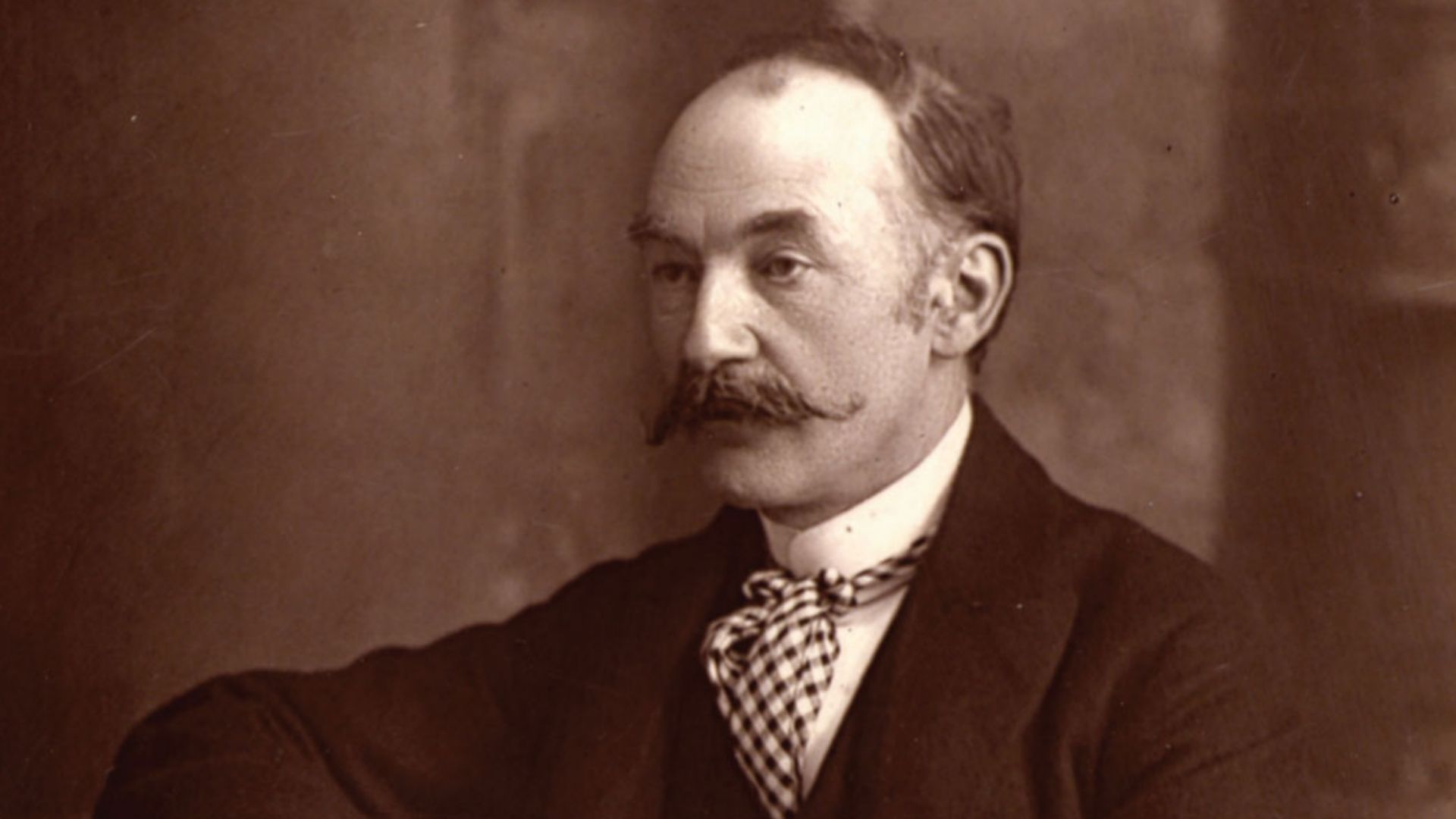

'How Great My Grief' (Triolet)
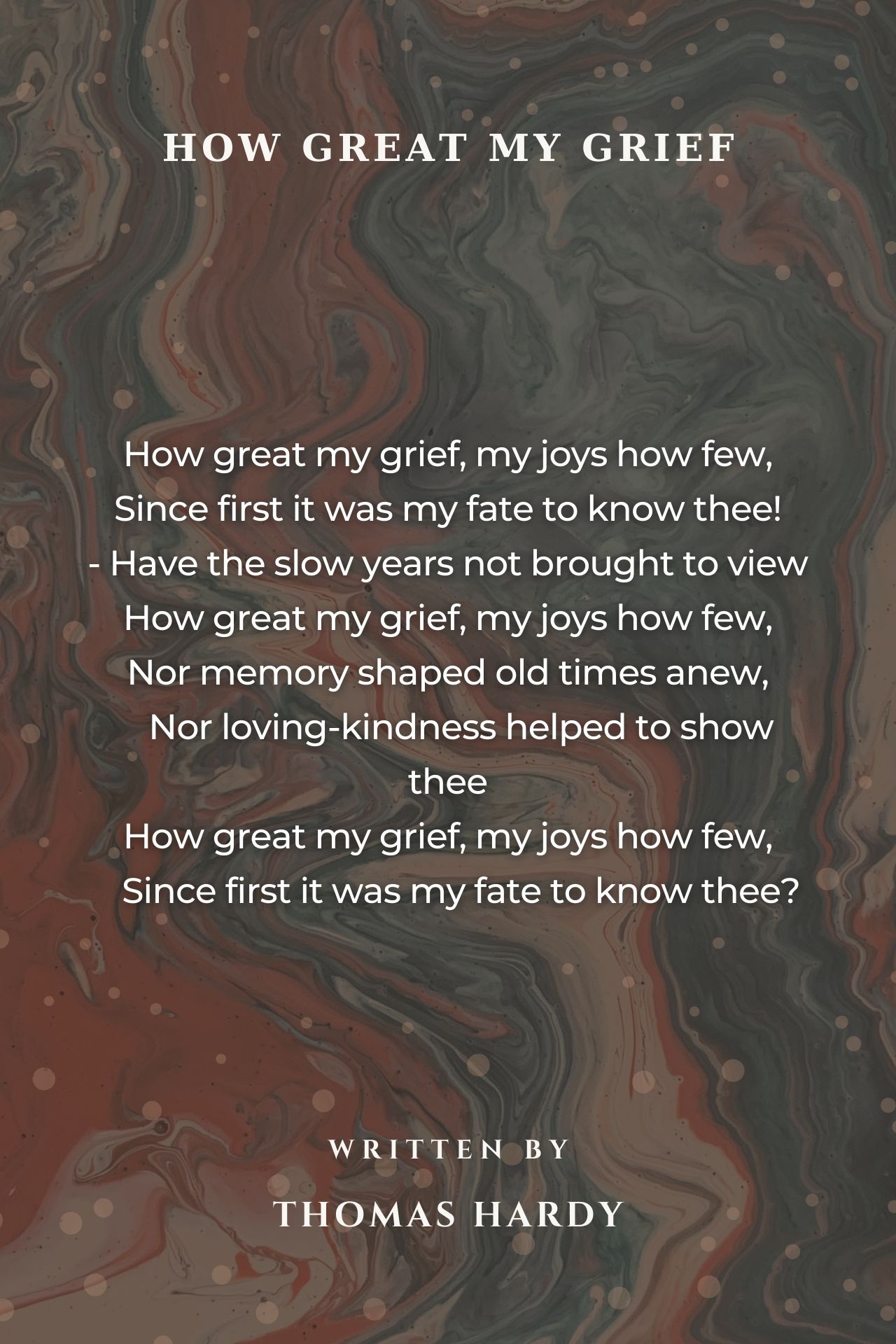
How great my grief, my joys how few,
Since first it was my fate to know thee!
- Have the slow years not brought to view
How great my grief, my joys how few,
Nor memory shaped old times anew,
Nor loving-kindness helped to show thee
How great my grief, my joys how few,
Since first it was my fate to know thee?
This poem can be smd i belive it was ritten by a jew. im asian so im not racist.
Brings forth the point, we meet people who impact our lives sometimes, beyond our comprehension and emotional control.
How great His grief, it's just the same For those who come to know Thee For we see struggles in the game How great His grief, it's just the same For those who follow in Your Name When we realize the pain of those who chose to know Thee How great His grief, it's just the same For the world laughs at those who chose to know Thee
How great my grief, my joys how few, Since first it was my fate to know thee! Two very powerful declarative lines, outline a life which becomes mainly 'slow years' of intense sorrow, with few respites of joy, after a meeting of ill omen. The moral seems to be choose acquaintances and friends wisely and think carefully, before making life altering choices, because some options have devastating consequences. These sentiments are delightfully expressed in a revealing way. This is a cleverly written poem crafted to a rigid requisite. The triolet must be written with eight lines rhyming in an exact rhyme scheme of abaaabab. The first, fourth, and seventh lines must be exactly the same, and the second and eighth lines. Thomas Hardy has written an interesting triolet, which laments the haunting memory of an error of judgement.
FINAL: The speaker reflects on the scarcity of fond moments over the years and the inability of memory or nostalgia to reshape those times. Ultimately, the poem stops short of regretting ever having met their supposed beloved.
This poem centers on the poignant expression of grief by a speaker struggling with domestic life's difficulties. Rather than mourning the loss of a loved one, the poem illustrates the spiraling anxiety of realizing that the person they are with romantically brings more grief than joy.
This poem has not been translated into any other language yet.
I would like to translate this poem



Delivering Poems Around The World
Poems are the property of their respective owners. All information has been reproduced here for educational and informational purposes to benefit site visitors, and is provided at no charge...
9/25/2024 6:37:23 PM # 1.0.0.1119



i relly like this poem it makes me hard as a rock. dont worry, im asian so its okay for me to not be racist towards others. can someone tell me if hes a jew or not because i want to meet him if hes not.