Adelbert Von Chamisso
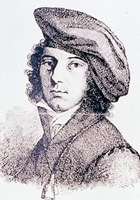

Adelbert Von Chamisso Poems
There lived a sage in days of yore,
And he a handsome pigtail wore;
But wondered much, and sorrowed more,
Because it hung behind him.
...
Burg Nideck ist im Elsaß der Sage wohlbekannt,
die Höhe, wo vorzeiten die Burg der Riesen stand;
...
Ich träum' als Kind mich zurücke
Und schüttle mein greises Haupt;
Wie sucht ihr mich heim, ihr Bilder,
Die lang' ich vergessen geglaubt?
...
Der erste Hohenstaufe, der König Konrad, lag
Mit Heeresmacht vor Weinsberg seit manchem langen Tag.
...
Kann nicht reden, kann nicht schreiben,
Kann nicht sagen, wie mir ist!
Mir ist wohl und bang im Herzen,
...
lasset uns, in dieser düstern, bangen Zeit,
Wo hochanschwellend donnernd der Geschichte Strom
Die starre langgehegte Eisesdecke sprengt,
...
All you do for your children,
For my Doll I do instead,
And in her little cradle
She lies beside my bed.
...
Es geht bei gedämpfter Trommel Klang;
Wie weit noch die Stätte! der Weg wie lang!
O wär er zur Ruh und alles vorbei!
...
Adelbert Von Chamisso Biography
Adelbert von Chamisso was a German poet and botanist. He was born Louis Charles Adélaïde de Chamissot at the château of Boncourt at Ante, in Champagne, France, the ancestral seat of his family. His name appears in several forms, one of the most common being Ludolf Karl Adalbert von Chamisso. Driven out by the French Revolution, his parents settled in Berlin, where in 1796 young Chamisso obtained the post of page-in-waiting to the queen, and in 1798 entered a Prussian infantry regiment as ensign. Shortly thereafter, upon the Peace of Tilsit, his family was permitted to return to France; he remained in Germany and continued his military career. He had little education, and while in the Prussian military service in Berlin assiduously studied natural science for three years. In collaboration with Varnhagen von Ense, he founded (1803) the Berliner Musenalmanach, in which his first verses appeared. The enterprise was a failure, and, interrupted by the war, it came to an end in 1806. It brought him, however, to the notice of many of the literary celebrities of the day and established his reputation as a rising poet. He had become lieutenant in 1801, and in 1805 accompanied his regiment to Hameln, where he shared in the humiliation of its treasonable capitulation in the following year. Placed on parole, he went to France, but both his parents were dead; returning to Berlin in the autumn of 1807, he obtained his release from the service early the following year. Homeless and without a profession, disillusioned and despondent, he lived in Berlin until 1810, when, through the services of an old friend of the family, he was offered a professorship at the lycée at Napoléonville in the Vendée. He set out to take up the post, but instead joined the circle of Madame de Staël, and followed her in her exile to Coppet in Switzerland, where, devoting himself to botanical research, he remained nearly two years. In 1812 he returned to Berlin, where he continued his scientific studies. In the summer of the eventful year, 1813, he wrote the prose narrative Peter Schlemihl, the man who sold his shadow. This, the most famous of all his works, has been translated into most European languages (English by William Howitt). It was written partly to divert his own thoughts and partly to amuse the children of his friend Julius Eduard Hitzig. In 1815, Chamisso was appointed botanist to the Russian ship Rurik, fitted out at the expense of Count Nikolay Rumyantsev, which Otto von Kotzebue (son of August von Kotzebue) commanded on a scientific voyage round the world. His diary of the expedition (Tagebuch, 1821) is a fascinating account of the expedition to the Pacific Ocean and the Bering Sea. During this trip Chamisso described a number of new species found in what is now the San Francisco Bay Area. Several of these, including the California poppy, Eschscholzia californica, were named after his friend Johann Friedrich von Eschscholtz, the Rurik's entomologist. In return, Eschscholtz named a variety of plants, including the genus Camissonia, after Chamisso. On his return in 1818 he was made custodian of the botanical gardens in Berlin, and was elected a member of the Academy of Sciences, and in 1819 he married his friend Hitzig's foster daughter Antonie Piaste (1800–1837). In 1827, partly for the purpose of rebutting the charges brought against him by Kotzebue, he published Views and Remarks on a Voyage of Discovery, and Description of a Voyage Round the World. Both works display great accuracy and industry. His last scientific labor was a tract on the Language of Owyhee. Chamisso's travels and scientific researches restrained for a while the full development of his poetical talent, and it was not until his forty-eighth year that he turned back to literature. In 1829, in collaboration with Gustav Schwab, and from 1832 in conjunction with Franz von Gaudy, he brought out the Deutscher Musenalmanach, in which his later poems were mainly published. He died in Berlin at the age of 57. His grave is preserved in the Protestant Friedhof III der Jerusalems- und Neuen Kirchengemeinde (Cemetery No. III of the congregations of Jerusalem's Church and New Church) in Berlin-Kreuzberg, south of Hallesches Tor. Belles lettres Chamisso's earliest writings, which include a verse translation of the tragedy Le Compte de Comminge in which "heilsam" is used in place of "heilig", show a 20 year old still struggling to master his new language, and a number of his early poems are in French. Between 1801 and 1804 he became closely associated with other writers and edited their journal. As a poet Chamisso's reputation stands high. Frauenliebe und -leben (1830), a cycle of lyrical poems set to music by Robert Schumann, by Carl Loewe, and by Franz Paul Lachner, is particularly famous. Also noteworthy are Schloss Boncourt and Salas y Gomez. He often deals with gloomy or repulsive subjects; and even in his lighter and gayer productions there is an undertone of sadness or of satire. In the lyrical expression of the domestic emotions he displays a fine felicity, and he knew how to treat with true feeling a tale of love or vengeance. Die Löwenbraut may be taken as a sample of his weird and powerful simplicity; and Vergeltung is remarkable for a pitiless precision of treatment. The first collected edition of Chamisso's works was edited by Hitzig and published in six volumes in 1836.)
The Best Poem Of Adelbert Von Chamisso
The Pigtail
There lived a sage in days of yore,
And he a handsome pigtail wore;
But wondered much, and sorrowed more,
Because it hung behind him.
He mused upon this curious case,
And swore he’d change the pigtail’s place,
And have it hanging at his face,
Not dangling there behind him.
Says he, “The mystery I’ve found;
I’ll turn me round.” He turned him round,
But still it hung behind him.
Then round, and round, and out, and in,
All day the puzzled sage did spin;
In vain—it mattered not a pin—
The pigtail hung behind him.
And right, and left, and round about,
And up, and down, and in, and out
He turned. But still the pigtail stout
Hung steadily behind him.
And though his efforts never slack,
And though he twist, and whirl, and tack,
Alas! still faithful to his back
The pigtail hangs behind him!
Adelbert Von Chamisso Comments




Delivering Poems Around The World
Poems are the property of their respective owners. All information has been reproduced here for educational and informational purposes to benefit site visitors, and is provided at no charge...
4/4/2026 10:05:50 PM # 1.0.0