
Alexander Anderson
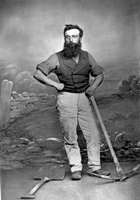

Alexander Anderson Poems
A strappin', sonsie, weel-matched pair
Were Jock Macree an' Maggie Blair,
An' mony wusses, said an' thinkit,
They had that nicht when they were linkit.
...
The bairnies cuddle doon at nicht,
Wi' muckle faucht an' din—
'O, try and sleep, ye waukrife rogues,
Your faither's comin' in'—
...
One red rose you took from my hand—
O the light was sweet that summer day—
One red rose from her queenly band,
That was far too sweet to pine away.
...
The feeble infant, but an hour in life,
Lay wailing in our arms, while on the bed
Slept, like a faded flower, the one year's wife,
With all her mother's first sweet feelings, dead.
...
I heard beneath my feet the clear sharp ring
Of grinding rail and wheel,
I felt, as on we sped with rush and swing,
The carriage sway and reel.
...
Ah, the stream by the ruin in the wood
Has long ago run dry,
And the only voice in the solitude
Is the wind that rushes by.
...
The spirit of God fell on him, and he pass'd
From out the common bounds wherein we move,
And like a mantle round his life he cast
The grandeur of his mission from above.
...
I stood within a wood, and heard the wind
Keep up its music in the solemn trees,
But this could soothe me not, for in my mind
My thoughts were ill at ease;
...
Once again within the city, 'mid its multitudinous din,
Stand I, while, as sinks a leaf when left by the uncertain wind,
So the daily village quiet, and the calm I had within,
Shrinks before the magic contact of the ever-shaping mind.
...
The merry children are playing
In the little village street;
The old men sit by the doorway:
Their evening rest is sweet.
...
Last year I sat within my room,
And heard the cricket in the gloom
Chirp out his palpitating lay,
As if he were on holiday.
...
Wull I ha'e to speak again
To thae weans o' mine?
Eicht o'clock, an' weel I ken
The schule gangs in at nine.
...
The mist lies on Glen Aymer hill,
Listless as if asleep,
Below the silence quivers still
With bleatings of the sheep.
...
The simmer day was sweet an' lang,
It had nae thocht o' sorrow,
As my true love and I stood on
The bonnie banks o' Yarrow.
...
Here's wee Tam aside the fire,
Soun' as soun' can be,
Tangs across his wee fat legs,
...
I am auld an' frail, an' I scarce can gang,
Though whiles when I tak' a turn,
It's only when the sun blinks oot
On the braes by the Vennel Burn.
...
He will not sing his loudest song,
This poet full of love and mirth,
Until the shadows which belong
To night are deep upon the hearth.
...
Whisper, dear, that love is sweet,
Sweeter far than anything;
Brighter than the flowers that grow
...
The humble bee is hiding
In the blossom's golden cells;
He, and he only, can tell me
Where the queen of the fairies dwells.
...
Bless her dear little heart!' said my mate, and he pointed out to me,
Fifty yards to the right, in the darkness, a light burning steady and clear.
'That's her signal in answer to me, when I whistle, to let me see
She is at her place by the window the time I am passing here.'
...
Alexander Anderson Biography
Alexander Anderson (April 30, 1845 – July 11, 1909) was a Scottish poet. Born in Kirkconnel, Dumfries and Galloway, Scotland, the sixth and youngest son of James Anderson a quarrier. When the boy was three, the household moved to Crocketford in Kirkcudbrightshire. He attended the local school where the teacher found him to be of average ability. The area around Croketford was renowned for martyrdom and Anderson seems to have taken inspiration from his walks in the hills in his later poetry. At sixteen he was back in his native village working in a quarry; some two years later (1862), he became a surfaceman or platelayer on the Glasgow and South-western railway, and generally wrote under the name of Surfaceman. Spending all his leisure in self-culture, he mastered German, French, and Spanish sufficiently to read the chief masterpieces in these languages. His poetic vein, which was true if somewhat limited in range, soon manifested itself, and in 1870 he began to send verses to the ‘People's Friend’ of Dundee, and subsequently his fist book ‘A Song of Labour and other Poems’, was published in 1873 by the Dundee advertiser in a run of 1000. Thanks to the support of The Peoples Friend this issue sold out within a fortnight. He was also aided by the support of the Rev George Gilfillan, a poetry critic in Dundee. Gilfillan wrote to Thomas Aird “You will be greatly interested in his simple manner and appearance-an unspoiled Burns is these respects and not without a little real mens divinor. Of course you know his poetry and his remarkable history”. and there followed Two Angels (1875), Songs of the Rail (1878), and Ballads and Sonnets (1879). In the following year he was made assistant librarian in the University of Edinburgh, and after an interval as secretary to the Philosophical Institution there, he returned as Chief Librarian to the university. Thereafter he wrote little. Of a simple and gentle character, he made many friends, including the Duke of Argyll, Thomas Carlyle, and Lord Houghton. A famous poem of his is "Cuddle Doon)
The Best Poem Of Alexander Anderson
The Landlord's Best
A Humorous Reading
A strappin', sonsie, weel-matched pair
Were Jock Macree an' Maggie Blair,
An' mony wusses, said an' thinkit,
They had that nicht when they were linkit.
An' on that day they baith were kirkit,
The lasses sat fu' gleg an' smirkit;
Though there was that upon their faces
That fain wad swappit Maggie places.
An' Jock looked unco gran' beside
His bonnie, blushin', weel-faured bride,
Whom he had vowed to love an' cherish—
Alas! that siccan vows should perish—
For twenty times, an' twenty mair,
When he was courtin' Maggie Blair,
He swore, without ae chance o' blinkin',
Ance Maggie his he'd stop the drinkin'.
For Jock—although I grieve to tell—
When left owre muckle to himsel',
Was jist a wee thing apt, if ony,
O' gettin' fuddled wi' a crony;
Could sing oor auld Scots sangs until
The tears cam' happin' at their will.
And then the ither gill gaed roun',
Untu they felt it tak' their croun;
Then nocht wad ser' them after that
But 'Willie brewed a peck o' maut,'
And Jock wad rise to lead their singin',
Till a' the hoose an' streets were ringin',
'We are na fou we're no' that fou,'
Then stagger hame to prove it true.
But a' sic wark cam' to a stan'
When he took Maggie by the han';
The whisky stoup an' dissipation
Were noo for him a puir temptation.
Nae mair at nicht, when sprees were on,
An' a' the 'Blue Bell' windows shone,
Was Jock's voice heard amid the thrang
Clear ringin' in an auld Scots sang,
In place o' a' sic rant and noise
He noo had calm domestic joys,
Sat wi' his pipe in lordly pride,
A monarch by his ain fireside.
An' Maggie, tidy, neat, an' braw,
The very life an' soul o' a',
Beside him knittin' unco thrang,
An' happy as the day was lang;
For she was ane that couldna sit
An idle moment, but wad knit.
Alas! in spite o' a' love's pleadin',
Jock left his sweet domestic Eden,
For by degrees he slippit doon
To see some neebors in the toon.
Then ane wad cry—'Come, Jock, what's wrang?
It's ages since I heard a sang.
Come in, come in, an' ha'e a gill—
A single glass can do nae ill;
Maggie, though she may look fu' sour,
Can surely spare ye for an hour.'
Jock thocht on Maggie a' her lane,
The vows he made no' lang since gane;
Shook his rouch heid—'I've in the pin,
I canna gang,' and then—gaed in.
That nicht Jock sang—'We are na fou,'
Alas! he sang what wasna true.
An' sae it cam' that mair an' mair
The forenichts saw his empty chair;
An' Maggie, unco wae to see't,
Took mony a lang an' lanely greet,
But ne'er gied Jock a bitter word,
For a' the stories that she heard.
He still was kin', although, by token,
The vows he ance made a' were broken.
Neebors cam' in to settle matters,
An' Maggie listened to their clatters.
Said ane, 'Noo, Maggie, un'erstan'
It's time ye took the upper han',
Rage at him, whether late or sune,
An' cast up a' the ills he's dune;
My fegs, if I were in your place
I'd set my mark upon his face.
Let my gudeman play siccan pranks,
He kens what he wad get for thanks.
The deaf side o' his head wad hear't,
An' weel I ken for that he's fear't.'
Ithers spoke oot wi' bold assertion,
An' a' to ae gran' en'—coercion.
But Maggie loot them say their say,
An', when they a' had gane away,
After anither spell o' grievin',
Sat doon, an' yokit to her weavin'.
Mony a sair, sair heart was hers
To see Jock on the road that errs;
The red upon her bonnie cheek
Grew less, although she wadna speak.
The glances o' her bonnie een
Hadna the licht that ance was seen.
O, Jock, man, look at their saft pleadin',
An' turn back to your ain sweet Eden.
In vain; Jock noo was far astray
Frae Eden an' its happy day;
Was oftener at the 'Blue Bell' Inn
Makin' his weekly wages spin;
Singin', as only he could do—
'We are na fou,' an' gettin' fou.
A neebor, wha had seen for lang
That things wi' her had a' gane wrang,
Cam' in, an', when the twa were sittin'
(Maggie as usual wi' her knittin'),
Said, 'Maggie, hear me for a wee,
But dinna tak' it ill frae me.
I ken that Jock, yer ain gudeman,
Against ye never raised a han',
But we maun mak' him stop the drinkin',
An' here's the ootcome o' my thinkin'.'
Fu' lang the twa were at their crack,
An' mony a face did Maggie mak'.
'Na, na, I couldna ha'e the face
To do that: 'twad be oot o' place.
Yet I wad work wi' a' my micht
To keep Jock trig an' douce an' richt.'
'Then do but this,' her neebor said,
'An' I could maist lay doon my head
He'd sooner jump owre Corsencon
Than look the road the 'Blue Bell's' on.
The landlord will tak' up the plan,
An' try to help us a' he can.
Jist think; it's only ae half hour,
An' after that Jock's in your power—
A sober, decent man, the pride
O' you an' a' the kintra side.'
Maggie thocht lang, an' deep, an' sair:
'If I thocht Jock wad drink nae mair—
I'll do't, I'll do't though a' the folk
Should speak; it's for the gude o' Jock.'
'Aweel,' her neebor said, 'I'll pit
The landlord up to what's on fit,
An' let it be next Friday nicht,
An' gudesake see ye do it richt.'
The Friday nicht cam' duly roun',
An' folk were busy in the toon,
The 'Blue Bell' was as thrang's a fair,
An' Jock, ye needna doot, was there—
The gill stoup had gane roun' to settle
A' qualms an' pit him into fettle.
An' there he sat—a happy man—
A glass o' whisky in his han',
For he had just sat doon frae singin'
'We are na fou,' an' a' was ringin';
When, bang! the door gaed wi' a clash,
An' in cam' Maggie wi' a dash,
Raxed oot her han', drew in a chair,
An' richt forenent him plumpit square;
Cried, 'You that's nearest touch that bell.'
An', when the landlord cam' himsel',
She gied her orders wi' the rest—
'A gill, an' see it's o' your best.'
The drink cam' ben: she filled her gless,
No half, but to the brim nae less,
Then, haudin't up wi' smirkin' pride,
She lookit owre at Jock an' cried—
'Here's to ye, Jock, my man, ye see
What's gude for you is gude for me,
Here's to ye'—an' wi' that she drew
The gless up to her bonnie mou',
Cocked up her finger, drank it a',
Then gied her sonsie face a thraw.
'That's gude,' cried Maggie; 'to my min',
When ance it's owre, it's unco fine.
Nae wunner men drink, for, my sang,
Sic glesses warm the road they gang;
I'll ha'e anither—gude be thankit,'—
Then filled a second glass an' drank it.
But Jock! He sat upon the chair
The very picture o' despair;
His mooth fell doon, an' wide he gapit,
Though no' a single word he shapit.
The glass o' whisky in his han'
Cowpit, an' owre the table ran.
He glowred at Maggie, rubbed his een,
Then glowred again. What could it mean?
An' was that Maggie—surely no'?
An' yet it strack him like a blow.
He sat strecht up, as though his back
Had been o' airn, but never spak'.
'I wuss,' cried Maggie, 'I could sing,
But gi'e that bell anither ring.
Talkin's dry wark, an'—let me see—
Half mutchkin? Ay, bring that to me,
I'll pay my way as lang's I'm able'—
An' banged a shillin' on the table.
Then Jock rose up wi' furious speed,
His een maist startin' frae his heid,
Sprang back, an' sent the coupit chair
Wi' ae kick richt across the flair,
Then, fu' o' shame, an' rage an' doot,
Hung doon his heid and boltit oot.
For days Jock gaed aboot like ane
Whase very heid is on the spin,
While, noo an' then upon his face,
A puzzled look wad tak' its place.
Then he would stop an' scart his croon,
Hotch up his shou'der an' look roun',
Cry, as he gi'ed anither claw—
'I canna un'erstan't ava!
Three gills an' no' a preen the waur,
Far less has garred me tak' the glaur.
It cowes the gowan, an' the mair
I think the mair I rive my hair.'
But aye the upshot o' his thinkin'
Was, 'What if Maggie tak's to drinkin'?
Maggie sae trig an' nice an' braw,
Nae wife like her amang them a',
An' tidy? Ye micht tak', fu' fain,
Your dinner aff the clean hearthstane.
O, Jock, O, Jock, your a' to blame,
But this ae nicht when I get hame
I'll pit my thinkin' into action,
An' wi' her try to mak' a paction.'
That nicht Jock sat, an' sat fu' lang,
Till Maggie thocht some thing was wrang,
For ae half-hour he never spoke,
Nor raxed his pipe doon for a smoke,
But aye he gi'ed anither shift,
Till Maggie catched at last his drift,
An' wi' a woman's tact an' wit,
Resolved to draw him oot a bit:—
'John I'm gaun doon the toon to see
Some frien's o' mine an' crack awee;
I'll no' be lang—rax me my shoon—
An' dinna let the fire gang doon.
I maist forgot, if I should meet
Auld frien's o' yours upon the street,
And should they stop and speer at me,
I'll say ye're weel—and should I see
The landlord —'
Here Jock started up,
Got Maggie's twa hands in his grup—
'Maggie, sit doon an' hear me speak
What I've been thinkin' a' this week,
For God's sake let us stop this drink,
An' never mair on whisky think.
I'm ready ony time to sign
The pledge, if your name gangs wi' mine.'
Then Maggie hung her heid to screen
The joy that danced within her een.
But yet half-feared owre sune to strike—
'It's hard to gi'e up what I like,
But if I thocht ye wad be true,
An' swear to a' ye've said the noo,
I micht be coaxed to answer 'yes,'
An' seal't this moment wi' a kiss.'
'I swear,' quo' Jock, 'an' there's my han',
O, Maggie, I'm a happy man,
But if ye kenned what awfu' doots
I had since'—Maggie whispered, 'Hoots!
Let byganes be—they bring but grief,
For noo we've turned anither leaf,
An' there's your kiss—'
What mair was needin',
To draw Jock back again to Eden?
Lang after that, ae nicht when Jock
Was half-way through a glorious smoke,
A puzzled look spread o'er his face,
An', layin' his pipe upon the brace,
He turned to Maggie, wha was sittin'
As usual busy wi' her knittin',
An' said, 'Noo, Maggie, tell me richt,
Hoo did ye stan' the drink that nicht?
To me 'twad been an unco test—
Hale three gills o' the landlord's best!'
'Aweel,' quo' Maggie, 'I've been thinkin',
That since we baith ha'e stoppit drinkin',
I'll own't—for noo it disna matter—
It was his best, John—It was water.'
Alexander Anderson Comments




Delivering Poems Around The World
Poems are the property of their respective owners. All information has been reproduced here for educational and informational purposes to benefit site visitors, and is provided at no charge...
4/5/2026 5:34:53 PM # 1.0.0


