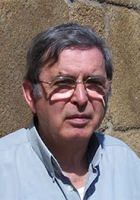

António Manuel Pires Cabral Biography
The author of some forty books of poetry, fiction and essays, A. M. Pires Cabral was born in 1941, in a village of northeastern Portugal, and took a degree in English and German. Unlike many Portuguese writers, who left the interior of the country for the urban centers along the coast, Pires Cabral remained in the region where he was born and raised, working there today as an administrator in the area of culture. The human reality of the rural northeast is very much present in his novels and short stories, as well as in some of his poetry, which at the same time could not be farther removed from the stereotypes of regionalist literature. The dominant theme of his most recent verse collections is a universal one: the lamentable inevitability of death.
It is said they come from Central Europe. I see them coming
from the direction of Grijó, in a weary caravan.
...
Back then our town
would be visited by prostitutes -
our only recourse,
...
Not all insects will make it to November.
In December hardly any wings will be seen
attempting their resigned, late-season
flaps that go nowhere, though the curtains
may yet harbor some survivor
less exposed to the weather. And January
will retain almost no memory of the tiny life
deposited somewhere by diligent females
and tenaciously resistant to the calendar.
I, meanwhile, will have resisted the cold
and perhaps scoffed at the transitory death
of so many humble bodies
gone downriver.
But when May finally beats its drum
or blows its horn,
the shriveled wings will unwrinkle,
the sky will be small, the flowers scarce.
And the vile insects will triumph
over the ice and over me,
my afflictions.
What's the difference between
sixty years and one year?
What difference between a week
and one day?
Unless it's that no insect suffers
the agony of winter, whereas I fiddle
with these words of exorcism,
these laborious dialectics,
and I don't hide my face, since I can't
hide my face, from the vicious
countenance of the long harsh winter
that will seize me by way of the insects.
...
That creature that affronted the dawn
with its acidic, assiduous voice.
That had spurs for its bayonet
and seethed with red envy.
The rooster. One of its bones
still lying in the yard.
...
Here lies a computer
in the trash. And yet
its tin brain contained memory
- gigabytes of it! -, performed
the four mathematical operations
and accepted verses
on its immaculate
virtual whiteness.
Now it can no longer add
or subtract,
nor groan out poems, nor underline
misspelled words.
The droplets of solder, precarious
metal neurons,
have lost their memory.
Tell me, brother,
since you got there first,
what it's like not to function.
And if the rust is painful.
...




Delivering Poems Around The World
Poems are the property of their respective owners. All information has been reproduced here for educational and informational purposes to benefit site visitors, and is provided at no charge...
3/11/2026 10:19:05 PM # 1.0.0