
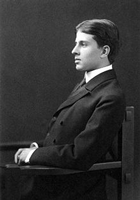

Arthur Upson Biography
Arthur Wheelock Upson (January 10, 1877 - August 14, 1908) was an American poet. He was born in Camden, New York on January 10, 1877 to Spencer Johnson Upson and Julia Claflin. His family moved from New York to Saint Paul, Minnesota in 1894, with Upson entering the University of Minnesota with the class of 1898. There, he served as editor of the campus newspaper, the Minnesota Daily. Unable to complete the requirements for a degree due to his ill health, he was later awarded a degree in 1906 due to his literary success, becoming an instructor there the same year. Upson reworked the song "Hail! Minnesota", at the request of the school's president Cyrus Northrop, the song later becoming the state song of Minnesota and the alma mater of the University of Minnesota.
Upson died at age 31, drowning after falling from his boat in Lake Bemidji, Minnesota on August 14, 1908. His body was found after he had been missing for two days. The boat which he fell from had capsized and had lacked one of its oars. It was suspected that Upson's death was a suicide, as he already attempted suicide only three years before. Upson was mourned as having been a highly promising artist, with the young Sinclair Lewis writing an editorial obituary that exalted Upson, comparing him to a Keats or a Chatterton. His collected poems, edited with an introduction by fellow poet Richard Burton, were published in 1908. Burton also published "an elegy on the death" of Upson in 1910 entitled a Midsummer Memory.
Of old it went forth to Euchenor, pronounced of his sire --
Reluctant, impelled by the god's unescapable fire --
To choose for his doom or to perish at home of disease
Or be slain of his foes, among men, where Troy surges down to the seas.
...
Out of the conquered Past
Unravishable Beauty;
Hearts that are dew and dust
Rebuking the dream of Death;
...
Grow, grow, thou little tree,
His body at the roots of thee;
Since last year's loveliness in death
The living beauty nourisheth.
...
In an old book at even as I read
Fast fading words adown my shadowy page,
I crossed a tale of how, in other age,
At Arqua, with his books around him, sped
...




Delivering Poems Around The World
Poems are the property of their respective owners. All information has been reproduced here for educational and informational purposes to benefit site visitors, and is provided at no charge...
3/14/2026 10:35:47 AM # 1.0.0


