
Elia Abu Madi
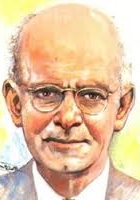

Elia Abu Madi Poems
l came ,l don't know from where or how l came to be l am, or why l came ?l don't know!
l saw a path in front of me l began to walk,l must keep on walking willingly or unwillingly ,whether l agree or not.
How did l came to be? How did l sighted my way? l can't perceive the matter ,l don't know!
Am l new or am l old in this existence ?
...
He said: Lo, the sky is somber, and frowned.
I said: Smile just the same! Enough frowns in the sky
He said: Youth has left me and fled; I said: Smile!
Sorrow will never bring back your vanished youth
...
At one time, Mr. Clay forgot that he was no more than mud
So, he walked insolently, bragged and boasted.
Body covered with fine silk,
He glorified himself in a self-admiring manner,
...
As it shrouded the White City,
The star-studded Night heard a groan
...
O you who complain without an illness
how will you do if you become really ill?
that who is the worst on earth
is that who look for leaving before it is the time
...
Here I am O' my staring country home
Look… do you remember who I am?
Could you glance into the far past?
Of a young boy naïve, careless.
Cheerful, always happy on the farm,
...
You were patience but O` it does not have a benefit after you,
Had it been beneficial, which other soul would need to be patience.
Weeping as for men is abhorred,
Except that, abstainess from it in your case is ingratitude.
...
Nay! It is rather a pathway for the soft breeze
It is a source of water for the birds to drink.
It belongs to the luminaries
To bathe in its cool water, in the summer nights.
...
Elia Abu Madi Biography
Elia Abu Madi (also known as Elia D. Madey; Arabic: إيليا أبو ماضي Īlyā Abū Māḍī [note 1]) (1889 or 1890 – 23 November 1957) was a Lebanese-American poet. Abu Madi was born in the village of Al-Muhaydithah, now part of Bikfaya, Lebanon, in 1889 or 1890. At the age of 11 he moved to Alexandria, Egypt where he worked with his uncle. In 1911, Elia Abu Madi published his first collection of poems, Tazkar al-Madi. That same year he left Egypt for the United States, where he settled in Cincinnati, Ohio. In 1916 he moved to New York and began a career in journalism. In New York Abu Madi met and worked with a number of Arab-American poets including Khalil Gibran. He married the daughter of Najib Diyab, editor of the Arabic-language magazine Mirat al-Gharb, and became the chief editor of that publication in 1918. His second poetry collection, Diwan Iliya Abu Madi, was published in New York in 1919; his third and most important collection, Al-Jadawil ("The Streams"), appeared in 1927. His other books were Al-Khama'il (1940) and Tibr wa Turab (posthumous, 1960). In 1929 Abu Madi founded his own periodical, Al-Samir, in Brooklyn. It began as a monthly but after a few years appeared five times a week. His poems are very well known among Arabs; journalist Gregory Orfalea wrote that "his poetry is as commonplace and memorized in the Arab world as that of Robert Frost is in ours."[note 2] he died in 1957.)
The Best Poem Of Elia Abu Madi
I Do Not Know
l came ,l don't know from where or how l came to be l am, or why l came ?l don't know!
l saw a path in front of me l began to walk,l must keep on walking willingly or unwillingly ,whether l agree or not.
How did l came to be? How did l sighted my way? l can't perceive the matter ,l don't know!
Am l new or am l old in this existence ?
Am l free or am l a captive in confinement?
Do l lead myself or l am being lead ?
l wish l knew ,but l don't know,l don't know!
l must coincide , but why ? l don't know!
III - Is my journey a rough one? Is it a long one?
Is it a short unpredictable one?
Am l walking or time is doing the walking for me ?
l don't know,l don't know!
IV- l saw stars ,but l don't know why they are irradiate ?
l saw the clouds ,but l don't know why they are sending out the rain?
l saw the forest with the trees ,but l don't know why they bear fruit after they bloom?
Are they like me ?they don't know why they came to be?l don't know!
l remember nothing of my past life,l can't predict my coming years.
l know l have a self ,but l don't know what it is?
So when would myself knows itself ,l don't know!
VI- l see a struggle going on within me .
l see myself as the devil then as an angel.
Bad and good battling inside my mind.
Why they keep on fighting ? Why they can't get along ?
l don't know ,l don't know!
Where are my cries and my laughter ?
Where are my sadness and my joy?
Am l sane or am l insane ?
Did l loss every thing ,but how it happened?
l don't know l don't know!
Am l going to be send back after my death?
Old or young,am l going to know myself?
Or am l to be no more? l don't know ,l don't know!
Elia Abu Madi Comments




Delivering Poems Around The World
Poems are the property of their respective owners. All information has been reproduced here for educational and informational purposes to benefit site visitors, and is provided at no charge...
4/6/2026 12:11:47 AM # 1.0.0



One striking theme that runs through Abu Madi's poems is asceticism (zuhdiyah) . I'm not sure if he was a Zahid like Abu Al Alaa Al Ma'arri. It is amazing how the poet wrote these placid, spiritual poems in the hustle and bustle of New York City, where he lived!