
Hiromi Itō
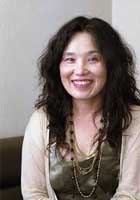

Hiromi Itō Poems
Childbirth was not dying nor defecating
Childbirth was just a very painful period
For the thirty-seven hours from beginning to end
...
I make shiratama
And take them to my man
I heat the sugar and form syrup
Put in the boiled dumplings
...
Mother leads us along
And we get on board
We get on, get off, then on again
We board cars and busses
We board planes
...
Mother leads us along and we get on board
We get on and off again
Boarding cars and buses and planes
Then more buses and trains and cars
...
Can you speak Japanese?
No, I cannot speak
Yes, I can speak
Yes, I can speak but cannot read
...
My grandmother was a medium
My mother was a magician
My mother's older sister was a geisha
My mother's younger sister had tuberculosis
...
More than through skin, more than through sex
Unease is something that becomes clear through language
Something that makes me particular
...
The first time I ever heard about coyotes
Was in a book called (in Japanese) Seton's Animals for Boys and Girls
There I encountered Lobo the Wolf King, bighorn sheep, a family of wild boars, cottontail rabbits, and raccoons, but it was the stories of the wise coyote I loved the best
I read the book over and over, over and over, it taught me the wisdom of rabbits, wolves, wild boars, but nothing surpassed the wisdom of the coyote
Tito was raised by humans, was kept constantly on a leash
No one loved her, they teased her until she ran away
She learned to survive
Ran for her life with her pups in her mouth
Trying to get away from dogs and people
I read about her over and over, over and over
There was a map of America in the front of the book with pictures of animals where the stories took place: coyotes in the central plains, wolves in the southwest and north, elsewhere there were cottontails, boars, and partridges
During my childhood, that was America to me
Where did that book go? I no longer live in my childhood home, not even in the same town, not even in the same country, I lost my place there, I lost people and relationships, almost lost others too, I lost my language, but what about that book I read over and over, over and over? I must have lost it too
Just the other day
I tried searching for it on Amazon
It popped right up, and I ordered it straight away
Lives of the Hunted it's called in English
Published in 1901, reprinted in 1967
It arrived at my home
A former library copy, the word discard stamped on it in big letters, probably the library didn't want it because the stories are too cruel, too cruel for today's youth, nowadays kids are used to killing one another in the virtual world, but even so, the stories are too cruel,
a mother coyote was giving her cubs her milk, was licking them when hunters shot her dead, her cubs fled into their den, only to be dragged out one by one
Here is how the book describes it:
Even at this age there was a certain individuality of character among the puppies. Some of them squealed and some of them growled when dragged out to die. One or two tried to bite. The one that had been slowest to comprehend the danger, had been the last to retreat, and so was on top of the pile, and therefore the first killed. The one that had first realized the peril had retreated first, and now crouched at the bottom of the pile. Coolly and remorselessly the others were killed one by one, and then this prudent little puppy was seen to be the last of the family. It lay perfectly still, even when touched, its eyes being half closed, as, guided by instinct, it tried to "play possum." One of the men picked it up. It neither squealed nor resisted.
Neither squealed
Nor resisted ...
The book was in English, but I could read it quickly
Since I remembered the Japanese
I had read the book over and over, over and over
All the coyote pups were killed
Only one survived, only a single pup
Tossed with its dead littermates into a sack and taken to a farm
In the original, the hunters named her Tito
That's what I had suspected, I had read it in an old translation, kids in Japan back then couldn't be expected to pronounce the unfamiliar sound ti, but that's the version I was brought up on
So for me, her name was always Chito
I was always Chito
Wow-wow-wow-wow-wow-w-o-o-o-o-o-o-w
I remember her voice
When I was a child, I read the book over and over, over and over
Here is how the book describes it:
an inborn hankering to sing
Her songs were
a volley of short barks
mixed with doleful squalls —
Wow-wow-wow-wow-wow-w-o-o-o-o-o-o-w
Here is how the book describes it:
when the sun went down she would feel the impulse to sing that wild song of the West which means so much to the Coyotes. It is not the invention of an individual nor of the present, but was slowly built out of the feelings of all Coyotes in all ages.
I'm not sure if I remember the Japanese correctly
Getting old is no fun at all, you forget important things like that
It is not the invention of an individual nor of the present,
but was slowly built out of the feelings of all Coyotes in all ages and
Her experiences all emphasized for her that old idea to "lay low"—
that is, to be quiet, unobtrusive, and hide when danger is in sight
Those were the most important things I learned as a child
Chito's wisdom
How to survive
Seeing the book, I remembered why
I came to this place called America
The most important things I learned as a child
Were in that book I read over and over
Maybe I had lost them for a while
Or just forgotten
The fate of the animals, their lives and deaths
Their lives upon the plains, and my life too
Chito was killed over and over again
But each time she came back to life
The humans tenaciously, persistently killed her
She tricked them and was tricked by them in return
She scattered her feces, went into heat
The more they hunted her
The more clearly things came into focus
In other words, all the things she thought along the way
Not the invention of an individual nor of the present
But slowly built out of the feelings of all coyotes in all ages
It was for Chito
For Chito
That I abandoned my home, bought an airline ticket
And came to this place
There was someone I barely knew, I'd only barely caught his scent
But still I followed my nose and pursued him
I found a room, rented a car
And stayed the full three months permitted without a visa, I thought I'd try to stay
When people asked me why I'd come, I said
I'm a poet, I've come to learn about the oral traditions of the Native Americans
And that was true
But I didn't even know what I wanted to know
I didn't know where to go
I didn't know whom to ask
I was terrible at speaking with people in my native tongue, so in English it was damn near impossible, I couldn't even tell them who I am (it took me decades to say that even in Japanese)
But the real reason I came
Was because I wanted to encounter a coyote
I wanted to prick up my ears and listen to its howl
Rattling dryly over the roads, through the darkness of night
...
Hiromi Itō Biography
Hiromi Itō ( born September 13, 1955) is one of the most prominent women writers of contemporary Japan, with more than a dozen collections of poetry, several works of prose, numerous books of essays, and several major literary prizes to her name. She divides her time between the towns of Encinitas, California and Kumamoto in southern Japan.)
The Best Poem Of Hiromi Itō
Postpartum
Childbirth was not dying nor defecating
Childbirth was just a very painful period
For the thirty-seven hours from beginning to end
I kept on bleeding just as if
I were having my period
I wanted to change my maxi pad, change it right away
I was constantly aware of my anus but
I knew I didn't have to defecate
The pain was unpleasant, nothing more
The pain was unpleasant
The pain was unpleasant
Dying is unpleasant
Unpleasant
April 30, 9:47 am, a baby girl
3,650 grams, 51 centimeters
After twenty-four hours have passed, the newborn is brought from the nursery and allowed
to be with the mother. A bed for the newborn is placed to the side of the mother's bed, but
everyone puts their baby in the bed with them and sleeps next to it. The bed for the newborn is
so high that unless the mother lifts herself up, she cannot see it.
My baby kept vomiting amniotic fluid in the nursery
May 1, 9:47 am, twenty-four hours had gone by, but there she stayed
May 1, the afternoon goes by and still no baby
May 2, the whole day goes by and still no baby
May 3, the whole morning and still no baby
There is no baby
Anywhere
I haven't started lactating, of course
May 3, 1 pm, the baby arrived
And has existed ever since
Hiromi Itō Comments




Delivering Poems Around The World
Poems are the property of their respective owners. All information has been reproduced here for educational and informational purposes to benefit site visitors, and is provided at no charge...
3/16/2026 3:48:30 PM # 1.0.0


