Ina Coolbrith
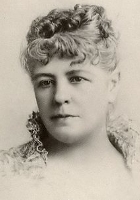

Ina Coolbrith Poems
O foolish wisdom sought in books!
O aimless fret of household tasks!
O chains that bind the hand and mind—
A fuller life my spirit asks!
...
On Hearing Kelley's Music to ‘Macbeth'
O melody, what children strange are these
From thy most vast, illimitable realm?
These sounds that seize upon and overwhelm
The soul with shuddering ecstasy! Lo! here
The night is, and the deeds that make night fear;
Wild winds and waters, and the sough of trees
Tossed in the tempest; wail of spirits banned,
Wandering, unhoused of clay, in the dim land;
The incantation of the Sisters Three,
Nameless of deed and name - the mystic chords
Weird repetitions of the mystic words;
The mad, remorseful terrors of the Thane,
And bloody hands - which bloody must remain.
Last, the wild march; the battle hand to hand
Of clashing arms, in awful harmony,
Sublimely grand, and terrible as grand!
The clan-cries; the barbaric trumpetry;
And the one fateful note, that, throughout all,
Leads, follows, calls, compels, and holds in thrall.
...
NOT yet from the yellow west,
Fade, light of the autumn day
Far lies my haven of rest,
And rough the way.
She has waited long, my own!
And the night is dark and drear
To meet alone.
Not yet, with the leaves that fall,
Fall, rose of the wayside thorn,
Fair and most sweet of all
The summer-born.
But O, for my rose that stands,
And waits, through the lessening year,
My gathering hands!
Fail not, O my life, so fast —
Fail not till we shall have met:
Soon, soon will thy pulse be past,
But oh, not yet! —
Till her fond eyes on me shine,
And the heart so dear, so dear,
Beats close to mine.
...
No lurking shadows here appear;
The weaving spider comes not here;
Here, if the solemn Owl doth sit,
‘Tis but above the tapers lit,
To blink at wisdom's shinning wit.
The skies are blue, the winds are fair,
Nor place nor space for tyrant care
Within the bounds, Bohemia.
Lo! gold is much, but ‘tis not all-
Too oft a lure the soul to thrall;
The subtle brain, the skilled hand,
Of melody the magic wand,
The silent songs the poets sing,
Which through the world take voice and wing,
The sparkling jest, the laughing lip,
The royal, genial fellowship-
Of these thy wealth, Bohemia.
O children of the Cloudless Clime!
Where'er the changing sands of time
Have borne ye, lo! from one and all
The voices answer, voices call!
From Seen, and from the Unseen Land,
Where, unforgot, dear comrades stand,
Lift loyal heart and loyal hand,
With love of thee, Bohemia.
...
HOW looked the earth unto His eyes,
So lately closed OH Paradise?
Clad all in purity
Of snowy raiment, as a bride
That waiteth for her lord to see —
That waiteth in her love and pride?
Was the snow white on fields and rocks,
Whereon the shepherds watched their flocks
In the mid-winter night?
And saw the angel, clothed in white,
The heavenly gates that opened wide,
In midst whereof was One
They dared not gaze upon!
Snow hither, thither, and afar,
Beneath the new, mysterious star?
Snow upon Lebanon,
Whose cedars stood, a crystal net
Of frost-work, beautiful to see?
Snow upon Olivet —
Snow upon awful Calvary?
Found He it fair to look upon,
Beneath the wooing of the sun?
The turf whereon He trod,
Did he not bend His glance to greet?
The daisy glancing from the sod,
The lily slim and tall;
The ferny banks of sheltered nooks,
The singing voice within the brooks,
Each slender blade of grass that sprang,
The tender shade of- leafy ways,
Each little bird that sang
Its wee heart out in praise —
I think He found them sweet,
He knew and loved them all.
...
What wizardry is this? What necromance?
These forest-aisles, these mountains grim and vast?
These shadowy forms and faces that advance
From out of the misty past?
The old familiar faces, how they crowd!
Like ghosts returning from the farther shore!
These Beings without Being, yet endowed
With life for evermore.
Each in my own life-weft has woven part,
Whether or grave or gay; unkempt or shorn;
This one, ‘The Luck' they call him, stole my heart
The day that he was born.
With these I sat beside the camp-fire's glow
And heard, through untaught lips, old Homer tell
The Tale of Troy, till with the falling snow
God's last white silence fell.
I knew the cabin in the lone ravine
Where she, the Fallen, far from mart and men,
Watched by the stricken and, unknown, made clean
Her garment's hem again.
And these, the Partners in world-storm and stress,
With faithful love, unknowing selfish aim;
The friendship pure that grew not cold nor less
Through good or evil fame.
These, too (I loved them!) , reckless, debonair,
That life and fortune staked upon a cast;
The soul itself held lightly as the air,
To win or lose at last.
I tracked the mountain trail with them; the sweet
Cool smell of pines I breathed beneath the stars;
The laugh, the song I heard; the rhythmic feet
To tinkle of guitars.
I knew the Mission's fragrant garden-close,
Heavy with blooms the wind might scarcely stir,
Its little laughing maid-Castilian rose! -
And saucy speech of her.
I knew them all-but best of all I knew
(Who in himself had something of all these)
The Man, within whose teeming fancy grew
These wondrous histories.
I see him often, with the brown hair half
Tossed from the leaning brow, the soft yet keen
Gray eyes uplifted with a tear or laugh
From the pen-pictured scene.
And hear the voice that read to me his dear
World-children-and I listen till I seem
Back in the olden days; they are the near
And these are but a dream.
O Prince of Song and Story! Thee we claim,
The first and dearest, still our very own!
We will not yield the glory of thy name
Nor share thy laureled throne!
Altho beneath a gray and alien sky,
Across long leagues of land and leagues of wave,
We may not reach thy dust with tear and sigh,
Nor deck thy lonely grave.
...
NAY, then, what can be done
When love is flown,
When love has passed away?
Sit in the twilight gray,
Thinking how near he was,
Thinking how dear he was,
That is no more, to-day!
How can the day be fair
Love may not share?
How day go by,
Hearing no fond words said,
With no dear kisses shed—
O, how can love be dead,
And yet not I!
...
An Atom, formless, in the void of space,
Wherein but the One presence, All in All,
That drew me, drew me, until like a cry,
Was felt at last the pulse of my desire-
‘Life! Life! O Thou that Art, give to me to be! '
Eon on eon, change evolving change,
Time, time almost that seemed eternity,
And then the Being I! the answered prayer!
The happier, wiser, greater, now than then-
Sensate to stand upon one grain of sand
Of this small sparkle of the Universe-
Keen to its measureless immensity,
With all the questionings unsatisfied?
Of what avail? An Atom, still, in space,
Wherein the Light obscurer grows, recedes-
That may not see, nor reach, nor understand.
Ah! did the Source, all-merciful, foresee,
And add to Life the greater boon Return,
And end of all?
Or is it end of all?
...
BALMILY, balmily, summer wind,
Sigh through the mountain passes;
Over the sleep of the beautiful deep,
Over the woods' green masses —
Ripple the grain of valley and plain,
And the reeds and the river grasses.
How many songs, O summer wind,
How many songs you know
Of fair, sweet things in your wanderings,
As over the earth you go,
To the Norland bare and bleak, from where
The red south roses blow.
Where the red south blossoms blow, O wind,
(Sing low to me, low and stilly!)
And the golden green of the citrons lean
To the white of the saintly lily;
Where the sun-rays drowse in the orange boughs.
(Sing, sing, for the heart grows chilly!)
And the belted bee hangs heavily
In rose and daffodilly.
I know a song, O summer wind,
A song of a willow-tree:
Soft as the sweep of its fringes deep
In languorous swoons of tropic noons,
But sad as sad can be!
Yet I would you might sing it, summer wind,
I would you might sing it me.
(O tremulous, musical murmur of leaves!
O mystical melancholy
Of waves, that call from the far sea-wall! —
Shall I render your meaning wholly,
Ere the day shall wane to the night again,
And the stars come, slowly, slowly?)
I would you might sing me, summer wind,
A song of a little chamber:
Sing soft, sing low, how the roses grow,
And the starry jasmines clamber;
Through the emerald rifts how the moonlight drifts,
And the sunlight's mellow amber.
Sing of a hand in the fluttering leaves,
Like a wee white bird in its nest:
Of a white hand twined in the leaves to find
A bloom for the fair young breast;
Sing of my love, my little love,
My snow-white dove in her nest,
As she looks through the fragrant jasmine leaves
Into the wasting west.
Tenderly, tenderly, summer wind,
With murmurous word-caresses,
O, wind of the south, to her beautiful mouth
Did you cling with your balmy kisses?
Flutter and float o'er the white, white throat,
And ripple the golden tresses?
'The long year groweth from green to gold,'
Saith the song of the willow-tree:
'My tresses cover, my roots enfold,'
O, summer wind, sing it me!
Lorn and dreary, sad and weary,
As lovers that parted be —
But sweet as the grace of a fair young face
I never again may see!
...
Be happy, happy, little maid,
Under the rose in blossom!
Whitely flutter its petals down
Over the whiter bosom.
Beauty and sunshine thine today
With never thought of sorrow...
As glad a day, as fair a sky,
Be thine upon the morrow!
...
Took a walk together;
O, how beautiful the way
Through the blooming heather!
Far-off bells rang matin-chimes,
Birds sang, silver-voicing,
And our happy hearts beat time
To the earth's rejoicing.
Well-a-day! ah, well-a-day!
Then pale grief had missed me,
And mirth and I kept company
Ere Cupid kissed me!
Love ran idly where he would,
Child-like, all unheeding;
I as carelessly pursued
The pathway he was leading:
Till upon the shadowed side
Of a cool, swift river,
Where the sunbeams smote the tide,
Goldenly a-quiver—
Well-a-day! ah, well-a-day!
'Love,' I cried, 'come rest thee.'
Ah, but heart and I were gay
Ere Cupid kissed me!
Shadows of a summer cloud
Fell on near and far land;
Fragrantly the branches bowed
Every leafy garland;
While with shining head at rest,
Next my heart reclining,
Love's white arms, with soft caress,
Round my neck were twining.
Well-a-day! ah, well-a-day!
Love who can resist thee?
On the river-banks that day
Cupid kissed me!
Woe is me! in cheerless plight,
By the cold, sad river,
Seek I Love, who taken flight,
Comes no more forever:
Love from whom more pain than bliss
Every heart obtaineth,
For the joy soon vanished is
While the pang remaineth.
Well-a-day! ah, well-a-day!
Would, Love, I had missed thee,
Peace and I are twain for aye,
Since Cupid kissed me.
...
To feel your arms about me,
To see your living face,
Of all within God's giving
This were supremest grace!
To be again together
As in long years ago,
Were all, were all of Heaven
My soul would ask to know.
...
NOW the- summer all is over!
We have wandered through the clover,
We have plucked in wood and lea
Blue-bell and anemone.
We were children of the sun,
Very brown to look upon:
We were stainéd, hands and lips,
With the berries' juicy tips.
And I think that we may know
Where the rankest nettles grow,
And where oak and ivy weave
Crimson glories to deceive.
Now the merry days are over!
Woodland - tenants seek their cover,
And the swallow leaves again
For his castle-nests in Spain.
Shut the door, and close the blind:
We shall have the bitter wind,
We shall have the dreary rain
Striving, driving at the pane.
Send the ruddy fire - light higher;
Draw your easy chair up nigher;
Through the winter, bleak and chill,
We may have our summer still.
Here are poems we may read,
Pleasant fancies to our need:
Ah, eternal summer-time,
Dwells within the poet's rhyme!
All the birds' sweet melodies
Linger in these songs of his;
And the blossoms of all ages
Waft their fragrance from his pages.
...
To Edmund Clarence Stedman on his seventieth birthday, October 8,1903
Who wears this crown-greater than kings may wear-
Is monarch of a kingdom, once possessed,
Nor foe nor fate from him may ever wrest!
Illimitable as space is, and as fair
As its illumined depths, he gathers there
All things, obedient to his high behest.
His is the sea, the valley's verdant breast,
And his the mountain-summit, lost in air.
Thought's infinite range to him no barrier bars;
His soul no boundary knows of time or space;
Bird, beast, flower, tree, to him in love belong;
Child of the earth, yet kindred to the stars,
He walks in dreams with angels face to face,
And God Himself speaks in his voice of song.
...
O WINDS, that ripple the long grass!
O winds, that kiss the jeweled sea!
Grow still and lingering as you pass
About this laurel tree.
Great Shasta knew you in the cloud
That turbans his white brow; the sweet,
Cool rivers; and the woods that bowed
Before your pinions fleet.
With meadow scents your breath is rife;
With red - wood odors, and with pine:
Now pause and thrill with twofold life,
Each spicy leaf I twine.
The laurel grows upon the hill
That looks across the western sea.
O winds, within the boughs be still,
O sun, shine tenderly,
And birds, sing soft about your nests:
I twine a wreath for other lands;
A grave! nor wife nor child has blest
With touch of loving hands.
Where eyes are closed, divine and young,
Dusked in a night no morn may break,
And hushed the poet lips that sung,
The songs none else may wake:
Unfelt the venomed arrow-thrust,
Unheard the lips that hiss disgrace,
While the sad heart is dust, and dust
The beautiful, sad face!
For him I pluck the laurel crown!
It ripened in the western breeze,
Where Saucelito's hills look down
Upon the golden seas;
And sunlight lingered in its leaves
From dawn, until the scarce dimmed sky
Changed to the light of stars; and waves
Sang to it constantly.
I weave, and strive to weave a tone,
A touch, that, somehow, when it lies
Upon his sacred dust, alone,
Beneath the English skies,
The sunshine of the arch it knew,
The calm that wrapt its native hill,
The love that wreathed its glossy hue,
May breathe around it still!
...
Robin sang a song for me
Once upon a day,
Never throat of Robin piped
Bonnier roundelay!
Robin built a home for him
In the apple-boughs;
There with wife and family
Kept he merry house.
But my Robin, overseas,
Where is song of his?
When that golden rapture breaks
The long silences?
O my lonely walls, no more
Glorious with sound!
Broken roof and rafter, mine,
Prone upon the ground!
What to me the nested tree,
Linnet, lark and wren?
Song that with my Robin dies
Never wakes again!
...
IN a garden that I know,
Only palest blossoms blow.
There the lily, purest nun,
Hides her white face from the sun,
And the maiden rose-bud stirs
In a garment fair as hers.
One shy bird, with folded wings,
Sits within the leaves and sings;
Sits and sings the daylight long,
Just a patient plaintive song.
Other gardens greet the spring
With a blaze of blossoming;
Other song-birds, piping clear,
Chorus from the branches near:
But my blossoms, palest known,
Bloom for me and me alone;
And my bird, though sad and lonely,
Sings for me, and for me only.
...
Just to make Pancho jealous-ay de mi! -
With Juan I flittered. I cared not for Juan,
Yet talked, laughed, danced with him, just but to see
My Pancho's eyes grow flame as he looked on.
Padre, it is the woman's way, you know-
And I'm but woman: Si, 'with fire to play.'
What would you? Could I dream ‘twould madden so?
Ah, God! the fires of hell are mine today!
‘Twas in the moonlight, in the garden where'
The roses bloom the thickest, night half sped,
And Juan had placed a rose bud in my hair-
There was a flash of steel, and Juan lay dead.
Mary! Madonna! Help Thou me this day!
Pancho I loved-him only, Mother Divine! . . .
And Juan is dead. . . O Padre mio, pray!
Pray for my soul, for Pancho's soul and mine!
...
CHEEKS of an ominous crimson,
Eye-brows arched to a frown,
Pretty red lips a-quiver
With holding their sweetness down;
Glance that is never lifted
From the hands that, in cruel play.
Are tearing the white-rose petals,
And tossing their hearts away.
Only to think that a whisper,
An idle, meaningless jest,
Should stir such a world of passion
In a dear, little, loving breast!
Yet ever for such light trifles
Will lover and lass fall out,
And the humblest lad-grow haughty,
And the gentlest maiden pout.
Of course, I must sue for pardon;
For what I can hardly say !—
But, deaf to opposing reason,
A woman will have her way.
And when, in despite her frowning,
The scorn, the grief, and the rue,
She looks so bewitchingly pretty,
Why, what can a fellow do?
...
Who say these walls are lonely-these-
They may not see the motley throng
That people it, as thick as bees
The scented clover beds among.
They may not hear, when footfalls cease,
And living voices, for awhile,
The speech, in many tongues and keys,
Adown each shadowy aisle.
Here are the friends that ne'er betray;
Companionship that never tires;
Here voices call from voiceless clay,
And ashes dead renew their fires.
For death can touch the flesh alone;
Immortal thought, from age to age
Lives on, and here, in varied tone,
It speaks from many a page.
Here searching History waits- the deeds
Of man and nation to rehearse:
Here clear-eyed Science walk and reads
The secrets of the universe.
Here lands and seas, from pole to pole,
The traveler spreads before the eye;
Here Faith unfolds her mystic scroll
The soul to satisfy.
Here Homer chants heroic Troy,
Here Dante strikes the harp in pain,
Here Shakespeare sounds the grief, the joy,
Of all human life and strain.
Alone and silent? Why, ‘tis rife
With form and sound! The hosts of thought
Are dwellers here; and thought is life.
Without it earth and man are not.
To war and statecraft leave the bay-
A greater crown to these belongs;
The rulers of the world are they
Who make its books and songs.
...
Ina Coolbrith Biography
Ina Donna Coolbrith (March 10, 1841 – February 29, 1928) was an American poet, writer, librarian, and a prominent figure in the San Francisco Bay Area literary community. Called the "Sweet Singer of California", she was the first California Poet Laureate and the first poet laureate of any American state. Coolbrith, born the niece of Latter Day Saint movement founder Joseph Smith, left the Mormon community as a child to enter her teens in Los Angeles, California, where she began to publish poetry. She terminated a youthful failed marriage to make her home in San Francisco, and met writers Bret Harte and Charles Warren Stoddard with whom she formed the "Golden Gate Trinity" closely associated with the literary journal Overland Monthly. Her poetry received positive notice from critics and established poets such as Mark Twain, Ambrose Bierce and Alfred Lord Tennyson. She held literary salons at her home—in this way she introduced new writers to publishers. Coolbrith befriended the poet Joaquin Miller and helped him gain global fame. While Miller toured Europe and lived out their mutual dream of visiting Lord Byron's tomb, Coolbrith was saddled with custody of his daughter, and the care of members of her own family, so she set up house in Oakland and accepted the position of city librarian. Her poetry suffered as a result of her long work hours, but she mentored a generation of young readers including Jack London and Isadora Duncan. After she served for 19 years, Oakland's library patrons called for reorganization, and Coolbrith was fired. She moved back to San Francisco and was invited by members of the Bohemian Club to be their librarian. Coolbrith began to write a history of California literature, including much autobiographical material, but the fire following the 1906 San Francisco earthquake consumed her work. Author Gertrude Atherton and Coolbrith's Bohemian Club friends helped set her up again in a new house, and she resumed writing and holding literary salons. She traveled by train to New York City several times and, with fewer worldly cares, greatly increased her poetry output. On June 30, 1915, Coolbrith was named California's poet laureate, and she continued to write poetry for eight more years. Her style was more than the usual melancholic or uplifting themes expected of women—she included a wide variety of subjects in her poems, which were noted as being "singularly sympathetic" and "palpably spontaneous". Her sensuous descriptions of natural scenes advanced the art of Victorian poetry to incorporate greater accuracy without trite sentiment, foreshadowing the Imagist school and the work of Robert Frost. California poet laureate Carol Muske-Dukes wrote of Coolbrith's poems that, though they "were steeped in a high tea lavender style", influenced by a British stateliness, "California remained her inspiration." Ina Coolbrith was born Josephine Donna Smith in Nauvoo, Illinois, the last of three daughters of Agnes Moulton Coolbrith and Don Carlos Smith, brother to Joseph Smith Coolbrith's father died of malarial fever four months after her birth, and a sister died one month after that; Coolbrith's mother then married Joseph Smith, in 1842, becoming his sixth or seventh wife, depending on whether Fanny Alger is counted as a wife or as a lover. No children came of the union—Agnes felt neglected in her unfruitful Levirate marriage, the only such marriage of Smith. Over the next two years, Smith married some 20 to 30 more wives, angering non-Mormons in the area. In June 1844, Smith was killed at the hands of an anti-Mormon, anti-polygamist mob. Losing her faith and fearful of her life, Coolbrith's mother left the Latter-day Saint community and moved to Saint Louis, Missouri, where she married a printer and lawyer named William Pickett. Twin sons were born to the couple, and in 1851 Pickett traveled overland with his new family to California in a wagon train. On the long trek, the young Ina read from a book of Shakespeare's works and from a collection of Byron's poems.As a ten-year-old girl, Ina entered California in front of the wagon train with the famous African-American scout Jim Beckwourth, riding with him on his horse, through what would later be named Beckwourth Pass. The family settled in Los Angeles, California, and Pickett established a law practice. To avoid identification with her former family or with Mormonism, Ina's mother reverted to using her maiden name, Coolbrith. The family resolved not to speak of their Mormon past, and it was only after Ina Coolbrith's death that the public learned of her origin. Coolbrith, sometimes called "Josephina" or just "Ina", wrote poems beginning at age 11, first publishing "My Ideal Home" in a newspaper in 1856, writing as Ina Donna Coolbrith. Her work appeared in the Poetry Corner of the Los Angeles Star, and in the California Home Journal. As she grew into young womanhood, Coolbrith was renowned for her beauty; she was selected to open a ball with Pío Pico, the last Mexican governor of California. In April 1858 at the age of 17, she married Robert Bruce Carsley, an iron-worker and part-time actor, but she suffered abuse at his hands, and further emotional pain came from the death of the couple's infant son. An altercation between Pickett and Carsley resulted in a bullet mutilating Carsley's hand, requiring amputation. Carsley accused Coolbrith of infidelity, and she divorced him in a sensational public trial; the dissolution was final on December 30, 1861. Her later poem, "The Mother's Grief", was a eulogy to her lost son, but she never publicly explained its meaning—it was only upon Coolbrith's death that her literary friends discovered she had ever been a mother. In 1862, Coolbrith moved with her mother, stepfather and twin half-brothers to San Francisco to ward off depression, and changed her name from Josephine Donna Carsley to Ina Coolbrith. Coolbrith soon met Bret Harte and Samuel Langhorne Clemens, writing as Mark Twain, in San Francisco. In 1867, four of Coolbrith's poems appeared in The Galaxy. In July 1868, Coolbrith supplied a poem, "Longing", for the first issue of the Overland Monthly, and served unofficially as co-editor with Harte in selecting poems, articles and stories for the periodical. She became a friend of actress and poet Adah Menken,adding to Menken's credibility as an intellectual, but was unable to impress Harte of Menken's worth.Coolbrith also worked as a schoolteacher for extra income. For a decade, Coolbrith supplied one poem for each new issue of the Overland Monthly.[18] After the 1866 publication of four of her poems in an anthology edited by Harte, Coolbrith's "The Mother's Grief" was positively reviewed in The New York Times. Another poem, "When the Grass Shall Cover Me", appeared unattributed in an anthology of John Greenleaf Whittier's favorite works by other poets, entitled Songs of Three Centuries (1875); Coolbrith's poem was judged the best of that group. In 1867, recently widowed Josephine Clifford arrived at the Overland Monthly to take a position as secretary. She formed a lifetime friendship with Coolbrith. Coolbrith's literary work connected her with poet Alfred Lord Tennyson and naturalist John Muir, as well as Charles Warren Stoddard who also helped Harte edit the Overland Monthly. As editors and arbiters of literary taste, Harte, Stoddard and Coolbrith were known as the "Golden Gate Trinity". Stoddard once said that Coolbrith never had any of her literary submissions returned from a publisher. Coolbrith met writer and critic Ambrose Bierce in 1869, and by 1871 when he was courting Mary Ellen Day, Bierce organized friendly card games between himself, Day, Coolbrith and Stoddard. Bierce felt that Coolbrith's best poems were "California", the commencement ode she wrote for the University of California in 1871, and "Beside the Dead", written in 1875. A finely detailed monochrome photograph portrait of a bearded and mustachioed man in his 30s or 40s, shown from the waist up, wearing a jacket and vest over a white shirt with its collar closed by a cravat secured by a jeweled finger ring, a multi-corded watch fob hanging from a vest button, decorated by another ring, the man's hands together in his lap, his body leaning to the left and the head turned to the right, his dark hair full and long in the back, long but thin on top, revealing a high forehead In mid-1870, Coolbrith met the eccentric poet Cincinnatus Hiner Miller, newly divorced from his second wife, and introduced him to the San Francisco literary circle at the suggestion of Stoddard. Miller quoted Tennyson in describing Coolbrith as "divinely tall, and most divinely fair". Coolbrith discovered that Miller was appreciative of the heroic, tragic life of Joaquin Murrieta, and she suggested that Miller take the name Joaquin Miller as his pen name, and that he dress the part with longer hair and a more-pronounced mountain man costume.Coolbrith helped Miller prepare for his trip to England, where he would lay a laurel wreath on the tomb of Lord Byron, a poet they both greatly admired. The two gathered California Bay Laurel branches in Sausalito and took portrait photographs together. Coolbrith wrote "With a Wreath of Laurel" about this enterprise.Miller went to New York by train, calling himself "Joaquin Miller" for the first time, and was in London by August 1870. When he placed the wreath at the Church of St. Mary Magdalene, Hucknall, it caused a stir among the English clergy who did not see any connection between California poets and the late lord. They sent to Constantine I, the King of Greece for another laurel wreath from that country of Byron's heroic death, accompanied by some Greek funding which was joined in kind from the purse of the Bishop of Norwich to rebuild and refurbish the 500-year-old church. The two wreaths were hung side by side over Byron's tomb.)
The Best Poem Of Ina Coolbrith
Longing
O foolish wisdom sought in books!
O aimless fret of household tasks!
O chains that bind the hand and mind—
A fuller life my spirit asks!
For there the grand hills, summer-crowned,
Slope greenly downward to the seas;
One hour of rest upon their breast
Were worth a year of days like these.
Their cool, soft green to ease the pain
Of eyes that ache o'er printed words;
This weary noise - the city's voice,
Lulled in the sound of bees and birds.
For Eden's life within me stirs,
And scorns the shackles that I wear;
The man-life grand - pure soul, strong hand,
The limb of steel, the heart of air!
And I could kiss, with longing wild,
Earth's dear brown bosom, loved so much,
A grass-blade fanned across my hand,
Would thrill me like a lover's touch.
The trees would talk with me; the flowers
Their hidden meanings each make known—
The olden lore revived once more,
When man's and nature's heart were one!
And as the pardoned pair might come
Back to the garden God first framed,
And hear Him call at even-fall,
And answer, ‘Here am I,' unshamed—
So I, from out these toils, wherein
The Eden-faith grows stained and dim,
Would walk, a child, through nature's wild,
And hear His voice and answer Him.
Ina Coolbrith Comments




Delivering Poems Around The World
Poems are the property of their respective owners. All information has been reproduced here for educational and informational purposes to benefit site visitors, and is provided at no charge...
4/5/2026 3:20:56 PM # 1.0.0