
Jan Struther

Jan Struther Poems
THE raw materials of love are yours-
Fond hearts, and lusty blood, and minds in tune;
And so, dear innocents! you think yourselves
...
When to this fire I held a taper,
First flared the impressionable paper;
I watched the paper, as I stood,
Kindle the more enduring wood;
...
The bus is swaying. We have left Sloane Square.
Noisily the conductor climbs the stair.
'Fares, please!' says he. 'Two penny ones,' say I.
'Two to World's End?' says he. I want to cry,
...
You think yourselves the adventurous ones, you young ones,
And us becalmed, torpid, our days uneventful,
Our blood stagnant, our minds' antennae blunted:
But I, who was young and now am old, can tell you
There is no adventure like the adventure of age.
...
Sir Daniel was a fearless knight;
In doublet green he went to fight.
The yellow plumes upon his head
Like the sun their brightness shed.
...
King Midas saw a buttercup
In a meadow blowing;
King Midas saw a marigold
In a garden growing;
...
THROUGH space and time I range
Seeking these two alone:
The savour of the strange,
The solace of the known.
...
THEY are wrong. It is not the knowing of good from evil,
Virtue from vice,
God from devil,
That drives us from paradise:
...
Some god, quite irresponsible and young,
Has jumbled time and place and dealt amiss:
A day of Grecian spring-time he has flung
Into this winter-bound Metropolis.
...
ACROSS our universe of steady stars,
Of maypole planets tethered to the sun,
Sometimes a wonder flies.
...
NOT much longer now
Will the eye see
Bonework of bole and bough,
The beautiful, austere
Essentials of the tree.
Intricate tracery
...
She said, 'I have no need for treasure,
For brooches and for jewelled rings.'
Proudly she said, 'I take my pleasure
In truer, kindlier things.'
She said, 'I have a dear lover,
...
Earth has borne a little son;
He is a very little one.
He has a head of golden hair
And a grave, unwinking stare.
...
Saint Valentine looked down from heaven
Upon his own especial day,
And scanned the broad face of the earth
Below him as it lay.
...
She was too lovely for remembrance-
Let us forget her like a dream,
Lest all our days and all our nights hereafter
Empty should seem.
...
TO grow older is this:
To feel on the first rose
The breath malign and fell
Of the first icicle,
And in the earliest kiss
...
PASTICHE
MAID, would you keep your heart
Smooth as unprinted snow?
Are you afraid to know
The turmoil and the smart,
...
YOU ask me, What is love? It is a craving
To spin the dawdling globe with a flicked finger
Till meeting come, and then
To slow it down again
...
I HATE to watch them reaping the Five Acre,
The field at the hill's foot, steeply sloping.
One sees the pattern too clearly, with a God's-eye view:
Sees how Time, with soothing quotidian clatter,
...
Country lovers play at love
In a scene all laid for loving.
Marriage-making stars above
Gossip and wink and look approving,
...
Jan Struther Biography
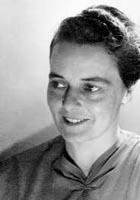
Jan Struther was the pen name of Joyce Anstruther, later Joyce Maxtone Graham and finally Joyce Placzek (June 6, 1901 – July 20, 1953), an English writer remembered for her character Mrs. Miniver and a number of hymns, such as "Lord of All Hopefulness". She was the daughter of Henry Torrens Anstruther and Eva Anstruther and spent her childhood in Whitchurch in Buckinghamshire, England. In 1923 she married Anthony Maxtone Graham, a broker at Lloyd's, with whom she had three children. In the 1930s she started to write for Punch magazine, and this brought her to the attention of The Times newspaper, where Peter Fleming asked her to write a series of columns for the paper, about "an ordinary sort of woman who leads an ordinary sort of life - rather like yourself". The character she created, Mrs Miniver, proved a huge success, and the columns were subsequently collected into book form in 1939. Upon the outbreak of war, this book was used as the basis for a patriotic and sentimental film about Mrs Miniver, released in 1942, which won six Academy Awards, including Best Picture. By this time, Struther had herself gone to America as a lecturer. In the 1940s she was a frequent guest panelist on the popular American radio quiz show Information Please, where she provided a warm and witty presence. She was one of the few women panelists to appear repeatedly on the program. An apocryphal story, attributed to fellow panelist Oscar Levant, tells that her appearances on the show stopped abruptly after she answered a question by referring to Agatha Christie's book Ten Little Niggers, which was the original British title of the book Ten Little Indians (later retitled And Then There Were None). But in fact, the episode of Information Please in which Struther used the original Christie title in her answer to a listener question was broadcast February 7, 1941, while the majority of Struther's appearances on Information Please (at least eight more shows) occurred after this incident, through January 29, 1945. Her long marriage to Anthony Maxtone Graham eventually failed, and she started an affair with Adolf Placzek, a Viennese art historian 12 years her junior. She married him as her second husband, 5 years before her death. Her final years were marked by severe depression, leading to a five-month stay in a psychiatric hospital. Following a mastectomy for breast cancer, she died of cancer in New York in 1953 at the age of 52. Her ashes are buried beside her father in the family grave at St. John The Evangelist Church, in Whitchurch. As well as the creation of the character Mrs Miniver in a fortnightly column in The Times, she is remembered for her hymns for children, including "Lord of All Hopefulness", "When a Knight Won His Spurs" and "Daisies are Our Silver". These resulted from an approach by Canon Percy Dearmer of Westminster Abbey, who in 1931 was commissioned by Oxford University Press to compile a collection of hymns. Ironically, she herself was an agnostic, although she did go to church. Struther is the subject of a biography, The Real Mrs. Miniver, written by her granddaughter, Ysenda Maxtone Graham. She is the great-aunt of Ian Maxtone Graham, former co-executive producer of The Simpsons.)
The Best Poem Of Jan Struther
Epithalamion
THE raw materials of love are yours-
Fond hearts, and lusty blood, and minds in tune;
And so, dear innocents! you think yourselves
Lovers full-blown.
Am I, because I own
Chisel, mallet and stone,
A sculptor? And must he
Who hears a skylark and can hold a pen
A poet be?
If neither's so, why then
You're not yet lovers. But in time to come
(If senses grow not dulled nor spirit dum
By constant exercise of skill and wit,
By patient toil and judgment exquisite
Of body, mind and heart,
You may, my innocents, fashion
This tenderness, this liking and this passion
Into a work of art.
Jan Struther Comments
'Aconite, ' what a lovely refreshing little poem. Once got first speaking that poem at a festival, many years ago.Interesting to read about the poet, Jan Struther.




Delivering Poems Around The World
Poems are the property of their respective owners. All information has been reproduced here for educational and informational purposes to benefit site visitors, and is provided at no charge...
4/6/2026 12:57:29 AM # 1.0.0



'Aconite, '...what a lovely refreshing little poem. Once got first at a festival after speaking that poem, many years ago.