
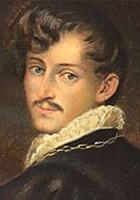

Joseph Freiherr von Eichendorff Biography
Joseph Karl Benedikt Freiherr von Eichendorff (March 10, 1788 – November 26, 1857) was a German poet and novelist of the later German romantic school.
Eichendorff's guiding poetic theme was that Man should find happiness in full absorption of the beauties and changing moods of Nature. He also wrote a history of German literature that was posthumously published. Eichendorff's poetry has been set by many composers, including Schumann, Mendelssohn, Brahms, Hugo Wolf, Richard Strauss, Friedrich Nietzsche, Hans Pfitzner, and Alexander Zemlinsky.
Eichendorff's best known work, Aus dem Leben eines Taugenichts (English: Of the Life of a Good-For-Nothing) is typical romantic novella, whose main themes are voyage and love. The protagonist leaves his father's mill and becomes a gardener at a Viennese castle where he falls in love with the daughter of the duke. Because she is unattainable he travels to Italy but then returns and learns that she had been adopted by the duke, so nothing stands in the way of a marriage between them.
Es war, als hätt' der Himmel
Die Erde still geküsst
Dass sie im Blütenschimmer
...
What a deep and nice silence
How alone I'm in this world
The woods ease their violence
...
When God's favour for someone
To far lands gives him His run
Willing to show his miracles' lots
...
Like blue breeze is mildly flowing
Springtime, springtime carrying in
Woodsbound a horn sound's blowing
...




Delivering Poems Around The World
Poems are the property of their respective owners. All information has been reproduced here for educational and informational purposes to benefit site visitors, and is provided at no charge...
4/10/2026 5:10:27 PM # 1.0.0


