Joseph Skipsey
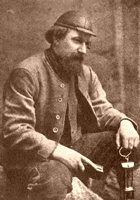

Joseph Skipsey Poems
The butterfly from flower to flower
The urchin chas’d; and, when at last
He caught it in my lady’s bower,
He cried, “Ha, ha!” and held it fast.
...
Mother wept, and father sigh’d;
With delight a-glow
Cried the lad, “To-morrow,” cried,
“To the pit I go.”
...
AH, be not vain. In yon flower-bell,
As rare a pearl, did I appear,
As ever grew in ocean shell,
To dangle at a Helen’s ear.
...
The Hartley men are noble, and
Ye'll hear a tale of woe;
I'll tell the doom of the Hartley men -
The year of sixty two.
...
Get up!" the caller calls, "Get up!"
And in the dead of night,
To win the bairns their bite and sup,
I rise a weary wight.
...
Misfortune is a darling, ever
Most faithful to the minstrel race;
Let low-bred wretches shun them, never
Yet acted she a part so base.
...
FROM the pipe-end off it glides,
Many hued appearing;
What, if cynic harsh derides,
Sets the boys a-staring.
...
'I HATE outlandish things, and own
I've little liking for the sonnet;
'Tis for a lazy Muse, and one
Who hath a bumler in her bonnet.
...
LAST night at the fair I met light-footed Polly,
And Nanny from Earsdon and bothersome Nell,
And yellow-hair'd Bessy and hazel-eyed Dolly;
But Rosy for sweetness did bear off the bell.
...
ANNIE LEE is fair and sweet—
Fair and sweet to look upon;
But Annie's heart is all deceit,
Therefore Annie Lee, begone.
...
'MY brother Jack the Rover, Sir!'
'Bless me, I thought he was a cousin?'
'Bound on a voyage to Elsinore!'
'Most merry damsels have a dozen!'
...
WHAT is man? The question floweth
From the lips with ease, and yet
He who best could answer knoweth
Answer true were hard to get:
...
'I JEALOUS? Pooh!—Doth not her eyes
Pursue his vessel o'er the billows?
No, jealous, no!—From whence those sighs!'
—'Tis but the wind among the willows!
...
I READ in an old book the myth
Of the Hellenian damsel with
The magic needle, when there fell
On me a power—a mystic spell—
...
HEY Robin, jolly Robin,
Tell me how thy lady doth?
Is she laughing, is she sobbing
Is she gay, or grave, or both?
...
MY mother bade me go. I went:
But beat my heart, ere I returned,
A rat-tat-tan, and what it meant
Too soon I to my sorrow learned.
...
THRO' the dark and dreary night,
Golden slumbers kiss thine eyes;
Sleep, and in the early light
With a golden smile arise!
...
MY lad he is a Collier Lad,
And ere the lark awakes,
He's up and away to spend the day
Where daylight never breaks;
...
'Twos on a night, with sleet and snow,
From out the north a tempest blew,
When Thistle gathered nerve to go
The little Nettle's self to woo.
...
I SAW but once that lovely one,
Nor need I see her twice to love;
She broke upon me like the dawn,
And o'er my soul her magic wove—
...
Joseph Skipsey Biography
Born March 17, 1832, in Percy, Northumberland. Joseph Skipsey was a colliery worker at seven years of age. He made himself educated, publishing verse in local newspapers until he was gradually able to leave harsh labour behind him. He earned a living as caretaker to schools and colleges. He and his wife Sara Ann Fendley, married in 1854, had eight children. Of the 8 children, only the last three, Elizabeth, Joseph and Cuthbert survived to adulthood and old age. Skipsey had several literary positions: Assistant Librarian, Newcastle Literary and Philosophical Society (1863), and custoldian of Shakespeare's birthplace at Stratford-on-Avon (1889-91). He was awarded a annual civil list pension in 1880 for his literary work, which included preparing popular editions of important poets. Skipsey died at Gateshead on Sept. 3, 1903, and was buried in Gateshead Cemetery.)
The Best Poem Of Joseph Skipsey
The Butterfly
The butterfly from flower to flower
The urchin chas’d; and, when at last
He caught it in my lady’s bower,
He cried, “Ha, ha!” and held it fast.
Awhile he laugh’d, but soon he wept,
When looking at the prize he’d caught
He found he had to ruin swept
The very glory he had sought
Joseph Skipsey Comments




Delivering Poems Around The World
Poems are the property of their respective owners. All information has been reproduced here for educational and informational purposes to benefit site visitors, and is provided at no charge...
4/7/2026 8:59:51 AM # 1.0.0