
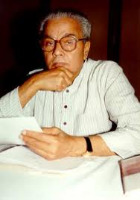

Kedarnath Singh Biography
Kedar Nath Singh is one of the most prominent modern poets writing Hindi. He is also an eminent critic and essayist. He was awarded the 1989 Sahitya Akademi Award in Hindi for his poetry collection, Akaal Mein Saras (loose translation into English: Cranes in Drought).
Early life
He was born on 7th July 1934 in village Chakia of district Ballia in eastern Uttar Pradesh. He passed M.A from Kashi Hindu Vidyalaya and did his Ph.D from the same University. In Gorakhpur, he spent sometimes as a Hindi Teacher and went to Jawaharlal Nehru University, where he served as a professor of Hindi Language in Indian Languages Center and retired as a professor from Jawaharlal Nehru University, New Delhi.Today, he lives in New Delhi.
Poetic Style
Kedar Nath Singh's poetry is characterized by simple, everyday language and images that string together to convey complex themes. One of his major poems is Bagh, a long poem with the tiger as its central character. Published in the mid 1980s, the poem remains one of the most widely read long poems in Hindi literature and is included in many university curricula. At some level, Bagh bears a striking resemblance to Ted Hughes' Crow, but the two remain independent in their treatment and scope.
Awards and honours
He was awarded the Sahitya Akademi award, the Kumaran Aashan, and the Vyas Award, among others.
Words don't die of cold
they die from a lack of courage
Words often perish
because of humid weather
I once met
a word
that was like a bright red bird
in the swamp along the riverbank in my village
I brought it home
but as soon as we reached the wooden door-frame
it gave me
a strangely terrified look
and breathed its last
After that I started fearing words
If I ran into them I beat a hasty retreat
if I saw a hairy word dressed in brilliant colours
advancing towards me
I often simply shut my eyes
Slowly after a while
I started to enjoy this game
One day for no reason at all
I hit a beautiful word with a stone
while it hid
like a snake in a pile of chaff
I remember its lovely glittering eyes
down to this day
With the passage of time
my fear has decreased
When I encounter words today
we always end up asking after each other
Now I've come to know
many of their hiding-places
I've become familiar with
many of their varied colours
Now I know for instance
that the simplest words
are brown and beige
and the most destructive
are pale yellow and pink
Most often the words we save
for our saddest and heaviest moments
are the ones
that on the occasions meant for them
seem merely obscene
And what shall I do now
with the fact that I've found
perfectly useless words
that wear ugly colours
and lie discarded in the garbage
to be the most trustworthy
in my moments of danger
It happened just yesterday -
half a dozen healthy and attractive words
suddenly surrounded me
in a dark street
I lost my nerve -
For a while I stood before them
speechless
and drenched in sweat
Then I ran
I'd just lifted my foot in the air
when a tiny little word
bathed in blood
ran up to me out of nowhere panting
and said -
‘Come, I'll take you home'
...
When the king died
his body was laid
in large coffin of gold.
A handsome body
no one who saw it
doubted that it was
the body of a king.
First the minister came
and stood with his head bowed
before the body
then the priest came
and mumbled something
under his breath for a long time
then the elephant came
and raised its trunk
in honour of the body
then the black and white horses came
but confused
by the grimness of the scene
they couldn't decide
whether they should neigh.
Slowly - very slowly
came
the carpenter
the washer-man
the barber
the potter . . .
they stood around the magnificent coffin.
A strange sadness surrounded
the coffin.
Everyone was sad
the minister was sad
because the elephant was sad
the elephant was sad
because the horses were sad
the horses were sad
because the grass was sad
the grass was sad
because the carpenter was sad . . .
...
Brothers and sisters
this day is dying
a two-minute silence
for this dying day
for the bird flying away
for the still water
for the night-fall
a two-minute silence
for that which is
for that which is not
for that which could have been
a two-minute silence
for the discarded peel
for the crushed grass
for every plan
for every project
a two-minute silence
for this great century
for every great idea
of this great century
for its great words
and great intentions
a two-minute silence
brothers and sisters
for these great achievements
a two-minute silence.
...
Come
when you find the time.
Come
even if you can't find the time.
Come
like the strength
in hands
like blood
flowing through arteries.
Come
like the slow silent
flames
in stoves.
Come.
Come
like the fresh thorns
in babul trees
after the rains.
Shredding days
smashing promises
come.
Come
as Wednesday
arrives
after Tuesday.
Come.
...
How strange it is
that at ten in the morning
the world is still going about its business
even without God.
The buses are crowded
and as usual
people are in a hurry.
His bag slung on his shoulder
the postman
is making his rounds as usual
even without God.
Banks somehow open on time
grass continues to grow
all calculations - however complicated -
somehow add up in the end
the one who must live
lives
the one who must die
dies
even without God.
How strange it is
that trains
late or on time
depart from and arrive at
some station or the other
that elections are held
planes continue to fly in the sky
even without God.
Even without God
horses continue to neigh
salt is still made in the sea
a sparrow
flies here and there
in a frenzy all day
and somehow finds her way
back to her nest
even without God.
Even without God
my sorrow is as profound as ever
and the hair of the woman
I had loved ten years ago
is as black as ever
and it is still as fascinating
to go out of this house
and then return home.
How strange it is
that water still flows
and the bridge still stands
in the middle of the stream
with its arms outstretched
even without God.
...




Delivering Poems Around The World
Poems are the property of their respective owners. All information has been reproduced here for educational and informational purposes to benefit site visitors, and is provided at no charge...
3/14/2026 3:48:30 AM # 1.0.0


