
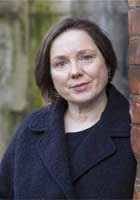

Lavinia Greenlaw Biography
Lavinia Greenlaw (born 30 July 1962) is an English poet and novelist.
Greenlaw was born in London into a family of doctors and scientists, but in 1973 when she was eleven years old, her family moved from London to a village in Essex. She has described the seven years there as "an interim time", with "memories of time being arrested, nothing much happening." She read modern arts at Kingston Polytechnic, studied at the London College of Printing and has an MA in art history from the Courtauld Institute. She has worked as an editor at Imperial College of Science and Technology and for the publishers Allison and Busby and subsequently Earthscan. She also worked as an arts administrator for the London Arts Board and the South Bank Centre. In 1994 she embarked upon a career as a freelance artist, critic and radio broadcaster. She has been writer in residence at the Science Museum, reader in residence at the Royal Festival Hall, and poet in residence at a firm of solicitors in London.
Her sound work, Audio Obscura, was commissioned in 2011 from Artangel and Manchester International Festival, and won the 2011 Ted Hughes Award for New Work in Poetry.
She lives in London and currently works as professor of creative writing at the University of East Anglia. She was a judge for the 2010 Manchester Poetry Prize.
1980, I was returned to the city exposed
in black and white as the lights went on and on.
A back-alley neon sign, the first I'd seen,
...
A dance between movement and space,
between image and imperative.
Each step, an arrival
...
Night was and they swayed into it:
a pair of scissors, of sails
turning only into themselves
more other than become.
...
Night was and they swayed into it:
a pair of scissors, of sails
turning only into themselves
more other than become.
It is often five o'clock.
Her husband has contracted not
to speak of her and she has forgotten
where to go. Where does everyone go?
...
Those buried lidless eyes can see
the infra-red heat of my blood.
I feel the crack, the whisper
as vertebrae ripple and curve.
Days of absolute stillness.
I sleep early and well.
His rare violent hunger,
a passion for the impossible.
He will dislocate his jaw
to hold it.
My fingers trace the realignment
as things fall back into place.
Each season, a sloughed skin
intensifies the colours that fuse
with mineral delicacy at his throat.
Flawless.
Beautiful, simple,
he will come between us.
Last night you found his tooth
on your pillow.
...




Delivering Poems Around The World
Poems are the property of their respective owners. All information has been reproduced here for educational and informational purposes to benefit site visitors, and is provided at no charge...
3/13/2026 11:26:41 AM # 1.0.0


