
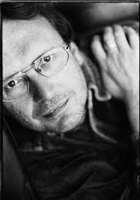

Luuk Gruwez Biography
Luuk Gruwez (born 9 August 1953) is a Flemish poet. Since 1976, he lives in Hasselt, where he worked until 1995 as a teacher.
Gruwez was born at Kortrijk. He attended high school there at the Damiaancollege and graduated in Germanic philology at the Katholieke Universiteit Leuven. In 1976 he moved from Kortrijk to Hasselt. He earns a living as a teacher there until his career break in 1995 after being granted a scholarship as a writer.
Gruwez' work is sometimes considered to belong to the neoromantic movement in response to the new realism of the 60s, with its typical emphasis on the emotions of life, love, disease, decay and death. But in Luuk Gruwez' work this kind of romance is always tempered by a portion of (self) irony.
In his later poetry the subject matter is broader and his style becomes more narrative. He is now a full-time writer of poetry and prose as well as columns, appearing weekly in De Standaard and monthly from 2001 to 2003 in De Morgen. In 2009 he received the Herman de Coninckprijs for his poem "Moeders" from Lagerwal. Tuur Florizoone (nl) and Jessa Wildemeersch composed music for these nominated poems.
For Toon Tellegen
[I]
Machines quite gentle are called for
for one fine day to fly to nowhere.
...
For Herman de Coninck
In men it's cold and frequently December.
In women it is mostly May.
They want to shimmer all their lives,
...
Voor Totje
Laat ons naar Wijvenheide gaan.
Hoe Jammerlijk dat afstanden bestaan,
maar wie per se naar Wijvenheide wil,
komt ook in Wijvenheide aan.
Laat ons naar Wijvenheide gaan.
Daar strijken karekieten neer.
De rietpluim wuift wie straks weer
weg moet, nu al uitgebreid ten afscheid.
Laat ons naar Wijvenheide gaan.
In Wijvenheide ligt een groot geheim:
de zilverreiger broedt er op een spiegelei.
...
For Totje
Let's head for Wijvenheide then.
What a shame that distances extend,
but those with Wijvenheide in their sights
will get to Wijvenheide in the end.
Let's head for Wijvenheide then.
Reed warblers land there from the skies.
Reed tufts wave long advance goodbyes
to those who soon will have to leave again.
Let's head for Wijvenheide then.
In Wijvenheide a great secret's kept:
The egret's trying to hatch a soft-fried egg.
...
En als er geen tederheid meer is,
laten wij de tederheid dan veinzen
met geblinddoekte handen en geloken ogen,
liggend aan elkander als een grens.
Een woord mag dan niet langer een woord heten,
maar een mondvol troostvol verzwijgen;
en verlangen niet langer een armslag lang,
maar verder, weidser dan een vergezicht
vol zomervogels, muziek van Mendelssohn, een sfumato
aan Da Vinci ontleend. Jij zult je mooiste medelijden
ruilen met mijn liefste verdriet; ik, voorzichtig talmen
om het tanen van je lichaam dieper af te tasten.
O als er dan nog tederheid is,
laten wij de tederheid vrezen
als een zeer oud zeer. Zoveel tederheid,
daar kon geen mens ooit tegen.
...




Delivering Poems Around The World
Poems are the property of their respective owners. All information has been reproduced here for educational and informational purposes to benefit site visitors, and is provided at no charge...
3/12/2026 5:53:05 PM # 1.0.0


