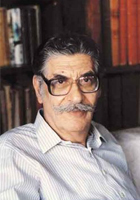

Manolis Anagnostakis Biography
Manolis Anagnostakis (10 March 1925 – 23 June 2005) was a Greek poet and critic at the forefront of the Marxist and existentialist poetry movements arising during and after the Greek Civil War in the late 1940s. Anagnostakis was a leader amongst his contemporaries and influenced the generation of poets immediately after him. His poems have been honored in Greece's national awards and arranged and sung by contemporary musicians. In spite of his accomplishments, Philip Ramp notes that Anagnostakis "is the least known, to an English speaking audience, of the major Greek poets of his generation."
Anagnostakis' poetry has been described as "terse". His early works may be comparable in number of lines to Cavafy, but do contain single-word lines and single-line verse paragraphs. Other characteristics of the early poems are its "bold, conversational tone", sometimes in the form of an epistle, and at others culminating in direct advice to the reader. This style, along with Anagnostakis' simple, direct description of a hostile world was emulated by other left-wing poets of his generation.
Beaton also notes "a deep distrust of the poet's very medium, which runs through almost all the poetry of his generation", as, for instance, in the poem "Now He Is A Simple Spectator". Also unusual amongst those contemporary poets sharing Anagnostakis' politics is Anagnostakis' use of Christian imagery in his poetry, and, unusual amongst Greek poets in general is a lack of romanticizing of the sea.
In the Synecheia series, written between the Civil War and the Regime of the Colonels, Vangelis Hadjivassiliou notes that Anagnostakis extends that ambivalence to his politics, as well. Anagnostakis asserts both that "...the War is not over yet./ For no war is ever over!" and that he is "Laughing at your wealth of armours/ Suddenly infiltrating your lines/ Upsetting the solid arrays".
The O stochos poems were written during the Regime of the Colonels. This work contains poems differing from the above characterizations of Anagnostakis as "ambivalent" and "grim". The book contains both a defense of poetry ("Poetics"), and a sardonic response to Cavafy's "Young Men of Sidon (A.D. 400)", titled "Young Men of Sidon, 1970", which defends levity against the demand for seriousness from Cavafy's "vivacious young man". Ekdotike Athenon S.A. cites the work as exemplary of Greek poetry after the Second World War, describing it as "[representing] the social questioning typical of the poetry of the post-war generation".
The post-1971 poems were, in some cases, even more terse than the Epoches poems, often being only epigrams. Categorizing Anagnostakis' poetry into a movement has proven somewhat challenging for critics. Hadjivassiliou characterizes the period of the Continuations as "wholly political". Nassos Vagenas, on the other hand, divides post-war Greek poetry into Marxist, existentialist, and surrealist, and then places Anagnostakis in the existentialist movement. Ramp suggests that the poet's lack of recognition outside of Greece can be attributed to the fact that Anagnostakis' poetry is politically "committed", but agrees that the poetry is not influenced by surrealism.
- You're betraying Poetry again, you'll tell me,
Man's most sacred expression
You're using it again as a means, a pack-mule
...
In Egyptou Street -first turning rightThere
now stands the Transaction Bank Building
Tourist agencies and emigration bureaus
...
Actually, we shouldn't complain.
Your company's good and congenial, full of youth,
Fresh young girls - stout-bodied lads
...
Are you for or against?
At least answer with a yes or with a no.
You have thought about the problem
...
Now I speak again, like a person who has escaped from a plague
I visit my friends; I know many who have been saved
...




Delivering Poems Around The World
Poems are the property of their respective owners. All information has been reproduced here for educational and informational purposes to benefit site visitors, and is provided at no charge...
4/4/2026 11:32:44 AM # 1.0.0