
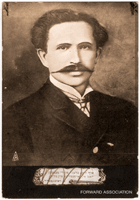

Morris Rosenfeld Biography
Morris Rosenfeld (Moshe Jacob Alter) (December 28, 1862 in Bokscha in Russian Poland, government of Suwałki – June 22, 1923 in New York) was a Yiddish poet.
His work sheds light on the living circumstances of emigrants from Eastern Europe in New York's tailoring workshops.
He was educated at Boksha, Suwałki, and Warsaw. He worked as a tailor in New York and London and as a diamond cutter in Amsterdam, and settled in New York in 1886, after which he was connected with the editorial staffs of several leading Jewish newspapers. In 1904 he published a weekly entitled Der Ashmedai. In 1905 he was editor of the New Yorker Morgenblatt. He was also the publisher and editor of a quarterly journal of literature (printed in Yiddish) entitled Jewish Annals. He was a delegate to the Fourth Zionist Congress at London in 1900, and gave readings at Harvard University in 1898, the University of Chicago in 1900, and Wellesley and Radcliffe colleges in 1902.
Rosenfeld was the author of Die Glocke (New York, 1888), poems of a revolutionary character; later the author bought and destroyed all obtainable copies of this book. He wrote also Die Blumenkette (ib. 1890) and Das Lieder Buch (ib. 1897;English transl. by Leo Wiener, Songs from the Ghetto, Boston, 1899; German transl. by Berthold Feivel, Berlin, and by E. A. Fishin, Milwaukee, Wis., 1899; Rumanian transl. by M. Rusu, Iaşi, 1899; Polish transl. by J. Feldman, Vienna, 1903; Hungarian transl. by A. Kiss, Budapest; Bohemian transl. by J. Dchlicky, Prague). His poems were published, under the title Gesammelte Lieder, in New York in 1904.
Oh, here in the shop the machines roar so wildly,
That oft, unaware that I am, or have been,
I sink and am lost in the terrible tumult;
...
I have a little boy at home,
A pretty little son;
I think sometimes the world is mine
...
When night and silence deep
Hold all the world in sleep,
As tho' Death claimed the Hour,
By some strange witchery
...
THE terrible wind, the dangerous storm, is
wrestling with a ship on the ocean ; it is trying
to break her, but she in distress cuts through the
...
I've often laughed and oftener still have wept,
A sighing always through my laughter crept,
Tears were not far away...
What is there to say?
...




Delivering Poems Around The World
Poems are the property of their respective owners. All information has been reproduced here for educational and informational purposes to benefit site visitors, and is provided at no charge...
4/6/2026 9:49:17 PM # 1.0.0


