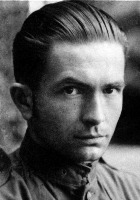

Paul van Ostaijen Biography
Paul van Ostaijen (22 February 1896 – 18 March 1928) was a Belgian poet and writer.
Van Ostaijen was born in Antwerp. His nickname was Mister 1830, derived from his habit of walking along the streets of Antwerp clothed as a dandy from that year.
His poetry shows influences from Modernism, Expressionism, Dadaism and early Surrealism, but Van Ostaijen's style is very much his own.
Van Ostaijen was an active flamingant, a supporter of Flemish independence. Because of his involvement with Flemish activism during World War I, he had to flee to Berlin after the war. In Berlin—one of the centers of Dadaism and Expressionism—he met many other artists. He also struggled through a severe mental crisis.
Upon returning to Belgium, Van Ostaijen opened an art gallery in Brussels. He died of tuberculosis in 1928 in a sanatorium in Miavoye-Anthée, in the Wallonian Ardennes.
The Czech poet Ivan Wernisch was so impressed by "the genius of van Ostaijen" that he learned Flemish to be able to translate him. His translation was published as Tanec gnómů, Dance of the gnomes, in 1990.
There must be white farms beyond the edge
of the blue fields by the moon
at night you hear along distant roads
horse hooves
you hear everything then silent delusion
...
The sailor
hears the voice of the Lorelei
he looks at his watch
and jumps in the water
...
An old man in the street
his simple tale to the old woman
it's nothing it sounds like a tenuous tragedy
his voice is white
it resembles a knife that's been whetted for so long
the steel has worn thin
...
A gentleman going up the street
a gentleman going down the street
two gentlemen going up and down
that is the one gentleman goes up
and the other gentleman goes down
...
Under the moon the long river slides by
Above the long river the moon mournfully slides
Under the moon on the long river the canoe slides to the sea
...




Delivering Poems Around The World
Poems are the property of their respective owners. All information has been reproduced here for educational and informational purposes to benefit site visitors, and is provided at no charge...
3/12/2026 6:31:08 AM # 1.0.0