
Where Mortal Light Learns To Burn Poem by Rajendra Prasad Meena Jaipur India
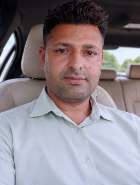

Where Mortal Light Learns To Burn
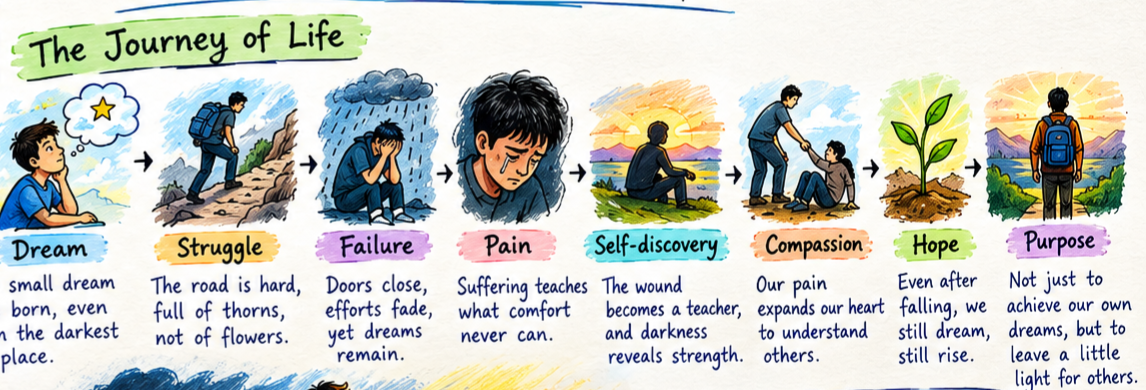
I entered life with neither map nor covenant,
only a pulse beneath an unremembered sky;
and from that first bewildered breath of existence,
I began to learn the ancient question—why?
Why must a human heart desire the distant,
when distance is woven with uncertainty and pain?
Why does the mind invent impossible horizons,
then spend a lifetime walking through the rain?
Perhaps because within the poverty of beginnings,
even an unnamed dream can quietly ignite;
and so I carried, through my earliest darkness,
a small, defiant fragment of light.
But the road did not receive me with tenderness;
it gave me dust where I had dreamt of flowers,
and taught me that the architecture of becoming
is often constructed through difficult hours.
I learned the grammar of deprivation slowly—
the eloquence concealed within an empty hand,
the dignity of those who endure in silence
what comfort will never fully understand.
I saw a mother divide the evening bread,
measuring hunger against the needs of those she loved;
I saw a father bury his exhaustion in silence,
then rise again because someone depended on his love.
And somewhere behind an ordinary window,
a child was building kingdoms in his eyes,
while poverty stood like an invisible boundary
between his fragile questions and the skies.
Perhaps that was when I first understood suffering:
it is not always the wound that makes us cry;
sometimes it is watching another human being
possess a dream and having no means to fly.
That knowledge followed me into my own journey,
where ambition became both compass and flame;
I worked beneath the tyranny of sleepless hours,
believing perseverance might one day answer my name.
I knocked upon the doors of possibility,
again and again, with faith inside my hand;
yet some doors remained magnificently silent,
as though effort itself were difficult to understand.
Then failure entered—not with thunder,
but with the quiet cruelty of an ordinary day;
a result, a rejection, an unanswered expectation,
and suddenly the future seemed to withdraw away.
For a while I mistook defeat for an ending,
and measured my worth by what I could not attain;
but beneath the ruins of that wounded certainty,
something unnamed began to awaken through pain.
For suffering, when endured without surrender,
can become an austere tutor of the soul;
the wound that once appeared to make us lesser
may teach us how broken things become whole.
Thus failure slowly changed its ancient meaning;
it was no longer merely the opposite of success—
it became a mirror held before my spirit,
asking what remained when achievement left me empty.
And Time, meanwhile, continued its silent pilgrimage,
taking faces, seasons, certainties away;
it taught me that nothing we call "forever"
has ever signed a contract promising to stay.
I watched relationships become memories,
watched yesterday recede beyond my reach;
and understood that absence is sometimes
the final language through which love can speak.
Then life became more precious precisely because
I knew how swiftly it could disappear;
a conversation, a child's laughter, a hand held gently—
suddenly ordinary moments became dear.
I began to question the old definition of greatness:
Is greatness merely standing higher than the rest,
or is it possessing enough humanity
to lift another when one's own heart is distressed?
For what is wealth without compassion,
and what is knowledge if it cannot illuminate?
What is success if, upon reaching its summit,
we discover no one beside us to celebrate?
So I began to carry other people's sorrows
with a tenderness born from wounds of my own;
I learned that the heart becomes larger
when it makes room for another's unknown.
I no longer wanted merely to conquer the mountain;
I wanted to understand those still below,
because every summit is haunted by the knowledge
that someone else is still searching for a road to go.
And then my dream changed its language:
it ceased to ask, "How high can I rise? "
and began to ask, "How much light can I leave
for someone travelling through a darker night? "
That question transformed the meaning of effort;
work was no longer only a ladder toward fame—
it became a quiet responsibility to become
worthy of the life that had given me my name.
So I continued, carrying failure beside me,
not as a chain, but as a scarred companion;
for every wound had enlarged my understanding,
and every loss had altered my horizon.
I still dream.
I still stumble.
I still fear the unfinished distance.
But now I know that becoming human
is not the conquest of every resistance;
it is walking forward with uncertainty beside you
without allowing uncertainty to become your identity.
Perhaps I shall never reach every horizon,
perhaps some dreams will remain forever unnamed;
perhaps time will erase even my footsteps
before the world has learned my name.
Yet if one exhausted heart finds courage
because my words once refused to surrender,
if one lonely soul discovers it is not alone,
then something of me will have endured forever.
For I have finally understood the strange mathematics
by which a mortal life acquires its worth:
we do not become eternal by possessing the world—
we become enduring by giving something to it.
And when my final evening gathers silently,
and the last horizon loosens from my sight,
I will not ask the world to remember my footsteps;
I will only hope I left behind a little light.
For I was never promised immortality—
only this brief, bewildering interval of being;
and perhaps the deepest victory of a human life
is not to escape the darkness,
but to enter it carrying compassion,
to walk through it carrying hope,
and to leave it
slightly less dark
than when we came.
This poem has not been translated into any other language yet.
I would like to translate this poem



Delivering Poems Around The World
Poems are the property of their respective owners. All information has been reproduced here for educational and informational purposes to benefit site visitors, and is provided at no charge...
9/23/2026 7:08:00 PM # rel_20260910T140628Z_5ffb431


