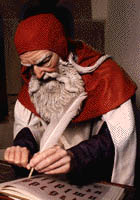

Robert Henryson Biography
Little is known about Robert Henryson's life, who was a very well-known Scottish author much admired by his contemporories (often described as the 'greatest' Scottish medieval author); who wrote in middle-scots in the second half of the fifteenth century, and mainly during the reign of James III. He 'possibly' attended and taught at the University of Glasgow, and is associated with the town of Dunfermline, where -inasmuch as can be ascertained from his work and sixteenth century tradition- he may have worked as a teacher, lawyer, or public notary. He was not a court poet, unlike his younger contemporary, William Dunbar.
Henryson's main works include a version of Aesop's Fables (usually entitled The Morall fabillis of Esope the Phrygian), The Testament of Cresseid, a follow-on to Chaucer's Troilus and Criseyde (but also seen as his own, original 'masterpiece', a poem in its own right) , Robene and Makyne, and Orpheus and Eurydice, a version of the classic tale.
Pricilla Bawcutt describes Henryson in Discovering Scottish Writers as excelling as 'a narrative poet' who handled the fable genre 'brilliantly.'
...
Thus chydand with her drerie destenye,
Weiping, scho woik the nicht fra end to end;
Bot all in vane; hir dule, hir cairfull cry,
...
Would my good Lady love me best,
And work after my will,
I should ane garment goodliest
Gar mak' her body till.
...
Robene sat on gud grene hill,
Kepand a flok of fe;
Mirry Makyne said him till,
"Robene, thow rew on me;
...
ROBIN sat on gude green hill,
Kepand a flock of fe:
Mirry Makyne said him till
'Robin, thou rew on me:
...




Delivering Poems Around The World
Poems are the property of their respective owners. All information has been reproduced here for educational and informational purposes to benefit site visitors, and is provided at no charge...
4/5/2026 4:53:38 PM # 1.0.0