Scott Cairns
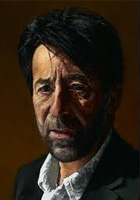

Scott Cairns Poems
You could almost think the word synonymous
with mind, given our so far narrow
history, and the excessive esteem
...
After Stevens
It was when he said expansively There is
no such thing as the truth that his thick thumbs
thickened and his lips, purple as grapes,
...
Agion Oros, 2006
The air is cool and is right thick with birdsong
as our bleary crew files out, of a sudden
disinterred from three sepulchral hours of prayer
...
προσέλθετε
For near is where you'll meet what you have wandered
far to find. And near is where you'll very likely see
how far the near obtains. In the dark katholikon
...
This morning the world's white face reminds us
that life intends to become serious again.
And the same loud birds that all summer long
annoyed us with their high attitudes and chatter
...
You'll need a corpse, your own or someone else's.
You'll need a certain distance; the less you care about
your corpse the better. Light should be
unforgiving, so as to lend a literal
...
—Katounakia, 2007
The cave itself is pleasantly austere,
with little clutter—nothing save
a narrow slab, a threadbare woolen wrap,
...
What I notice first within
this rough scene fixed
in memory is the rare
quality of its lightning, as if
...
Each morning we begin again. My wife
wakes me with a shove, and condescends to try
her sorry Deutsch with me; she's chewing mud.
God, she's dumb. I tell her so, but mostly
...
A psalm of Isaak, amid uncommon darkness
O Being both far distant and most near,
O Lover embracing all unlovable, O Tender
Tether binding us together, and binding, yea
...
1
A psalm of Isaak, accompanied by Jew's harp.
O God Belovéd if obliquely so,
dimly apprehended in the midst
...
We wanted to confess our sins but there were no takers.
—Milosz
And the few willing to listen demanded that we confess on television.
So we kept our sins to ourselves, and they became less troubling.
...
A little loam and topsoil
is a lot.
—Heather McHugh
A vacant lot, maybe, but even such lit vacancy
as interstate motels announce can look, well, pretty
...
Magdalen's Epistle
Of Love's discrete occasions, we
observe sufficient catalogue,
a likely-sounding lexicon
...
Not your ordinary ice cream, though the glaze
of these skeletal figures affects
the disposition of those grinning candies
one finds in Mexico, say, at the start of November,
...
Your petitions—though they continue to bear
just the one signature—have been duly recorded.
Your anxieties—despite their constant,
...
He did not fall then, blind upon a road,
nor did his lifelong palsy disappear.
He heard no voice, save the familiar,
...
Scott Cairns Biography
Scott Cairns was born in Tacoma, Washington. He earned a BA from Western Washington University, an MA from Hollins College, an MFA from Bowling Green State University, and a PhD from the University of Utah. Cairns is the author of eight books of poetry, including The Theology of Doubt (1985), The Translation of Babel (1990), Philokalia (2002), Idiot Psalms (2014), and Slow Pilgrim: The Collected Poems (2015). His writing has appeared in The Atlantic, The Paris Review, The New Republic, Poetry, and elsewhere, and has been anthologized in Best Spiritual Writing and Best American Spiritual Writing. Besides writing poetry, Cairns has also written a spiritual memoir, Short Trip to the Edge (2007), and the libretto for the oratorios “The Martyrdom of Saint Polycarp” and “A Melancholy Beauty.” Spirituality plays an integral role in Cairns’ writing; in an interview, he said, “I’ve come to think of beauty as how God woos us to himself. One doesn’t so much create it or illuminate it as partake of it. Thereafter, one participates, collaborates, in its endless development.” Cairns has received fellowships from the Guggenheim Foundation and the National Endowment for the Humanities, and was awarded the Denise Levertov Award in 2014. He has taught at numerous universities including University of North Texas, Old Dominion University, Seattle Pacific University, and the University of Missouri. Cairns is the founding director of Writing Workshops in Greece, a program that brings writers to study and engage with literary life in modern Greece.)
The Best Poem Of Scott Cairns
Adventures in New Testament Greek: Nous
You could almost think the word synonymous
with mind, given our so far narrow
history, and the excessive esteem
in which we have been led to hold what is,
in this case, our rightly designated
nervous systems. Little wonder then
that some presume the mind itself both part
and parcel of the person, the very seat
of soul and, lately, crucible for a host
of chemical incentives—combinations
of which can pretty much answer for most
of our habits and for our affections.
When even the handy lexicon cannot
quite place the nous as anything beyond
one rustic ancestor of reason, you might
be satisfied to trouble the odd term
no further—and so would fail to find
your way to it, most fruitful faculty
untried. Dormant in its roaring cave,
the heart's intellective aptitude grows dim,
unless you find a way to wake it. So,
let's try something, even now. Even as
you tend these lines, attend for a moment
to your breath as you draw it in: regard
the breath's cool descent, a stream from mouth
to throat to the furnace of the heart.
Observe that queer, cool confluence of breath
and blood, and do your thinking there.
Scott Cairns Comments




Delivering Poems Around The World
Poems are the property of their respective owners. All information has been reproduced here for educational and informational purposes to benefit site visitors, and is provided at no charge...
4/4/2026 3:10:58 PM # 1.0.0