
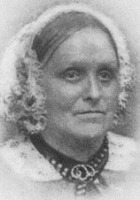

Susanna Moodie Biography
Susanna Moodie was born in Bungay, on the River Waveney in Suffolk, the younger sister of three other writers, including Agnes Strickland and Catharine Parr Traill. She wrote her first children's book in 1822, and published other children's stories in London, including books about Spartacus and Jugurtha. In London she was also involved in the Anti-Slavery Society, transcribing the narrative of the former Caribbean slave Mary Prince. On 4 April 1831, she married John Moodie, a retired officer who had served in the Napoleonic Wars. In 1832, with her husband and daughter, Moodie emigrated to Canada. The family settled on a farm in Douro township, near Lakefield, north of Peterborough, Upper Canada, where her brother Samuel worked as a surveyor, and where artifacts are housed in a museum. Founded by Samuel, the museum was formerly an Anglican church and overlooks the Otonabee river where Susanna once canoed. It also displays artifacts concerning both Samuel and Catharine Parr Traill.
Moodie continued to write in Canada and her letters and journals contain valuable information about life in the colony. She observed life in what was then the backwoods of Ontario, including native customs, the climate, the wildlife, relations between the Canadian population and recent American, and the strong sense of community and the communal work,known as "bees" (which she, incidentally, hated). She suffered through the economic depression in 1836, and her husband served in the militia against William Lyon Mackenzie in the Upper Canada Rebellion in 1837.
As a middle-class Englishwoman Moodie did not particularly enjoy "the bush", as she called it. In 1840 she and her husband moved to Belleville, which she referred to as "the clearings". She studied the Family Compact and became sympathetic to the moderate reformers led by Robert Baldwin, while remaining critical of radical reformers such as Lyon Mackenzie. This caused problems for her husband, who shared her views, but, as sheriff of Belleville, had to work with members and supporters of the Family Compact.
In 1852, she published Roughing it in the Bush, detailing her experiences on the farm in the 1830s. In 1853, she published Life in the Clearings Versus the Bush, about her time in Belleville. She remained in Belleville, living with various family members (particularly her son Robert)after her husband's death, and lived to see Canadian Confederation. She died in Toronto, Ontario on 8 April 1885 and is buried in Belleville Cemetery.
Her greatest success was Roughing it in the Bush. The inspiration for the memoir came from a suggestion by her editor that she write an "emigrant's guide" for British people looking to move to Canada. Moodie wrote of the trials and tribulations she found as a "New Canadian", rather than the advantages to be had in the colony. She claimed that her intention was not to discourage immigrants but to prepare people like herself, raised in relative wealth and with no prior experience as farmers, for what life in Canada would be like.
Recognition
Moodie's books and poetry inspired Margaret Atwood's collection of poetry, The Journals of Susanna Moodie, published in 1970. It was also an important influence on one of Atwood's later novels, Alias Grace, based on an account of murder convict Grace Marks which appeared in Life in the Clearings Versus the Bush. She has also been a source of inspiration for Carol Shields, who published a critical analysis of Susanna Moodie's work, Susanna Moodie: Voice and Vision. Additionally, the central character of Shield's novel, Small Ceremonies, is working on a biography of Moodie.
Commemorative Postage Stamp
On 8 September 2003, to commemorate the 50th anniversary of the National Library of Canada, Canada Post released a special commemorative series, "The Writers of Canada", with a design by Katalina Kovats, featuring two English-Canadian and two French-Canadian stamps. Three million stamps were issued. Moodie and her sister Catherine Parr Traill were featured on one of the English-Canadian stamps.
Well I recall my Father's wife,
The day he brought her home.
His children looked for years of strife,
And troubles sure to come --
...
Lie down -- lie down! -- my noble hound,
That joyful bark give o'er;
It wakes the lonely echoes round,
But rouses me no more --
...
'Tis merry to hear, at evening time,
By the blazing hearth the sleigh-bells chime;
To know the bounding steeds bring near
The loved one to our bosoms dear.
...
What -- write my name!
How vain the feeble trust,
To be remembered
When the hand is dust --
...
Poet --
Enchanting spirit! -- at thy votive shrine
I lowly bend a simple wreath to twine;
...




Delivering Poems Around The World
Poems are the property of their respective owners. All information has been reproduced here for educational and informational purposes to benefit site visitors, and is provided at no charge...
4/7/2026 1:42:30 PM # 1.0.0


