
William Edmondstoune Aytoun
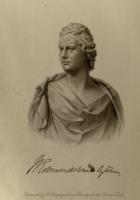

William Edmondstoune Aytoun Poems
I.
News of battle!-news of battle!
Hark! 'tis ringing down the street:
...
I.
The Rhine is running deep and red,
The island lies before-
...
COME hither, Evan Cameron!
Come, stand beside my knee:
I hear the river roaring down
Towards the wintry sea.
...
Take away that star and garter-
Hide them from my aching sight:
Neither king nor prince shall tempt me
...
It was a Moorish maiden was sitting by a well,
And what the maiden thought of, I cannot, cannot, tell,
...
I am Constantine Kanaris:
I, who lie beneath this stone,
Twice into the air in thunder
Have the Turkish galleys blown.
...
'Danube, Danube! wherefore com'st thou
Red and raging to my caves?
Wherefore leap thy swollen waters
...
Place me once more, my daughter, where the sun
May shine upon my old and time-worn head,
For the last time, perchance. My race is run;
And soon amidst the ever-silent dead
...
Why look the distant mountains
So gloomy and so drear?
Are rain clouds passing o’er them,
Or is the tempest near?
...
I.
'Wilt not lay thee down in quiet slumber?
Weary dost thou seem, and ill at rest;
...
In the silence of my chamber,
When the night is still and deep,
And the drowsy heave of ocean
...
I.
Come listen to another song,
Should make your heart beat high,
...
Do not lift him from the bracken,
Leave him lying where he fell-
Better bier ye cannot fashion:
...
I.
'Lift me without the tent, I say,-
Me and my ottoman,-
...
It was upon an April morn,
While yet the frost lay hoar,
We heard Lord James's bugle-horn
...
Fhairshon had a son,
Who married Noah's daughter,
And nearly spoiled ta Flood
By trinking up ta water:
...
Sound the fife, and cry the slogan-
Let the pibroch shake the air
With its wild triumphal music,
...
William Edmondstoune Aytoun Biography
Aytoun was the only son of a prosperous Edinburgh family. The fierce Jacobitism and love of ballads of his mother, Joan Keir Aytoun, had a lasting influence upon Aytoun's own political and literary preferences. His father, Roger Aytoun, was a leading writer to the Signet; this was a superior order of solicitors peculiar to Scotland, among whose privileges was that of appearing before the Court of Sessions, the supreme civil court of the kingdom. Roger Aytoun planned William's education carefully, preparing him with a private tutor for three years before sending him to the newly opened Edinburgh Academy in 1824 and to Edinburgh University in 1828. The university curriculum was basically classical, but Aytoun followed his own interests, reading widely in British literature and history, and becoming a member of the Speculative Society. His chief concern, however, was already the writing of poetry. Aytoun finished Poland, Homer, and Other Poems in 1830, but the six poems were not published until 1832. Although "Poland" expresses sympathy for the Poles' struggle to regain their independence from Russia, the other poems reflect Aytoun's increasing conservatism. In them, he contrasts the virtue and nobility of the "bright ages" with the vice and sordidness of the present. This contrast became a recurrent theme in Aytoun's poetry. After he had completed his university studies, Aytoun complied reluctantly with his father's wishes and entered the legal profession. He became a writer to the Signet in 1835 and was admitted to the Faculty of Advocates in 1840. But his first love was literature. He had spent seven months in Germany in 1833-1834 studying the language and German literature. His first contributions to Blackwood's, in 1836, were translations of German ballads. In the early 1840s he had three prose works published--two pamphlets on topical religious controversies and a biography of Richard I. More importantly, from 1841 to 1844, Aytoun and Theodore Martin wrote for Tait's and Fraser's a series of parodies that were to develop into a remarkably popular book. The Book of Ballads , written with Theodore Martin, was published in 1845 under the pseudonym Bon Gaultier. It included, in the phrase of George Kitchin, "a mannequin's parade of Victorian modes": parodies of national ballads, of the Eastern tale, of the philosophical poem, of the reflective poem, of the "poetical puff," of the epigram, of thieves' literature, of young ladies' literature, and of the leading stylists of the day. Superior to his coauthor Martin as a parodist, Aytoun took special delight in deflating the romantic sensibility of much contemporary poetry. Today, Bon Gaultier's humor seems rather broad, but it is difficult to overrate the historical importance of the book. Saintsbury characterized it as "that admirable book of light verse, the equal of anything earlier and certainly not surpassed since." The Book of Ballads ran through thirteen editions from 1845 to 1877 in England alone; the number of pirated editions in America was at least as large. Blackwood sold over 32,000 copies from 1857 to 1909. The number of ballads increased from thirty-nine in the first edition to fifty-six in the sixteenth. Because of its enormous scope, it served as a textbook for later parodists, showing what subjects could be legitimately exposed to laughter. Its success also encouraged Aytoun to write Firmilian. In 1844, in the most important act of his business career, Aytoun formally joined the staff of Blackwood's Edinburgh Magazine. He found in the conservative Blackwood's the ideal organ for his deepest feelings and beliefs. In politics, society, and literature, he looked back to the past with an admiration approaching reverence. He disliked the new and unusual; he identified the status quo with order. Aytoun soon became Blackwood's most prolific writer and, after the death of "Christopher North" (John Wilson) in 1854, was acknowledged to be its best. His writings were in many forms, including prose, poetry, and translation, and on many subjects, including politics, literature, railways, magic, boxing, art, and wines. For his efforts in the debate over free trade, the Derby administration rewarded him with the honorary position of sheriff and lord admiral of Orkney and Zetland. In 1845 Aytoun became professor of rhetoric and belles lettres at the University of Edinburgh, a position he raised to new importance. But Aytoun's annus mirabilis was 1849. On 11 April, he married Jane Emily Wilson, the youngest daughter of "Christopher North." It became a marriage of great contentment. Also in 1849, Edinburgh University conferred the honorary degree of M.A. upon Aytoun (four years later, Oxford was to make him a D.C.L.). Finally, 1849 was the publication date of the book that became Aytoun's most famous work among his contemporaries and a Victorian best-seller. Lays of the Scottish Cavaliers and Other Poems reached its fifteenth British edition in fifteen years and its thirty-second in thirty-two years. Blackwood sold over 60,000 copies during the Victorian period alone, and, with foreign editions, the final total approaches the 100,000 mark. Although the book attained considerable popularity in America, Australia, and Germany, its greatest vogue was in Scotland, where selections were included in school reading books and recited by students. Its appeal is obvious. At their best, such ballads offer blood and fire in a "cut-and-thrust" style; they have a nervous energy that appeals immediately to the heart. They lie on that thin line between admirable rhetoric and genuine poetry, neither too low nor too high for the mass of educated readers. Aytoun's last decade was less successful and less happy. In Bothwell (1856), this Jacobite tried to vindicate Queen Mary and to show that Bothwell was the unfortunate dupe of Scottish nobles and the English queen. Challenging comparison with the Spasmodics, the monologue tells a clearly defined story, the material of which was drawn from history. Unfortunately, its chief virtue--"no spasm"--is negative, and its ballad measure becomes monotonous in a lengthy poem. In June 1858, Aytoun's two-volume edition of The Ballads of Scotland was published. He aimed to present in their original forms all 139 Scottish ballads of "real intrinsic merit" that had been composed before the union of the kingdoms. Both contemporary and twentieth-century critics have praised the collection. In December 1858 Aytoun's and Martin's Poems and Ballads of Goethe was published (the year of publication is given as 1859 on the title page); this was a revision and expansion of their earlier translations for Blackwood's. It is an uneven collection. His wife died on 15 April 1859, four days after their tenth wedding anniversary. Aytoun was left a childless, lonely man. He told Martin, "The great calamity of life has fallen upon me." Aggravating Aytoun's sorrow was his disappointment over public affairs, particularly the resignation of the Conservative ministry. He tried to lighten his gloom by writing the novel Norman Sinclair (1861). Thinly disguised as fiction, it is an objective review of his life, an attempt to distance and find pattern in the past. Valuable as autobiography and perhaps as therapy, it has little merit as literature. Aytoun never recovered his genial spirits. A chronic stomach ailment made eating and sleeping difficult. The sedentary professor who had lived almost exclusively in Edinburgh was forced to seek relief in the health resorts of France, Switzerland, and Germany. His literary output was curtailed: he produced only occasional articles for Blackwood's and a Nuptial Ode on the Marriage of His Royal Highness The Prince of Wales (1863). In his loneliness, Aytoun married for a second time on Christmas Eve, 1863. Although his mother and two sisters all lived to be over ninety, Aytoun died on 4 August 1865 at the age of fifty-two. A minor talent and largely forgotten today, Aytoun made one lasting contribution to literature. Firmilian was so successful an attack on the Spasmodic School of Poetry that it seemingly undermined its own reason for existence; but the kind of excessive romanticism exemplified by that early Victorian school is a recurrent literary phenomenon.)
The Best Poem Of William Edmondstoune Aytoun
Edinburgh After Flodden
I.
News of battle!-news of battle!
Hark! 'tis ringing down the street:
And the archways and the pavement
Bear the clang of hurrying feet.
News of battle? Who hath brought it?
News of triumph? Who should bring
Tidings from our noble army,
Greetings from our gallant King?
All last night we watched the beacons
Blazing on the hills afar,
Each one bearing, as it kindled,
Message of the opened war.
All night long the northern streamers
Shot across the trembling sky:
Fearful lights, that never beckon
Save when kings or heroes die.
II.
News of battle! Who hath brought it?
All are thronging to the gate;
'Warder-warder! open quickly!
Man-is this a time to wait?'
And the heavy gates are opened:
Then a murmur long and loud,
And a cry of fear and wonder
Bursts from out the bending crowd.
For they see in battered harness
Only one hard-stricken man,
And his weary steed is wounded,
And his cheek is pale and wan.
Spearless hangs a bloody banner
In his weak and drooping hand-
God! can that be Randolph Murray,
Captain of the city band?
III.
Round him crush the people, crying,
'Tell us all-oh, tell us true!
Where are they who went to battle,
Randolph Murray, sworn to you?
Where are they, our brothers-children?
Have they met the English foe?
Why art thou alone, unfollowed?
Is it weal, or is it woe?'
Like a corpse the grisly warrior
Looks from out his helm of steel;
But no word he speaks in answer,
Only with his armèd heel
Chides his weary steed, and onward
Up the city streets they ride;
Fathers, sisters, mothers, children,
Shrieking, praying by his side.
'By the God that made thee, Randolph!
Tell us what mischance hath come!'
Then he lifts his riven banner,
And the asker's voice is dumb.
IV.
The elders of the city
Have met within their hall-
The men whom good King James had charged
To watch the tower and wall.
'Your hands are weak with age,' he said,
'Your hearts are stout and true;
So bide ye in the Maiden Town,
While others fight for you.
My trumpet from the Border-side
Shall send a blast so clear,
That all who wait within the gate
That stirring sound may hear.
Or, if it be the will of heaven
That back I never come,
And if, instead of Scottish shouts,
Ye hear the English drum,-
Then let the warning bells ring out,
Then gird you to the fray,
Then man the walls like burghers stout,
And fight while fight you may.
'T were better that in fiery flame
The roofs should thunder down,
Than that the foot of foreign foe
Should trample in the town!'
V.
Then in came Randolph Murray,-
His step was slow and weak,
And, as he doffed his dinted helm,
The tears ran down his cheek:
They fell upon his corslet,
And on his mailèd hand,
As he gazed around him wistfully,
Leaning sorely on his brand.
And none who then beheld him
But straight were smote with fear,
For a bolder and a sterner man
Had never couched a spear.
They knew so sad a messenger
Some ghastly news must bring:
And all of them were fathers,
And their sons were with the King.
VI.
And up then rose the Provost-
A brave old man was he,
Of ancient name and knightly fame,
And chivalrous degree.
He ruled our city like a Lord
Who brooked no equal here,
And ever for the townsmen's rights
Stood up 'gainst prince and peer.
And he had seen the Scottish host
March from the Borough-muir,
With music-storm and clamorous shout
And all the din that thunders out,
When youth's of victory sure.
But yet a dearer thought had he,
For, with a father's pride,
He saw his last remaining son
Go forth by Randolph's side,
With casque on head and spur on heel,
All keen to do and dare;
And proudly did that gallant boy
Dunedin's banner bear.
Oh, woeful now was the old man's look,
And he spake right heavily-
'Now, Randolph, tell thy tidings,
However sharp they be!
Woe is written on thy visage,
Death is looking from thy face:
Speak, though it be of overthrow-
It cannot be disgrace!'
VII.
Right bitter was the agony
That wrung the soldier proud:
Thrice did he strive to answer,
And thrice he groaned aloud.
Then he gave the riven banner
To the old man's shaking hand,
Saying-'That is all I bring ye
From the bravest of the land!
Ay! ye may look upon it-
It was guarded well and long,
By your brothers and your children,
By the valiant and the strong.
One by one they fell around it,
As the archers laid them low,
Grimly dying, still unconquered,
With their faces to the foe.
Ay! ye well may look upon it-
There is more than honour there,
Else, be sure, I had not brought it
From the field of dark despair.
Never yet was royal banner
Steeped in such a costly dye;
It hath lain upon a bosom
Where no other shroud shall lie.
Sirs! I charge you keep it holy,
Keep it as a sacred thing,
For the stain you see upon it
Was the life-blood of your King!'
VIII.
Woe, woe, and lamentation!
What a piteous cry was there!
Widows, maidens, mothers, children,
Shrieking, sobbing in despair!
Through the streets the death-word rushes,
Spreading terror, sweeping on-
'Jesu Christ! our King has fallen-
O great God, King James is gone!
Holy Mother Mary, shield us,
Thou who erst did lose thy Son!
O the blackest day for Scotland
That she ever knew before!
O our King-the good, the noble,
Shall we see him never more?
Woe to us and woe to Scotland,
O our sons, our sons and men!
Surely some have 'scaped the Southron,
Surely some will come again!'
Till the oak that fell last winter
Shall uprear its shattered stem-
Wives and mothers of Dunedin-
Ye may look in vain for them!
IX.
But within the Council Chamber
All was silent as the grave,
Whilst the tempest of their sorrow
Shook the bosoms of the brave.
Well indeed might they be shaken
With the weight of such a blow:
He was gone-their prince, their idol,
Whom they loved and worshipped so!
Like a knell of death and judgment
Rung from heaven by angel hand,
Fell the words of desolation
On the elders of the land.
Hoary heads were bowed and trembling,
Withered hands were clasped and wrung:
God had left the old and feeble,
He had ta'en away the young.
X.
Then the Provost he uprose,
And his lip was ashen white,
But a flush was on his brow,
And his eye was full of light.
'Thou hast spoken, Randolph Murray,
Like a soldier stout and true;
Thou hast done a deed of daring
Had been perilled but by few.
For thou hast not shamed to face us,
Nor to speak thy ghastly tale,
Standing-thou, a knight and captain-
Here, alive within thy mail!
Now, as my God shall judge me,
I hold it braver done,
Than hadst thou tarried in thy place,
And died above my son!
Thou needst not tell it: he is dead.
God help us all this day!
But speak-how fought the citizens
Within the furious fray?
For, by the might of Mary,
'T were something still to tell
That no Scottish foot went backward
When the Royal Lion fell!'
XI.
'No one failed him! He is keeping
Royal state and semblance still;
Knight and noble lie around him,
Cold on Flodden's fatal hill.
Of the brave and gallant-hearted,
Whom ye sent with prayers away,
Not a single man departed
From his monarch yesterday.
Had you seen them, O my masters!
When the night began to fall,
And the English spearmen gathered
Round a grim and ghastly wall!
As the wolves in winter circle
Round the leaguer on the heath,
So the greedy foe glared upward,
Panting still for blood and death.
But a rampart rose before them,
Which the boldest dared not scale;
Every stone a Scottish body,
Every step a corpse in mail!
And behind it lay our monarch
Clenching still his shivered sword:
By his side Montrose and Athole,
At his feet a southern lord.
All so thick they lay together,
When the stars lit up the sky,
That I knew not who were stricken,
Or who yet remained to die,
Few there were when Surrey halted,
And his wearied host withdrew;
None but dying men around me,
When the English trumpet blew.
Then I stooped, and took the banner,
As ye see it, from his breast,
And I closed our hero's eyelids,
And I left him to his rest.
In the mountains growled the thunder,
As I leaped the woeful wall,
And the heavy clouds were settling
Over Flodden, like a pall.'
XII.
So he ended. And the others
Cared not any answer then;
Sitting silent, dumb with sorrow,
Sitting anguish-struck, like men
Who have seen the roaring torrent
Sweep their happy homes away,
And yet linger by the margin,
Staring idly on the spray.
But, without, the maddening tumult
Waxes ever more and more,
And the crowd of wailing women
Gather round the Council door.
Every dusky spire is ringing
With a dull and hollow knell,
And the Miserere's singing
To the tolling of the bell.
Through the streets the burghers hurry,
Spreading terror as they go;
And the rampart's thronged with watchers
For the coming of the foe.
From each mountain-top a pillar
Streams into the torpid air,
Bearing token from the Border
That the English host is there.
All without is flight and terror,
All within is woe and fear-
God protect thee, Maiden City,
For thy latest hour is near!
XIII.
No! not yet, thou high Dunedin!
Shalt thou totter to thy fall;
Though thy bravest and thy strongest
Are not there to man the wall.
No, not yet! the ancient spirit
Of our fathers hath not gone;
Take it to thee as a buckler
Better far than steel or stone.
Oh, remember those who perished
For thy birthright at the time
When to be a Scot was treason,
And to side with Wallace, crime!
Have they not a voice among us,
Whilst their hallowed dust is here?
Hear ye not a summons sounding
From each buried warrior's bier?
'Up!'-they say-'and keep the freedom
Which we won you long ago:
Up! and keep our graves unsullied
From the insults of the foe!
Up! and if ye cannot save them,
Come to us in blood and fire:
Midst the crash of falling turrets,
Let the last of Scots expire!'
XIV.
Still the bells are tolling fiercely,
And the cry comes louder in;
Mothers wailing for their children,
Sisters for their slaughtered kin.
All is terror and disorder,
Till the Provost rises up,
Calm, as though he had not tasted
Of the fell and bitter cup.
All so stately from his sorrow,
Rose the old undaunted Chief,
That you had not deemed, to see him,
His was more than common grief.
'Rouse ye, Sirs!' he said; 'we may not
Longer mourn for what is done:
If our King be taken from us,
We are left to guard his son.
We have sworn to keep the city
From the foe, whate'er they be,
And the oath that we have taken
Never shall be broke by me.
Death is nearer to us, brethren,
Than it seemed to those who died,
Fighting yesterday at Flodden,
By their lord and master's side.
Let us meet it then in patience,
Not in terror or in fear;
Though our hearts are bleeding yonder,
Let our souls be steadfast here.
Up, and rouse ye! Time is fleeting,
And we yet have much to do;
Up! and haste ye through the city,
Stir the burghers stout and true!
Gather all our scattered people,
Fling the banner out once more,-
Randolph Murray! do thou bear it,
As it erst was borne before:
Never Scottish heart will leave it,
When they see their monarch's gore!'
XV.
'Let them cease that dismal knelling!
It is time enough to ring,
When the fortress-strength of Scotland
Stoops to ruin like its King.
Let the bells be kept for warning,
Not for terror or alarm;
When they next are heard to thunder,
Let each man and stripling arm.
Bid the women leave their wailing,-
Do they think that woeful strain,
From the bloody heaps of Flodden
Can redeem their dearest slain?
Bid them cease,-or rather hasten
To the churches, every one;
There to pray to Mary Mother,
And to her anointed Son,
That the thunderbolt above us
May not fall in ruin yet;
That in fire, and blood, and rapine,
Scotland's glory may not set.
Let them pray,-for never women
Stood in need of such a prayer!
England's yeomen shall not find them
Clinging to the altars there.
No! if we are doomed to perish,
Man and maiden, let us fall;
And a common gulf of ruin
Open wide to whelm us all!
Never shall the ruthless spoiler
Lay his hot insulting hand
On the sisters of our heroes,
Whilst we bear a torch or brand!
Up! and rouse ye, then, my brothers,
But when next ye hear the bell
Sounding forth the sullen summons
That may be our funeral knell,
Once more let us meet together,
Once more see each other's face;
Then, like men that need not tremble,
Go to our appointed place.
God, our Father, will not fail us
In that last tremendous hour,-
If all other bulwarks crumble,
HE will be our strength and tower:
Though the ramparts rock beneath us,
And the walls go crashing down,
Though the roar of conflagration
Bellow o'er the sinking town;
There is yet one place of shelter,
Where the foeman cannot come,
Where the summons never sounded
Of the trumpet or the drum.
There again we'll meet our children,
Who, on Flodden's trampled sod,
For their king and for their country
Rendered up their souls to God.
There shall we find rest and refuge,
With our dear departed brave;
And the ashes of the city
Be our universal grave!'
William Edmondstoune Aytoun Comments




Delivering Poems Around The World
Poems are the property of their respective owners. All information has been reproduced here for educational and informational purposes to benefit site visitors, and is provided at no charge...
4/11/2026 4:22:46 AM # 1.0.0


