
Adah Isaacs Menken
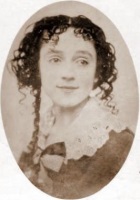

Adah Isaacs Menken Poems
Where is the promise of my years;
Once written on my brow?
Ere errors, agonies and fears
...
Ashkelon is not cut off with the remnant of a valley.
Baldness dwells not upon Gaza.
...
I see her yet, that dark-eyed one,
Whose bounding heart God folded up
In His, as shuts when day is done,
Upon the elf the blossom's cup.
...
In the Beginning, God, the great Schoolmaster, wrote upon the white leaves of our souls the text of life, in His own autograph.
...
I.
'Carry me out of the host, for I am wounded.'
The battle waged strong.
A fainting soul was borne from the host.
...
Who hath not sent out ships to sea?
Who hath not toiled through light and darkness to make them strong for battle?
...
Bright as the light that burns at night
In the starry depths of Aiden,
When star and moon in leafy June
...
Where shall I lead the flocks to-day?
Is there no Horeb for me beyond this desert?
Is there no rod with which I can divide this sea of blood to
...
Look on that form, once fit for the sculptor!
Look on that cheek, where the roses have died!
Working and waiting have robbed from the artist
...
I
Lost-lost-lost!
To me, for ever, the seat near the blood of the feast.
...
'Oh! I am sick of what I am. Of all
Which I in life can ever hope to be.
Angels of light be pitiful to me.'
...
Thou Pleiad of the lyric world
Where Pasta, Garcia shone,
Come back with thy sweet voice again,
And gem the starry zone.
...
In from the night.
The storm is lifting his black arms up to the sky.
Friend of my heart, who so gently marks out the lifetrack for
...
Poor, impious Soul! that fixes its high hopes
In the dim distance, on a throne of clouds,
And from the morning's mist would make the ropes
...
Alone on the hill of storms
The voice of the wind shrieks through the mountain.
The torrent rushes down the rocks.
...
Visions of Beauty, of Light, and of Love,
Born in the soul of a Dream,
Lost, like the phantom-bird under the dove,
...
O angels! will ye never sweep the drifts from my door?
Will ye never wipe the gathering rust from the hinges?
...
I
Leave me; oh! leave me,
Lest I find this low earth sweeter than the skies.
...
'Where'er there's a life to be kindled by love,
Wherever a soul to inspire,
Strike this key-note of God that trembles above
...
I
O crownless soul of Ishmael!
Uplifting and unfolding the white tent of dreams against the
...
Adah Isaacs Menken Biography
Adah Isaacs Menken (June 15, 1835 – August 10, 1868) was an American actress, painter and poet. She was born Adah Bertha Theodore in New Orleans to a French Creole mother and a Free Negro father, Auguste Theodore. She danced as a child in New Orleans, Havana and Texas. Eventually she worked in San Francisco. Menken was known for her poetry and painting, though both were poorly received. In 1859 she appeared on Broadway in the play "The French Spy. Once again, her work was not highly regarded by the critics. The New York Times described her as 'the worst actress on Broadway'. The Observer said "she is delightfully unhampered by the shackles of talent". She converted to Judaism and married a Jewish musician, Alexander Isaac Menken. The commentators continued to be cynical, saying that a marriage to a rich husband was the only way to sustain a flagging (acting) career. The marriage to Alex Menken was short-lived. Alex Menken separated from and later divorced Adah, though she remained committed to Judaism her entire life. She had four marriages in the space of seven years. Her second husband was John C. Heenan, the American prizefighter. (Adah Menken was accused of bigamy because she had not secured a legally recognised divorce from Alex Menken). John Heenan was one of the most famous and popular figures in America at the time, particularly on the east coast and especially in New York, his home town. The press were quick to point this out as they continued to accuse her of marrying solely to maintain her celebrity status. However, everyone that knew her well said that she genuinely loved the gregarious and outgoing Heenan. The marriage lasted less than a year. By the time Heenan left to fight in England in January 1860, the couple were estranged. Heenan's popularity would increase dramatically because of his fight with the English champion. The Washington Post described him as the most famous man in America. Menken would bill herself as 'Mrs. Heenan' throughout 1860, despite protestations from Heenan's entourage (though not Heenan himself). There is no doubt that the productions Menken appeared in benefitted from Menken's use of her married name. This particular subject is covered by the excellent book, "The Great Prizefight" by Alan Lloyd. She played "Mister Bones," a minstrel character, and impersonated Edwin Booth as Hamlet and Richelieu. She performed with Blondin, a Niagara Falls tightrope walker. Her provocative stage performance, strapped to a horse bareback, wearing only tights in Mazeppa, helped establish her reputation as a scandalous figure. On August 24, 1863, the master of San Francisco theater, Tom McGuire presented Mazeppa with Miss Menken. She later became Mrs. Robert Henry Newel. Even later she became Mrs. James Barkley. The probable facts of her life were not established until 1938. She went to perform in Paris, France and was romanced by Alexandre Dumas, père. She went to London, England, and was wooed by Charles Reade, Dante Gabriel Rossetti, Algernon Charles Swinburne, and Tom Hood, and became a friend to Charles Dickens. Rosetti is said to have offered her ten pounds to seduce Swinburne away from his fetish for flagellation, but that after six weeks she admitted defeat and returned the money. Later, in ill health, she wrote to a friend, "I am lost to art and life. Yet, when all is said and done, have I not at my age tasted more of life than most women who live to be a hundred? It is fair, then, that I should go where old people go." She died at the age of thirty-three in Paris, France in 1868 and is interred in the Cimetière du Montparnasse. Much of the information pertaining to Menken's racial and religious background has been questioned in more recent historical biography, particularly in Performing Menken: Adah Isaacs Menken and the Birth of American Celebrity, Cambridge University Press, 2003.)
The Best Poem Of Adah Isaacs Menken
Infelix
Where is the promise of my years;
Once written on my brow?
Ere errors, agonies and fears
Brought with them all that speaks in tears,
Ere I had sunk beneath my peers;
Where sleeps that promise now?
Naught lingers to redeem those hours,
Still, still to memory sweet!
The flowers that bloomed in sunny bowers
Are withered all; and Evil towers
Supreme above her sister powers
Of Sorrow and Deceit.
I look along the columned years,
And see Life's riven fane,
Just where it fell, amid the jeers
Of scornful lips, whose mocking sneers,
For ever hiss within mine ears
To break the sleep of pain.
I can but own my life is vain
A desert void of peace;
I missed the goal I sought to gain,
I missed the measure of the strain
That lulls Fame's fever in the brain,
And bids Earth's tumult cease.
Myself! alas for theme so poor
A theme but rich in Fear;
I stand a wreck on Error's shore,
A spectre not within the door,
A houseless shadow evermore,
An exile lingering here.
Adah Isaacs Menken Comments




Delivering Poems Around The World
Poems are the property of their respective owners. All information has been reproduced here for educational and informational purposes to benefit site visitors, and is provided at no charge...
3/10/2026 6:53:42 PM # 1.0.0


