
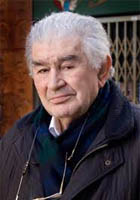

Antonio Gamoneda Biography
Antonio Gamoneda was born in Oviedo, Spain, in 1931. Two years after the death of his father he moved, together with his mother, to Léon at the age of three, where he still lives now.
With the collection of poems 'Sublevación inmóvil' Gamoneda started, in 1960, to have his works published. Although with this, at least regarding the period, he belongs to the 'generación poética' of the fifties, his own style expands the social realism style which was typical of the time.
THIS is the age of iron in the throat. There.
You inhabit yourself but do not recognize yourself: you live in an abandoned vault in which you listen to your heart
while grease and oblivion spread through all your veins and
you calcify amid the pain and from your mouth
fall black syllables.
You make your way toward the invisible
and know that what does not exist is real.
Vaguely, you keep your causes and your dreams
(you still retain the fragrance of the suicides),
they feed your rage and piety.
Not much of you remains: your vertigo, your fingernails
and shadows of memories.
You think of disappearance. You caress
the cerebral darkness, drop to the liver charred by grief.
Such is the age of iron in the throat. Now
nothing can be understood. And even so,
you love as much as you have lost.
...
LA INFECCIÓN es más grande que la tristeza; lame los parietales torturados, entra en los dormitorios del sudor y el láudano y luego tiembla como un ala fría: es la humedad de los agonizantes.
Viene despacio la paloma impura, viene a los vasos llenos de sombra
y la ceniza capilar se extiende sobre vestigios de mercurio y llanto.
La lente anuncia la mendicidad pero su luz procede del abismo. Ante las córneas abrasadas penden los hilos del silencio. Luego
las desapariciones bajan al corazón.
...
THE INFECTION is larger than sadness; it licks the tortured parietal bones, it penetrates the bedrooms of sweat and laudanum and later it trembles like a cold wing: it is the moisture of people who are dying.
Slowly the impure dove approaches, approaches cups full of shadow
and capillaries of ash spread over remnants of mercury and tears.
The lens reveals mendacity but its light comes from the abyss. In front of scorched corneas hang threads of silence. Later
the disappearances depress the heart.
...
HAY un muro delante de mis ojos.
En el espesor del aire hay signos invisibles,
hierba cuyos hilos entran al corazón lleno de sombra,
líquenes en el residuo del amor.
Incesto y luz. Piensa en la lente que precedía a la piedad, piensa en las aguas:
si yo pudiese atravesar la inexistencia se abrirían las fuentes de la misericordia
y habría ciegos cuyas grandes manos trabajarían dulcemente,
pero la cobardía es bella en los cabellos de mi madre y en ese muro está escrito el silencio.
Llanto en la lucidez, verdades cóncavas:
«No vale nada la vida, / la vida no vale nada».
Recordad esta canción antes de mirar mis ojos;
mirad mis ojos en el instante de la nieve.
...
THERE'S a wall in front of my eyes.
In the thick air, there are invisible signs,
grass whose threads penetrate the heart full of shadow,
lichens in the residue of love.
Incest and light. Consider the lens that came before piety, consider the waters:
if I were able to cross nonexistence fountains of compassion would open
and there would be blind men whose big hands worked sweetly, but cowardice is beautiful in my mother's hair and on this wall silence is written.
Lucid lament, concave truths:
‘Life is worth nothing / nothing is worth life.'
All of you, remember this song before looking in my eyes;
look at my eyes when it snows
...




Delivering Poems Around The World
Poems are the property of their respective owners. All information has been reproduced here for educational and informational purposes to benefit site visitors, and is provided at no charge...
4/4/2026 3:30:47 PM # 1.0.0


