
Charles Badger Clark
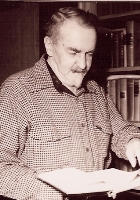

Charles Badger Clark Poems
The daybreak comes so pure and still.
He said that I was pure as dawn,
That day we climbed to Signal Hill.
...
Old camp-mate, black and rough to see,
A hard-worked aid and ally you
In all my single-handed wars
...
I laughed when the dawn was a-peepin'
And swore in the blaze of the noon,
But down from the stars is a-creepin'
...
Two miles of ridin' from the school, without a bit of trouble—
The main road hit her father's ranch as straight as you could fall.
I led her by a shorter cut that made the distance double
...
As I was ridin' all alone
And winkin' in the noontime glare,
I seen a hawse all hide and bone
...
Red is the arch of the nightmare sky,
Red are the mountains beneath,
Bright where a million red imps leap high,
...
Once again the regiments marching down the street,
Shoulders, legs and rifle barrels swinging all in time.
Let the slack civilian plod; ours the gayer feet,
...
Deeply the buffalo trod it
Beating it barren as brass;
Now the soft rain-fingers sod it,
...
I've tracked you up the wind, my buck;
You're lying plain in sight.
No need of hasty trigger-pluck—
...
No fresh green things in the Bad Lands bide;
It is all stark red and gray,
And strewn with bones that had lived and died
...
We're the prairie pilgrim crew,
Sailin' with the sun,
Lookin' West to meet a great reward,
...
Oh, days whoop by with swingin' lope
And days slip by a-sleepin',
And days must drag, with lazy rope,
...
This I declare: As I trudge the road
Of pain-filled souls with a heavy load—
A pilgrim lad, with staff in hand, plodding along through the shifting sand;
...
My father prayed as he drew a bead on the graycoats,
Back in those blazing years when the house was divided.
Bless his old heart! There never was truer or kinder;
...
You and I settled this section together;
Youthful and mettled and wild were we then.
You were the gladdest town out in the weather;
...
I dread the break when I shall die—
Not from my human friends, for they
Are shifting shadows such as I
...
Our town has history enough.
Across the railroad, on the bluff,
Prof. scans the records of our age
...
Stop! there's the wild bunch to right of the trail,
Heads up and ears up and ready to sail,
Led by a mare with the green in her eyes,
...
Fathers with eyes of ancient ire,
Old eagles shorn of flight,
Forget the breed of my blue-eyed sire
...
Charles Badger Clark Biography
Charles Badger Clark (January 1, 1883 – September 26, 1957) was an American poet. Charles Badger Clark was born on January 1, 1883 in Albia, Iowa. His family moved to Dakota Territory, where his father served as a Methodist preacher in Huron, Mitchell, Deadwood and Hot Springs. He dropped out of Dakota Wesleyan University after he clashed with one of its founders, C.B. Clark. He travelled to Cuba, returned to Deadwood, South Dakota, where he contracted tuberculosis, then moved to Tombstone, Arizona to assuage his illness with the dry weather. He returned again to South Dakota in 1910 to take care of his ailing father. There, he contracted tuberculosis. In 1925, he moved to a cabin in Custer State Park in the Black Hills of South Dakota, where he lived for thirty years. In 1937, he was named the Poet Laureate of South Dakota by Governor Leslie Jensen. His work was published in Sunset Magazine, Pacific Monthly, Arizona Highways, Colliers, Century Magazine, the Rotarian, and Scribner's. He died on September 26, 1957. His poem entitled 'Lead by America' was performed by the Fred Waring Chorus in 1957. In 1969, Bob Dylan recorded 'Spanish is the Loving Tongue'. In America by Heart, Sarah Palin quotes his poem entitled 'A Cowboy's Prayer' as one of the prayers she likes to say.)
The Best Poem Of Charles Badger Clark
Others
The daybreak comes so pure and still.
He said that I was pure as dawn,
That day we climbed to Signal Hill.
Back there before the war came on.
God keep me pure as he is brave,
And fit to take his name.
I let him go and fight to save
Some other girl from shame.
Across the gulch it glimmers white,
The little house we plotted for.
We would be sitting here tonight
If he had never gone to war—
The firelight and the cricket's cheep,
My arm around his neck—
I let him go and fight to keep
Some other home from wreck.
And every day I ride to town
The wide lands talk to me of him—
The slopes with pine trees marching down,
The spread-out prairies, blue and dim.
He loved it for the freedom's sake
Almost as he loved me.
I let him go and fight to make
Some other country free.
Charles Badger Clark Comments
" Doggerel" is it? I certainly love steak and salmon, but a chuckwagon stew is nourishing comfort food. Clark's poems take me back to the horses, campfires and bedrolls of my uncomplicated growing years,




Delivering Poems Around The World
Poems are the property of their respective owners. All information has been reproduced here for educational and informational purposes to benefit site visitors, and is provided at no charge...
4/4/2026 9:05:21 PM # 1.0.0



did u even wright the poem The Pioneers