
Charles Péguy
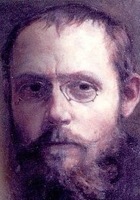

Charles Péguy Poems
When you love someone, you love him as he is.
I alone am perfect.
It is probably for that reason
...
For the past three days she had been wandering, and following.
She followed the people.
She followed the events.
...
Charles Péguy Biography
Charles Péguy was a noted French poet, essayist, and editor. His two main philosophies were socialism and nationalism, but by 1908 at the latest, after years of uneasy agnosticism, he had become a devout but non-practicing Roman Catholic. From that time, Catholicism strongly influenced his works. Biography Péguy was born to poverty. His mother, widowed when he was an infant, mended chairs for a living. In 1894, benefitting from republican school reform, he was received in the École Normale Supérieure, and attended notably the lectures of Henri Bergson and Romain Rolland, whom he befriended. He formally left the École Normale, without graduating, in 1897, even though he continued attending some lectures in 1898. Influenced by Lucien Herr (librarian of the École Normale), he became an ardent Dreyfusard. From his earliest years, he was influenced by socialism. From 1900 to his death in 1914, he was the main contributor and the editor of the literary magazine Les Cahiers de la Quinzaine, which first supported the Socialist Party director Jean Jaurès. Péguy ultimately ended his support after he began viewing Jaurès as a traitor to the nation and to socialism. In the Cahiers, Péguy published not only his own essays and poetry, but also works by important contemporary authors such as Romain Rolland. His free verse poem, "Portico of the Mystery of the Second Virtue", has gone through more than 60 editions in France. It was a favorite book of Charles de Gaulle. He died in battle, shot in the forehead, in Villeroy, Seine-et-Marne during World War I, on the day before the beginning of the Battle of the Marne. Influence Benito Mussolini referred to Péguy as a "source" for Fascism. But, according to Zaretsky in The Virginia Quarterly Review, Péguy would have likely been horrified by this appropriation. At the end of Graham Greene's novel Brighton Rock (1938), the unnamed Frenchman the old priest tells Rose about, who never took the sacraments but who some think was a saint, is obviously Péguy. In 1983, Geoffrey Hill published a long poem with the title The Mystery of the Charity of Charles Péguy.)
The Best Poem Of Charles Péguy
Freedom
GOD SPEAKS:
When you love someone, you love him as he is.
I alone am perfect.
It is probably for that reason
That I know what perfection is
And that I demand less perfection of those poor people.
I know how difficult it is.
And how often, when they are struggling in their trials,
How often do I wish and am I tempted to put my hand under their stomachs
In order to hold them up with my big hand
Just like a father teaching his son how to swim
In the current of the river
And who is divided between two ways of thinking.
For on the one hand, if he holds him up all the time and if he holds him too much,
The child will depend on this and will never learn how to swim.
But if he doesn't hold him up just at the right moment
That child is bound to swallow more water than is healthy for him.
In the same way, when I teach them how to swim amid their trials
I too am divided by two ways of thinking.
Because if I am always holding them up, if I hold them up too often,
They will never learn how to swim by themselves.
But if I don't hold them up just at the right moment,
Perhaps those poor children will swallow more water than is healthy for them.
Such is the difficulty, and it is a great one.
And such is the doubleness itself, the two faces of the problem.
On the one hand, they must work out their salvation for themselves. That is the rule.
It allows of no exception. Otherwise it would not be interesting. They would not be men.
Now I want them to be manly, to be men, and to win by themselves
Their spurs of knighthood.
On the other hand, they must not swallow more water than is healthy for them,
Having made a dive into the ingratitude of sin.
Such is the mystery of man's freedom, says God,
And the mystery of my government towards him and towards his freedom.
If I hold him up too much, he is no longer free
And if I don't hold him up sufficiently, I am endangering his salvation.
Two goods in a sense almost equally precious.
For salvation is of infinite price.
But what kind of salvation would a salvation be that was not free?
What would you call it?
We want that salvation to be acquired by himself,
Himself, man. To be procured by himself.
To come, in a sense, from himself. Such is the secret,
Such is the mystery of man's freedom.
Such is the price we set on man's freedom.
Because I myself am free, says God, and I have created man in my own image and likeness.
Such is the mystery, such the secret, such the price
Of all freedom.
That freedom of that creature is the most beautiful reflection in this world
Of the Creator's freedom. That is why we are so attached to it,
And set a proper price on it.
A salvation that was not free, that was not, that did not come from a free man could in no wise be attractive to us. What would it amount to?
What would it mean?
What interest would such a salvation have to offer?
A beatitude of slaves, a salvation of slaves, a slavish beatitude, how do you expect me to interested in that kind of thing? Does one care to be loved by slaves?
If it were only a matter of proving my might, my might has no need of those slaves, my might is well enough known, it is sufficiently known that I am the Almighty.
My might is manifest enough in all matter and in all events.
My might is manifest enough in the sands of the sea and in the stars of heaven.
It is not questioned, it is known, it is manifest enough in inanimate creation.
It is manifest enough in the government,
In the very event that is man.
But in my creation which is endued with life, says God, I wanted something more.
Infinitely better. Infinitely more. For I wanted that freedom.
I created that very freedom. There are several degrees to my throne.
When you once have known what it is to be loved freely, submission no longer has any taste.
All the prostrations in the world
Are not worth the beautiful upright attitude of a free man as he kneels. All the submission, all the dejection in the world
Are not equal in value to the soaring up point,
The beautiful straight soaring up of one single invocation
From a love that is free.
Charles Péguy Comments
I have lost a leaflet with Peguy's poem God Speaks translated by Julian Green, which spoke of my little hope as well as resurrection with the image of the rough bark and tender bud. Can you help me find it?
In our Bible study this morning a film we watched spoke of a poem Charles Peguy wrote on the supernatural gifts. It is appraently no longer published, but you may have some copies that I could order. Kindly reply to my email above.




Delivering Poems Around The World
Poems are the property of their respective owners. All information has been reproduced here for educational and informational purposes to benefit site visitors, and is provided at no charge...
3/14/2026 4:51:14 AM # 1.0.0



does anyone now title of Charles Peguy's poem on faith and hope